

Best Motor Oil of 2026: 24 Oils Scored, Top 10 Ranked by Viscosity
We score every motor oil we can verify, for performance and ingredient safety. These are the 10 best of 24 in our catalog.
CarCareTruth scored 24 motor oils for 2026. Mobil 1 Extended Performance Full Synthetic 5W-30 ranks first, a PAO full synthetic carrying GM dexos1 Gen 3 and Honda and Acura HTO-06 approvals, which is among the broadest factory coverage on this page. Start with the grade in your owner's manual. This page tells you which jug to buy inside that grade: Pennzoil Platinum leads 5W-20, Mobil 1 Extended Performance leads 0W-20, and Mobil 1 High Mileage 5W-30 is the pick past 75,000 miles. Driving something European? Mobil 1 FS European Car Formula 0W-40 carries the deepest published approval list here. Modern light-duty diesel? Mobil 1 ESP X2 0W-20 holds GM's dexosD license. There is also a spec change to know about: API SQ and ILSAC GF-7A are now the current standards, GF-7A replaced GF-6A as the basis for the Starburst symbol, and a lot of roundups published this year still describe the older generation as current.
Affiliate disclosure: CarCareTruth is reader-supported. As an Amazon Associate I earn from qualifying purchases. We may also earn commissions from other retailers linked on this page, at no extra cost to you. Affiliate revenue never influences our scores or rankings. Full disclosure
Best of Motor Oil
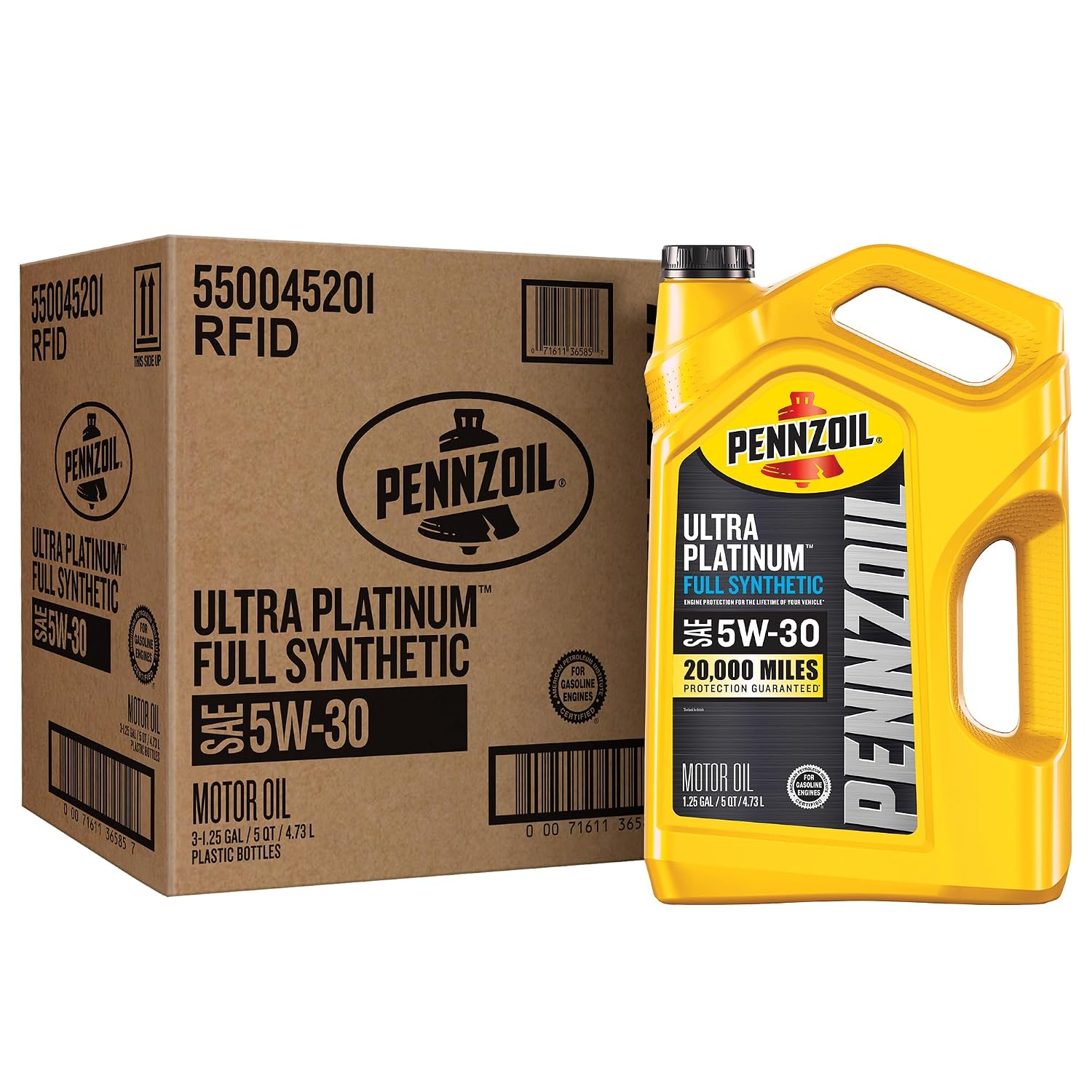
Pennzoil Ultra Platinum Full Synthetic 5W-30 Motor Oil
The Full Ranking
| Rank | Product | Viscosity | CCTCCT Score | HealthHealth & Safety | Price tier | Buy |
|---|---|---|---|---|---|---|
1Best Overall | 5W-30Ultra Platinum Full Synthetic 5W-30 Motor OilPennzoil — | 5W-30 | 7.6/10 | 8.5/10 | — | Check Price |
2 | 0W-40FS European Car Formula Full Synthetic Motor Oil 0W-40Mobil 1Best for European Cars 5 qt | 0W-40 | 7.6/10 | 9.5/10 | 5 qt | Check Price |
3 | 5W-40Rotella T6 Full Synthetic 5W-40 Heavy Duty Engine OilShell 12 qtProp 65 | 5W-40 | 7.5/10 | 8.8/10 | 12 qt | Check Price |
4 | 5W-30High Mileage Full Synthetic Motor Oil 5W-30Mobil 1Best for High Mileage 5 qtProp 65 | 5W-30 | 7.5/10 | 8.8/10 | 5 qt | Check Price |
5 | 5W-30Restore & Protect Full Synthetic SAE 5W-30 Motor OilValvolineBest for Deposit Cleanup 5 qt | 5W-30 | 7.5/10 | 9.5/10 | 5 qt | Check Price |
6 | 5W-30Signature Series 5W-30 100% Synthetic Motor OilAMSOIL 4 qt | 5W-30 | 7.5/10 | 8.5/10 | 4 qt | Check Price |
7 | 5W-30Extended Performance Full Synthetic Motor Oil 5W-30Mobil 1Best Overall 5 qtProp 65 | 5W-30 | 7.4/10 | 8.8/10 | 5 qt | Check Price |
8 | 5W-20Platinum Full Synthetic 5W-20 Motor OilPennzoilBest 5W-20 6 qt | 5W-20 | 7.3/10 | 9.5/10 | 6 qt | Check Price |
9 | 5W-20Advanced Full Synthetic SAE 5W-20 Motor OilValvoline 5 qt | 5W-20 | 7.3/10 | 9.5/10 | 5 qt | Check Price |
10 | 0W-20Extended Performance Full Synthetic Motor Oil 0W-20Mobil 1Best 0W-20 5 qtProp 65 | 0W-20 | 7.3/10 | 8.5/10 | 5 qt | Check Price |
Editorial pick, unranked | 5W-30Advanced Full Synthetic SAE 5W-30 Motor OilValvolineBest 5W-30 on the Current Spec 5 qt | 5W-30 | 7.3/10 | 8.5/10 | 5 qt | Check Price |
Editorial pick, unranked | 0W-20ESP X2 Full Synthetic 0W-20 Motor OilMobil 1Best for GM Duramax Diesel 6 qtProp 65 | 0W-20 | 7.3/10 | 8.5/10 | 6 qt | Check Price |
The rest of the oil change
The oil is one line on the receipt. These are the other things the job actually needs, and the ones that are not vehicle-specific get bought once and kept.
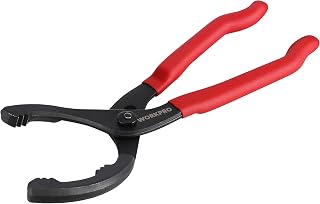
Filter wrench
WORKPRO W114083A 12" Adjustable Oil Filter Pliers
Nitrile gloves
Ansell AlphaTec Solvex 37-185 Chemical-Resistant Gloves
As an Amazon Associate I earn from qualifying purchases. Pricing and stock are set by the retailer and can change at any time.
Why each pick earned its spot
Best Overall: Mobil 1 Extended Performance Full Synthetic Motor Oil 5W-30
5W-30 is the most common grade in America, and this is the strongest all-round jug in it. Mobil 1 Extended Performance 5W-30 is a PAO Group IV full synthetic certified to API SP with ILSAC GF-6A, and it stacks two OEM approvals that matter: GM dexos1 Gen 3, which GM asks for by name and which you can verify at the shelf from the dexos logo on the front and the eleven-digit license number on the back, and Honda and Acura HTO-06. That is among the broadest factory coverage of any extended-drain synthetic here. One thing to read carefully. The bottle advertises a 20,000-mile drain interval; community oil analyses show healthy remaining additive reserve at 10,000 to 15,000 miles on ordinary daily-driver use, and the 20,000-mile figure applies to highway-dominant driving. Follow your car's service schedule, not the label headline. One more thing worth knowing: this oil is certified to API SP and GF-6A, not the newer API SQ and GF-7A. If holding the current certification matters more to you than the approval list, the Valvoline pick below is on it.
Best 0W-20: Mobil 1 Extended Performance Full Synthetic Motor Oil 0W-20
0W-20 is the factory fill for a huge share of modern Toyota, Honda, Ford and GM engines, and this is the strongest pick in that grade. It runs on a Group IV base oil, meaning fully man-made, not refined from crude, and that is confirmed in its own safety data sheet rather than claimed in marketing. It carries API SP with ILSAC GF-6A and a current GM dexos1 Gen 3 license, the certification GM asks for by name. You can verify that yourself at the shelf: GM requires the dexos logo on the front label and an eleven-digit license number on the back, and without both markings the oil is not licensed. One caveat on the mileage. The bottle advertises a 20,000-mile drain interval. That is a manufacturer claim, we found no independent verification of it, and the community oil analysis available for this oil is a single thread. Follow your car's service schedule.
Best 5W-20: Pennzoil Platinum Full Synthetic 5W-20 Motor Oil
This is the pick for the millions of Ford engines that specify 5W-20, and it is one of the few oils here already licensed to the current standard: API SQ with ILSAC GF-7A, not the API SP and GF-6A that most competing guides still describe as new. It adds GM dexos1 Gen 3 and Ford's WSS-M2C970-A1 approval, and uses the same PurePlus gas-to-liquid base stock as our overall winner. Something useful about this grade generally: 0W-20 and 5W-20 land in the same viscosity band once the engine is warm. They differ in cold-start flow, so a 5W-20 is not a thicker oil in daily driving. One gap: the safety data sheet on file predates the current formulation, so the paperwork lags the bottle.
Best 5W-30 on the Current Spec: Valvoline Advanced Full Synthetic SAE 5W-30 Motor Oil
If you want the newest certification in the most common grade in America, this is it. Valvoline Advanced Full Synthetic 5W-30 carries API SQ with ILSAC GF-7A, the standards that arrived in 2025, and stacks GM dexos1 Gen 3, Ford WSS-M2C961-A1 and Chrysler MS-13340 on top. GF-7A is not a marketing refresh. It added an aged-oil pre-ignition test, so the oil has to keep resisting low-speed pre-ignition after it has been in service, which matters most in small turbocharged engines. Valvoline is stocked at essentially every parts counter in the country, so this is an easy one to actually find. One note on the paperwork: Valvoline's own data sheet uses the phrase meets the requirements of, which is not the same as holding a license, though the bottle does carry the Starburst.
Best for High Mileage: Mobil 1 High Mileage Full Synthetic Motor Oil 5W-30
Past about 75,000 miles the argument for a high-mileage formula is seal conditioners, and that chemistry is real: ester-type additives swell aged rubber seals, an approach documented in patents going back to the 1970s. This is the strongest of the three high-mileage oils here because it is the only one carrying a current GM dexos1 Gen 3 license, where Valvoline MaxLife is on the older Gen 2 and Castrol GTX High Mileage does not confirm those approvals on its label. Broad Ford and Chrysler coverage rounds it out, though read that carefully: Mobil lists those as recommended for use in, which is its own claim, not an automaker approval. One limit applies to every high-mileage oil, not just this one. No independent testing was found showing that seal-swell additives stop leaks in an engine that is already worn. The chemistry is established; the outcome in your engine is not promised.
Best for European Cars: Mobil 1 FS European Car Formula Full Synthetic Motor Oil 0W-40
European engines are built around a different target: a thicker oil film when the engine is hot and working hard, longer factory service intervals, and limits on the ash and additive metals that clog particulate filters. That is why a Mercedes or Porsche manual names an approval instead of just a grade. This oil carries the deepest published approval list of the European options here, including Mercedes-Benz 229.3 and 229.5, Porsche A40, BMW Longlife-01, VW 502.00 and 505.00, Renault RN0700 and RN0710, and GM dexosR. An approval means the automaker tested this specific oil and published it on a list, which is a different thing from a bottle claiming it meets a standard. On drain intervals, Mobil states two different numbers for two different purposes: a 15,000-mile protection claim, and a 10,000-mile requirement attached to its own limited warranty. Your car's service schedule is the one that governs.
Best for GM Duramax Diesel: Mobil 1 ESP X2 Full Synthetic 0W-20 Motor Oil
The 3.0-liter Duramax and other modern light-duty diesels do not take heavy-duty truck oil. They call for GM's dexosD specification in a 0W-20 grade, which is a different animal from the 5W-40 a Cummins wants. Mobil 1 ESP X2 0W-20 holds that dexosD license, along with Mercedes-Benz 229.71, Porsche C20, VW 508 00 and 509 00, and ACEA C5 and C6. Those C-category approvals exist to protect the particulate filter by capping ash, so substituting a conventional diesel oil is not a neutral swap. Three oils in this catalog carry dexosD and score within a hair of each other. If you simply want the literal factory part, the AC Delco dexosD 0W-20 is GM's own; this one is the pick if you want the widest European coverage alongside it.
Best for Deposit Cleanup: Valvoline Restore & Protect Full Synthetic SAE 5W-30 Motor Oil
This is the one oil here sold on removing deposits the engine already has, not just preventing new ones. There is a patent behind the approach: Valvoline's IP holding company holds US Patent 11,078,436, which describes a base-oil blend engineered for solvency, using a high proportion of Group V base oil to dissolve carbon instead of merely suspending it. Read that for what it is. A patent shows the method is novel and was examined; it does not confirm the effect happens in your engine, or that this retail bottle uses that exact formulation, which Valvoline has not published. The headline claim of removing up to 100 percent of deposits over four or more consecutive oil changes comes from Valvoline's own bench testing, with no independent verification found. One practical caveat for GM owners: this oil does not carry a dexos1 license, so check your manual before buying it.
Full ranked catalog — including picks 11+, out-of-stock options, and the ones we couldn’t crown.
How we rank
Every motor oilin our catalog runs through the same scoring rubric: measured effectiveness, ingredient-safety data translated from each product’s SDS, and environmental impact. We don’t take placement fees, and affiliate links never move a product up the list.
The 2026 spec change most oil guides missed
Open a motor oil roundup published this year and there is a good chance it tells you API SP and ILSAC GF-6A are the newest standards. That is out of date. API SQ and ILSAC GF-7A arrived in 2025, and GF-7A replaced GF-6A as the standard an oil must meet to wear the API Starburst. API's own summary web page still describes the older generation as current, which is presumably how so many writers got it wrong; the specs cited here come from API 1509, the document that actually governs the program.
API SP was not retired. It can still be licensed and sold, and API SQ joined it as the newest category. SQ is backward compatible, so it is safe anywhere an older category was specified.
The upgrade is not cosmetic. GF-7A adds an aged-oil low-speed pre-ignition test, so the oil has to keep resisting pre-ignition after months in service, not only when freshly poured. It holds timing chain wear to a 0.080 percent maximum increase. And it bounds seal compatibility numerically, which we come back to in the myths section below.
Two details to carry to the shelf. GF-7A covers 0W-20, 5W-20, 0W-30, 5W-30 and 10W-30 and keeps the Starburst symbol. GF-7B is 0W-16 only and uses the Shield. If your car takes 5W-30, the Shield is not your mark.
How to actually read the bottle
Three markings tell you more than the entire front label.
- The donut (API Service Symbol). The top section names the service category, SQ being the newest. The center gives the viscosity grade. Only one service category may appear at a time.
- The Starburst. This certifies ILSAC GF-7A. Heavier grades cannot earn it: a 20W-50 can wear the donut but never the Starburst.
- An OEM license number. For GM, the rule is explicit. The dexos logo goes on the front and an eleven-digit license number on the back. Without both, the oil is not licensed, whatever the marketing says.
The wording gap to watch for is "meets the requirements of." That phrasing is a manufacturer certifying itself. The mark is a license, renewed annually, and you can look any brand up in API's public licensee directory. An unlicensed oil may well be fine, but nobody independent has checked it.
Best motor oil for turbo and direct-injection engines
Small turbocharged engines are now the default in everything from a Civic to an F-150, and they introduced a failure mode older engines did not have: low-speed pre-ignition, where the fuel-air mixture lights early and hard enough to damage pistons and rods.
The good news is that this is a solved problem, and the solution is a certification, not a specialty product. API SN Plus was created specifically to add pre-ignition protection, and API SP and SQ carry it forward. Any oil on this page carrying API SP, API SQ, ILSAC GF-6A or GF-7A has passed the pre-ignition test. That is most of them, which is why turbo ownership does not narrow your choice much.
Where GF-7A earns its upgrade is the aged-oil version of that test. An oil that resists pre-ignition when fresh but loses the ability at 6,000 miles is not much use to someone driving a turbo daily. If your engine is turbocharged and direct-injected, the newest certification is the one worth paying attention to, and Valvoline Advanced 5W-30 and Pennzoil Platinum 5W-20 are the picks here already carrying it.
There is real formulation science underneath: calcium-based detergents are associated with higher pre-ignition rates, while magnesium detergents and molybdenum are associated with lower ones. You cannot read that off a bottle, which is exactly why the certification exists.
Viscosity, without the folklore
The standard that defines these numbers, SAE J300, says something useful in its own scope: it defines oil "in rheological terms only," meaning flow behavior and nothing else. A viscosity grade is a flow specification, not a quality rating.
If you do not know which grade your engine calls for, look it up before you read any further: our oil grade and capacity lookup gives the viscosity and the number of quarts for a specific year, make and model, each one cross-checked against the OEM owner's manual plus an independent source. Everything on this page assumes you already know the grade.
The W stands for Winter, not weight. The first number describes cold behavior, measured by how easily the starter turns the engine and whether the pump can pick the oil up. The second describes viscosity at operating temperature, plus a minimum film strength under high shear.
That leads to the most useful fact in this section: 0W-20 and 5W-20 are the same grade when hot. They sit in the same viscosity band and share the same film-strength minimum, differing in cold-start flow. A 0W-20 is not thinner in daily driving; it just moves better on a January morning. Two oils inside that band can still differ from each other, so this is about the grade, not a guarantee that any two jugs are identical.
One trap deserves attention. The 40-grade is not one thing. A 0W-40 or 5W-40 only has to hold a film strength of 2.9 under load, while 15W-40 and heavier have to hold 3.7. Higher is thicker where it counts. Two bottles both marked 40 are not the same oil inside a loaded bearing.
As for why modern engines specify thin oil, the real number is smaller than the conspiracy suggests. The National Academies quantified it: dropping viscosity 25 percent yields about a 0.5 percent reduction in fuel consumption, reaching roughly 1 percent with a cold-temperature reduction stacked on. That is nearly invisible to you and worth billions across a manufacturer's fleet, which explains the enthusiasm without implying anyone sacrificed your engine. Thin oils still have to pass the same valvetrain and chain wear tests as everything else.
What the safety data actually says
Most oil guides say nothing here, and the honest answer turns out to be more reassuring than the internet's version.
Most new motor oil carries no health-hazard classification on its safety data sheet. The aspiration code H304, which means a product can be fatal if swallowed and enters the airways, does not apply to finished motor oil. That threshold is a thickness rating of 20.5 measured at 40 degrees Celsius, and real motor oils measure roughly 45 to 85 at that same temperature. You will sometimes see H304 listed against an individual base-oil ingredient inside a sheet, which is why the classification that matters is the one applied to the finished mixture. Engine flushes and light penetrating solvents are the products in this aisle that genuinely carry it.
Used oil is a different material. Combustion loads it with polycyclic aromatic hydrocarbons, the same family of combustion byproducts found in soot and diesel exhaust. But the common claim that used motor oil is "classified as a carcinogen" is not supportable as written. There is no standalone IARC classification for used engine oil, and the CDC's toxicology agency states directly that it has not been classified for carcinogenicity in people. What is documented is that untreated and mildly treated mineral oils are IARC Group 1 while highly refined oils are Group 3, that long-term skin exposure caused skin cancer in animal studies, and that the pathway is repeated, prolonged skin contact rather than an occasional splash. The safety sheets address that with gloves and washing.
On protective gear, the sheets are consistent in one direction and conditional in the other: they decline a respirator for normal use, and they treat gloves and eye protection as depending on actual contact or splash risk, with some naming nitrile and others listing it as one option among several. Nitrile gloves and eye protection are the cautious default that follows from the chemistry, not a manufacturer instruction. The occupational limit that exists for oil mist, 5 mg per cubic meter under the OSHA workplace standard, was written for industrial work that generates airborne mist, which pulling a drain plug does not. Our guide to gloves and eye protection for car-care chemicals covers where that line sits across the rest of the aisle.
One note on California warning labels, since they come up constantly. The listing covers used engine oil and untreated or mildly treated base stocks, not new severely refined oil. Whether a given bottle carries a warning tracks the manufacturer's legal caution as much as its chemistry, and we found cases where two major retailers disagree about the same product. California's own guidance states that a warning does not mean a product violates a safety standard. It is not something a shopper can rank oils by, so this guide does not rank on it.
Where used oil goes
Used oil is regulated under its own federal category, not automatically as hazardous waste, and home oil changers are exempt from the generator rules that apply to shops. That does not make disposal optional. The EPA's framing is blunt: "Used oil from one oil change can contaminate one million gallons of fresh water, a years' supply for 50 people!"
Re-refined oil is worth knowing about too. The EPA states it "works just as well as virgin oil" when it carries the same API Starburst, and it takes considerably less energy to produce.
Two myths worth retiring
Dark oil is not worn-out oil. Darkening means the dispersant additives are doing what they were designed to do, holding soot and oxidation byproducts in suspension so they do not deposit inside the engine. Diesel oil darkens fastest because diesel combustion produces more soot. Color tells you nothing reliable. A used-oil analysis measuring wear metals, oxidation and remaining additive reserve does.
Synthetic oil does not cause leaks. The idea traces to genuine chemistry, since low-polarity base stocks can shrink some seal materials, which is why formulators add seal-swell agents. Seal compatibility is now part of licensing: GF-7A tests an oil against nine standard reference rubber compounds. Five of them carry numeric limits, capping shrinkage at 5 percent for four materials and 2 percent for the fluorocarbon, while four newly added compounds are measured and reported without a pass limit for this cycle. So the protection is real but not total. If your engine leaks after a switch, the oil is very unlikely to be the cause, and the more common explanation is a better-detergency oil clearing deposit off a seal that was already failing.
How CarCareTruth scores motor oil
Every oil here is graded on certification currency, documented drain-interval performance, additive package evidence, viscosity accuracy and formula transparency, plus a health grade translated from its safety data sheet and ingredient chemistry. We score oils. We do not run them in engines, and we say so instead of implying a laboratory we do not have.
Two limits stated plainly. Twenty-two of these twenty-four carry provisional rather than verified confidence, meaning specifications are documented but independent corroboration is thin. And several manufacturer drain-interval claims rest on a single community oil analysis. Where a label claim outruns its evidence, the pick says so.
So, the short version: check the grade in your owner's manual, buy a jug carrying the current certification in that grade, and treat the mileage printed on the front as marketing rather than a schedule. Once fresh oil is in, a fuel injector cleaner is the other maintenance item that targets deposits, from the fuel side. If your engine burns oil between changes instead of leaking it, that is a different diagnosis, and we walk through it for one commonly affected engine in our Tacoma oil consumption guide.
Sources
- API 1509, Engine Oil Licensing and Certification System, 23rd Edition. API SQ and ILSAC GF-7A licensing, grade eligibility, LSPI and chain-wear limits, elastomer compatibility table. https://www.api.org/-/media/files/certification/engine-oil-diesel/publications/api%201509%2023rd%20edition.pdf
- API EOLCS Directory of Licensees. Verify any brand's current license. https://engineoil.api.org/Directory/EolcsSearch
- SAE J300, Engine Oil Viscosity Classification (revised May 2024). https://saemobilus.sae.org/standards/j300_202405-engine-oil-viscosity-classification
- GM dexos licensing and label-verification rule. https://www.gmdexos.com/about/index.html
- US Patent 11,078,436 B2, lubricant for preventing and removing carbon deposits. https://patents.google.com/patent/US11078436B2/en
- National Academies, Cost, Effectiveness, and Deployment of Fuel Economy Technologies for Light-Duty Vehicles. https://www.nationalacademies.org/read/21744/chapter/18
- ATSDR Public Health Statement, Used Mineral-Based Crankcase Oil. https://wwwn.cdc.gov/Tsp/PHS/PHS.aspx?phsid=665&toxid=123
- IARC Monographs, agents classified by the IARC Monographs. https://monographs.iarc.who.int/wp-content/uploads/2018/09/ClassificationsAlphaOrder.pdf
- OEHHA Proposition 65 listing, soots, tars and mineral oils. https://oehha.ca.gov/proposition-65/chemicals/soots-tars-and-mineral-oils-untreated-and-mildly-treated-oils-and-used-engine-oils
- California Proposition 65 warnings FAQ. https://www.p65warnings.ca.gov/frequently-asked-questions
- OSHA Annotated PEL Table Z-1, oil mist (mineral). https://www.osha.gov/annotated-pels/table-z-1
- EPA, Managing, Reusing, and Recycling Used Oil. https://www.epa.gov/recycle/managing-reusing-and-recycling-used-oil
- CalRecycle, oil change interval guidance. https://calrecycle.ca.gov/usedoil/oilchange/
Related guides
Frequently Asked Questions
What is the best motor oil in 2026?
For most gasoline engines, Mobil 1 Extended Performance Full Synthetic 5W-30 ranks first in this guide, on a PAO Group IV base stock carrying GM dexos1 Gen 3 and Honda and Acura HTO-06 approvals. The bigger answer is that the grade in your owner's manual matters more than the brand on the bottle. Any oil carrying the current API SQ or ILSAC GF-7A certification in the grade your engine specifies will protect it. Once you are inside the right grade and certification, differences between major brands are small. The difference between a licensed oil and an unlicensed one is not.
What is ILSAC GF-7, and does it replace GF-6A?
Yes, for the Starburst symbol. ILSAC GF-7A and GF-7B arrived in 2025 alongside API SQ, and GF-7A replaced GF-6A as the standard an oil must meet to display the API Starburst. GF-7A applies to 0W-20, 5W-20, 0W-30, 5W-30 and 10W-30. GF-7B is restricted to SAE 0W-16 only and uses the Shield symbol, so a 5W-30 owner should not go looking for the Shield. The most meaningful upgrade in GF-7A is an aged-oil pre-ignition test: the oil must resist low-speed pre-ignition after it has been in service, not only when fresh. Note that API SP was not retired and can still be sold and displayed; API SQ joined it as the newest category, and SQ is backward compatible with SP and earlier.
Can I use 5W-30 instead of 0W-20?
The grade in your owner's manual is the one your engine was calibrated around, and the second number is not the reason. 0W-20 and 5W-20 land in the same viscosity band once the engine is warm, differing mainly in cold-start flow. Moving from a 20-grade to a 30-grade is a real change in how thick the oil film is when hot. Running thicker than specified measurably reduces fuel economy and slows oil delivery on a cold start. Running thinner reduces the film in a loaded bearing at high temperature. Automakers themselves sometimes list more than one acceptable grade: Ford's service bulletins from the early 2000s, covering that era's engines, named 5W-30 as the fallback where a vehicle was not listed for 5W-20. Check the manual first, and treat a grade change as a decision, not a substitution.
How often should you really change full synthetic oil?
Almost certainly less often than every 3,000 miles. California's state recycling agency ran a public campaign stating outright that the 3,000-mile standard is out of date and no longer applies to most cars, with many vehicles able to run 5,000, 7,500, 10,000 or even 15,000 miles. Follow the interval in your owner's manual or your car's oil-life monitor. One thing to understand about those monitors: they are algorithms, not sensors. Ford's and Honda's systems calculate remaining life from engine temperature, idling time, trip length and load, and they do not measure the oil itself. Severe service is real too. Frequent trips under five miles, extensive idling, towing, and extreme heat or cold all shorten the interval.
Does motor oil brand matter if it meets API SQ?
Less than the marketing suggests, and the licensing system is why. To display the API donut or Starburst, an oil must pass a defined battery of tests covering valvetrain wear, timing chain wear, pre-ignition resistance and seal compatibility, and hold a license renewed every year. Any brand carrying the current mark in your grade has cleared the same bar. Where brands actually separate is base stock quality, additive treat rates, documented drain-interval performance, and how openly the manufacturer publishes what is in the bottle. One wording detail to catch on the shelf: a bottle saying it meets the requirements of a standard, without displaying the mark, is self-certifying rather than licensed.
What does dexos1 Gen 3 mean, and do I need it?
dexos1 Gen 3 is General Motors' own oil specification, and if you drive a modern GM gasoline vehicle your manual almost certainly asks for it by name. GM states that using unlicensed oil could cause engine damage that may not be covered under warranty, so take it literally. Verifying it is easy and GM spells out how: look for the dexos logo on the front label and an eleven-digit alphanumeric license number on the back. Without both markings, the oil is not licensed regardless of the marketing copy. dexos1 Gen 3 is backward compatible with earlier dexos1 versions. GM diesel engines use dexosD instead, and dexosR is the high-performance variant sold in 0W-40 and 5W-50.
What is the best motor oil for high mileage engines?
Mobil 1 High Mileage 5W-30 is the pick in this guide, because it is the only high-mileage oil here carrying a current GM dexos1 Gen 3 license alongside broad Ford and Chrysler coverage. Valvoline MaxLife and Castrol GTX High Mileage are the alternatives, though MaxLife is on the older dexos1 Gen 2 and GTX is a synthetic blend rather than a full synthetic. The chemistry behind high-mileage oil is real: ester-type seal conditioners swell aged rubber seals, a patented and long-used approach. What is not established is the outcome. No independent testing was found showing these additives reliably stop leaks in an engine that is already worn. Higher detergent levels and slightly heavier viscosity are the other common differences.
Do turbo engines need a special motor oil?
They need a current certification more than a special product. Low-speed pre-ignition is an abnormal combustion event that mainly affects turbocharged direct-injection engines, and it is the specific problem API SN Plus, SP and SQ were created to address. Any oil carrying API SP, API SQ, ILSAC GF-6A or GF-7A has passed the pre-ignition test, so nearly every oil in this guide qualifies and it does not separate them much. GF-7A goes one step further by requiring the oil to keep resisting pre-ignition after it has aged in service, which is the more realistic test for a car that gets driven. There is real research behind the formulation too: calcium-based detergents are associated with higher pre-ignition rates, while magnesium detergents and molybdenum are associated with lower ones, which is part of why modern additive packages look the way they do.
Can you mix synthetic and conventional motor oil?
Yes, and mixing compatibility is a licensing requirement, not a courtesy. To earn the API mark, an oil must pass a test proving it stays mixed with reference oils. Synthetic blend, sold on every parts shelf, is a deliberate mixture of synthetic and conventional base stocks under a single license. The sensible practice when topping up is to match the viscosity grade and service category. The related myth is also worth retiring: you can switch back from synthetic to conventional at any time. What you give up is the performance you paid for, not engine integrity.
Is motor oil harmful to touch or breathe?
Most new motor oil carries no health-hazard classification on its safety data sheet. The aspiration code H304, which appears on many thin petroleum products, does not apply to finished motor oil: that classification threshold is a thickness rating of 20.5 measured at 40 degrees Celsius, and real motor oils measure roughly 45 to 85 at the same temperature, far too thick to qualify. You may still see H304 listed against an individual base-oil ingredient inside the sheet, which is why the mixture as a whole is what gets classified. Engine flushes and light solvents are the products in this aisle that genuinely do carry it. On protective gear, the safety data sheets consistently decline a respirator for normal use, and treat gloves and eye protection as conditional on actual contact or splash risk. Nitrile gloves and eye protection are the cautious default that follows from the chemistry, not a manufacturer instruction.
Is used motor oil a carcinogen?
Used oil is genuinely different from new oil, but the widely repeated claim that it is classified as a carcinogen is not accurate. There is no standalone classification for used engine oil from the International Agency for Research on Cancer, and the CDC's toxicology agency states plainly that used crankcase oil has not been classified for carcinogenicity in people by IARC, the Department of Health and Human Services or the EPA. What is documented: combustion loads used oil with polycyclic aromatic hydrocarbons, the same family of combustion byproducts found in soot and diesel exhaust; long-term skin exposure caused skin cancer in laboratory animals; and IARC classifies untreated and mildly treated mineral oils as Group 1, with highly refined oils in Group 3. California lists used engine oil, which is why disposal guidance treats it seriously. The documented risk pathway is repeated, prolonged skin contact, not a single splash, and the safety sheets address it with gloves and washing rather than alarm.
What oil do European cars actually require?
European manuals name an approval, not just a grade, and that distinction is the whole answer. An approval such as Mercedes-Benz 229.5, BMW Longlife-01, VW 502.00 or Porsche A40 means the automaker tested that specific oil and published it on an approved list. A bottle claiming it meets a standard has made that claim itself, with nobody auditing it. European specifications are built around a thicker oil film when hot, longer service intervals, and limits on ash and additive metals that protect particulate filters and catalysts, which is a different priority than the American fuel-economy-first approach. The reliable move is to look your oil up on the automaker's own approved list instead of trusting the front label.
#1 · Ultra Platinum Full Synthetic 5W-30 Motor Oil
7.6/10 CCT