
Best Wheel Cleaner of 2026: 21 Scored, Top 10 Ranked
We score every wheel cleaner we can verify, for performance and ingredient safety. These are the 10 best of 21 in our catalog.
CarCareTruth scored 21 wheel cleaners for 2026, and the Bilt Hamber Auto-Wheel ranks first: a pH-neutral iron-reactive formula whose sodium mercaptoacetate active bleeds deep red as it dissolves bonded brake dust, with no acid to etch alloy, chrome, or powder coat. It is also the priciest pick here, and its SDS carries H317 skin sensitization and H319 eye irritation, which is what holds its health score to 5.0. If your priority is that same iron-reactive chemistry at a fraction of the price per ounce and with milder irritation codes, the Griot's Garage Heavy-Duty Wheel Cleaner is the pick. If your priority is heavy brake-dust buildup, the Chemical Guys Diablo Gel clings to the wheel and rinses non-hazardous per its SDS. If your priority is cost, the Chemical Guys Diablo Wheel & Tire Cleaner in the 32 oz ready-to-use bottle undercuts the winner by more than half per ounce, and its SDS classifies it non-hazardous with no signal word, though it carries a California Prop 65 warning and has no iron-reactive chemistry, so heavy bonded brake dust still wants one of the iron removers above. The honest health story here is the split: the top of this list is non-acid and pH-balanced, while several cheaper formulas are strongly acidic with DANGER-level corrosion and Prop 65 warnings translated straight from their SDS.
Affiliate disclosure: CarCareTruth is reader-supported. As an Amazon Associate I earn from qualifying purchases. We may also earn commissions from other retailers linked on this page, at no extra cost to you. Affiliate revenue never influences our scores or rankings. Full disclosure
Best of Wheel Cleaner
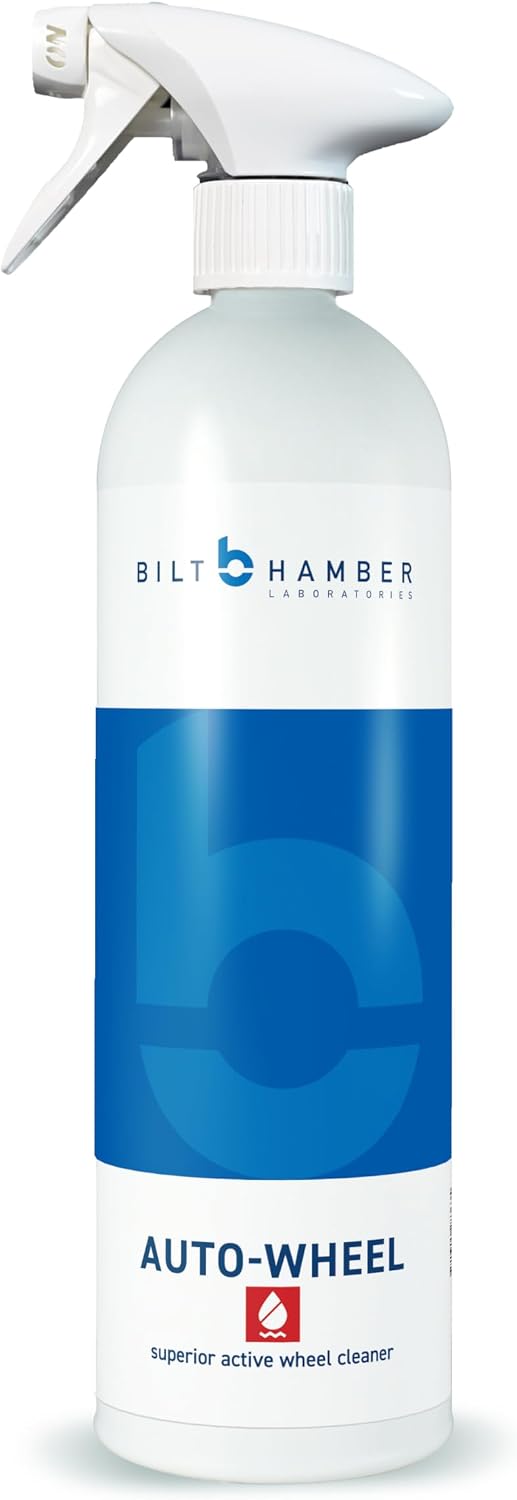
Bilt Hamber Auto-Wheel Active Wheel Cleaner
biodegradable formula
The Full Ranking
Why each pick earned its spot
Best Overall: Bilt Hamber Auto-Wheel Active Wheel Cleaner
The Bilt Hamber Auto-Wheel posts the top score on our card: a pH-neutral (5.5 to 7.0) iron-reactive formula built on sodium mercaptoacetate that bleeds deep red as it dissolves bonded brake dust, with no acid to etch alloy, chrome, or powder coat. Its WARNING-level SDS lists H317 skin sensitization and H319 eye irritation, which is what holds its health score to 5.0, and it costs the most per ounce of anything in this top five.
Best for Heavy Brake Dust: Chemical Guys Diablo Gel Wheel & Rim Cleaner
The Chemical Guys Diablo Gel Wheel & Rim Cleaner is a clinging oxygen-infused gel concentrate that grips vertical wheel faces and chews through heavy brake dust and road film, and its SDS classifies it as non-hazardous with no Prop 65 warning on the gel formula.
Best Lower-Cost Iron Remover: Griot's Garage Heavy-Duty Wheel Cleaner
If your priority is the same iron-reactive chemistry without the winner's price or its skin-sensitizer code, the Griot's Garage Heavy-Duty Wheel Cleaner is pH-balanced (6.5 to 7.0), rated by the brand for painted alloy, chrome, uncoated aluminum, anodized, and powder-coated wheels, and its SDS tops out at H315 skin irritation and H320 mild eye irritation.
Best Foaming: Mothers Foaming Wheel & Tire Cleaner
The Mothers Foaming Wheel & Tire Cleaner is a non-acidic foaming formula that clings while it lifts brake dust, grease, and road grime from clearcoated, painted, chrome, and PVD factory wheels, finishing spot-free at a WARNING-level SDS. It does carry a California Prop 65 warning.
Best Value: Chemical Guys Diablo Wheel & Tire Cleaner
This is the ready-to-use 32 oz spray, not the clinging concentrate gel higher up the list, and buying the big bottle is what makes it the value play: it undercuts the winner by more than half per ounce and sits among the top ten sellers in Amazon's Automotive Wheel Care category. Its SDS classifies it non-hazardous under OSHA HCS with no signal word and no GHS codes at the mixture level, estimated VOC is under 10 g/L, and Section 12 records no aquatic-toxicity hazard. Two things to weigh: the bottle carries a California Prop 65 cancer warning for trace 1,4-dioxane and acetaldehyde, and there is no iron-reactive chemistry here, so nothing bleeds red and heavy bonded brake dust still wants one of the iron removers above.
Full ranked catalog — including picks 11+, out-of-stock options, and the ones we couldn’t crown.
How we rank
Every wheel cleanerin our catalog runs through the same scoring rubric: scored effectiveness, ingredient-safety data translated from each product’s SDS, and environmental impact. We don’t take placement fees, and affiliate links never move a product up the list.
Wheel cleaner is where chemistry and honesty meet, because the formulas in this category range from gentle pH-neutral foams to harsh acid blends that can etch a clear coat. Brake dust is iron, so the best modern cleaners are either pH-balanced color-changing iron removers that bleed red as they dissolve the bonded particles, or non-acid alkaline surfactants that lift grime without the corrosion risk. The baked-on sap and road tar that often ride along the lower wheel and fender are a different chemistry, where a bug and tar remover handles the sticky stuff that an iron remover leaves behind. On alloy, chrome, polished, anodized, and especially coated or freshly painted wheels, the pH-neutral and non-acid picks are the safer match, since strong acids can dull and etch those finishes. The other half of the truth is health, and it does not track rank or price cleanly. The top of this list is non-acid and pH-balanced, but WARNING-level is not the same as harmless: our first-place pick carries an H317 skin-sensitizer code, while the cheapest pick in our top five is classified non-hazardous with no GHS codes at all and still carries a California Prop 65 warning. Further down the list, several acid-based formulas carry DANGER signal words, H314 skin corrosion, H318 serious eye damage, and Prop 65 warnings, all translated straight from each product's SDS rather than the marketing copy. Match the chemistry to your wheel finish, dwell and rinse before it dries, and you get clean wheels without the risk. How we score: CCT grades each wheel cleaner on real-world cleaning power AND on health translated straight from its SDS, never marketing copy.
Related guides
Frequently Asked Questions
What is the best wheel cleaner?
The best wheel cleaner overall is the Bilt Hamber Auto-Wheel, a pH-neutral iron-reactive formula that dissolves bonded brake dust, bleeds deep red as it works, and uses no acid, so it will not etch alloy, chrome, or powder coat. It takes the top composite score on our card, though its SDS carries an H317 skin-sensitizer code that holds its health score to 5.0. If your priority is the same chemistry at a lower price and with milder irritation codes, the Griot's Garage Heavy-Duty Wheel Cleaner is the pick, and for heavy brake-dust buildup the Chemical Guys Diablo Gel clings to the wheel and rinses non-hazardous.
What is the best wheel cleaner for brake dust?
For baked-on brake dust, an iron-reactive cleaner works best, because the active chemistry dissolves the iron particles embedded in the wheel and bleeds red so you can see it lifting. The Bilt Hamber Auto-Wheel is the top-scoring iron remover here, and the Griot's Garage Heavy-Duty Wheel Cleaner runs the same class of chemistry at a much lower price per ounce. For a clinging option on heavy buildup, the Chemical Guys Diablo Gel grips vertical wheel faces and stays put during the dwell. All three lift brake dust without the strong acids that older wheel cleaners relied on.
Is acid wheel cleaner safe for coated or painted wheels?
Strong acid wheel cleaners can etch clear coats, dull polished finishes, and damage anodized or freshly painted wheels, which is why most modern picks moved to pH-neutral and alkaline chemistry. Several acid-based formulas on this list carry DANGER signal words with H314 skin corrosion and H318 serious eye damage on their SDS, and some add a California Prop 65 warning. On coated or painted wheels, a pH-balanced or non-acid cleaner is the safer match, and the SDS hazard codes are the chemistry to read before you buy.
What's the difference between pH-neutral and acid wheel cleaner?
A pH-neutral or pH-balanced wheel cleaner sits near 7 on the scale and relies on surfactants or an iron-reactive chemistry to lift grime, which makes it gentle on coatings, polished lips, and delicate finishes. An acid wheel cleaner uses a strong low-pH formula to strip heavy buildup fast, but that aggressiveness comes with corrosion and etching risk and, on many SDS sheets, DANGER-level hazard codes. For most owners a pH-neutral cleaner does the job without the surface risk.
What is the best wheel cleaner for alloy wheels?
For alloy wheels, a pH-balanced or non-acid cleaner is the safest effective choice, since alloy and its clear coat can be dulled or etched by strong acids. The Bilt Hamber Auto-Wheel is pH-neutral and iron-reactive, the Griot's Garage Heavy-Duty Wheel Cleaner is rated by the brand for painted alloy, chrome, uncoated aluminum, anodized, and powder-coated wheels, and the Chemical Guys Diablo Wheel & Tire Cleaner is a non-acid, non-caustic spray the brand documents as safe for all wheel finishes. Always confirm the label lists your specific finish before the first use.
How do I use wheel cleaner, and will it damage my wheels?
Work on cool wheels out of direct sun, rinse off loose grit first, then spray the cleaner on, let it dwell for the labeled time (often 3 to 5 minutes), agitate with a soft wheel brush, and rinse thoroughly before it dries. Damage risk comes mostly from strong acids on coated, polished, or delicate finishes and from letting product dry on the surface. A pH-neutral or iron-reactive cleaner used as directed is low risk, and the SDS hazard codes on each product tell you how aggressive the chemistry actually is.
Can you use wheel cleaner on tires?
Some cleaners are labeled wheel-and-tire and are fine on both, but a dedicated wheel cleaner is formulated for the wheel finish, not the rubber. Using a harsh wheel cleaner on tires repeatedly, whether it is an acidic iron-reactive type or a strong alkaline degreaser, can dry out and degrade the rubber over time. For the tire itself, a dedicated tire cleaner before dressing does a better, safer job.
What is iron remover and do I need one?
An iron remover is a wheel and paint cleaner whose chemistry reacts with embedded iron particles, mostly brake dust plus some rail dust and fallout, converting them into a water-soluble compound that rinses away and bleeds purple or red as it works. You need one when iron has bonded into the wheel or paint and a normal wash, even with a clay bar, will not lift the gritty specks or orange spotting left behind. Many wheel cleaners are already iron-reactive, so you often get this function built in. If your wheels come clean with regular washing, you do not need a dedicated one.
#1 · Auto-Wheel Active Wheel Cleaner
7.5/10 CCT
As an Amazon Associate I earn from qualifying purchases.