
Best Bug and Tar Remover for Cars (2026): Top 10 Ranked
We score every bug and tar remover we can verify, for performance and ingredient safety. These are the 9 best of 10 in our catalog.
CarCareTruth scored 10 bug and tar removers for 2026, and the Meguiar's Heavy Duty Bug & Tar Remover ranks first: an aqueous cling-foam aerosol that grips vertical panels and lifts fresh bug splatter, sap, and lighter road tar, marketed clear-coat safe and broadly confirmed as such by owners. It tops our card, and its DANGER signal word comes from the flammable aerosol can (H222/H229), not from the chemistry, which carries no mixture-level health codes at all. For owners who want decontamination built into a regular wash, the Chemical Guys Bug and Tar Heavy Duty is an aqueous concentrate that doubles as a shampoo at a WARNING-level profile. If your paint is ceramic-coated and you want the gentlest chemistry for frequent touch-ups, the Griot's Garage Bug & Smudge Remover carries only an eye-irritation note on its SDS. For baked-on tar and asphalt the Stoner Tarminator clears it fastest, but its SDS classifies a suspected carcinogen (H351) and suspected reproductive toxin (H361), which is why it scores low on health and reads as outdoor-only. That is the trade-off running through this whole category. The top of the list is mild aqueous chemistry. Several solvent picks below it carry DANGER-level codes pulled straight from each SDS, not from marketing.
Affiliate disclosure: CarCareTruth is reader-supported. As an Amazon Associate I earn from qualifying purchases. We may also earn commissions from other retailers linked on this page, at no extra cost to you. Affiliate revenue never influences our scores or rankings. Full disclosure
Best of Bug And Tar Remover
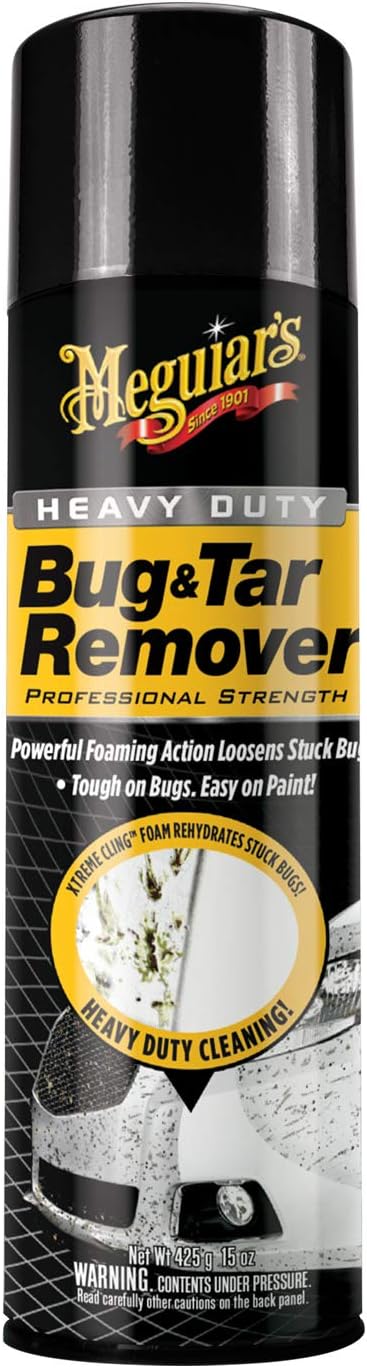
Meguiar's Heavy Duty Bug & Tar Remover (G180515, 15 oz Aerosol)
The Full Ranking
| Rank | Product | CCTCCT Score | HealthHealth & Safety | Price tier | Buy |
|---|---|---|---|---|---|
1 | Heavy Duty Bug & Tar Remover (G180515, 15 oz Aerosol)Meguiar'sBest Overall —Prop 65 | 7.5/10 | 8.5/10 | — | Check Price |
2 | Bug and Tar Heavy Duty Car Wash (CWS104)Chemical GuysBest for a Regular Wash Prop 65 | 7.3/10 | 7.3/10 | Check Price | |
3 | Bug & Smudge RemoverGriot's GarageBest Mild / Coating-Safe Prop 65 | 6.8/10 | 6.0/10 | Check Price | |
4 | Road Kill Bug RemoverMcKee's 37 No SDS | 6.8/10 | 5.0/10 | Check Price | |
5 | Bug Remover (16 oz)Adam's Polishes | 6.5/10 | 5.7/10 | Check Price | |
6 | Automotive Adhesive RemoverGoo Gone | 6.2/10 | 5.0/10 | Check Price | |
7 | TarX Tar and Adhesive RemoverCarPro | 6.1/10 | 4.0/10 | Check Price | |
8 | Tarminator Tar, Sap, and Asphalt RemoverStonerBest for Baked-On Tar / Asphalt Prop 65 | 5.7/10 | 1.0/10 | Check Price | |
9 | Bug & Tar Remover (T-520A Trigger Spray)Turtle WaxBest Store-Shelf Solvent —Prop 65 | 5.5/10 | 3.0/10 | — | Check Price |
Why each pick earned its spot
Best Overall: Meguiar's Heavy Duty Bug & Tar Remover (G180515, 15 oz Aerosol)
The Meguiar's Heavy Duty Bug & Tar Remover (G180515) tops our card: an aqueous surfactant foam whose Xtreme Cling formula holds on vertical panels while it loosens fresh bug residue, sap, and lighter tar. One buying note before you click: the single 15 oz can is not currently sellable, so our link goes to the six-pack of the same can, which works out cheaper per can but is a bigger up-front spend. Its DANGER signal word is driven only by the pressurized can (H222 extremely flammable aerosol, H229 pressurized container), and its SDS carries no mixture-level health codes at all, which is the mildest hazard profile of any aerosol here. Two honest caveats: the US listing carries a Prop 65 warning attributable to trace sodium nitrite, and the SDS on file dates to 2017, so we hold its confidence at provisional. Baked-on weathered tar needs extended dwell, repeat passes, or a dedicated solvent.
Best for a Regular Wash: Chemical Guys Bug and Tar Heavy Duty Car Wash (CWS104)
The Chemical Guys Bug and Tar Heavy Duty (CWS104) is an aqueous concentrate that doubles as a two-bucket shampoo and a bug and tar pre-wash, so decontamination folds into the wash you already do. It sits at a WARNING level with skin and eye irritation only (H315, H319), no inhalation code and no flammability. Its 2026 SDS adds a Prop 65 warning, the one deduction that keeps it just behind the milder picks on health, and at concentrate strength it strips wax by design.
Best Mild / Coating-Safe: Griot's Garage Bug & Smudge Remover
The Griot's Garage Bug & Smudge Remover is the mildest chemistry in the category: a chelator and alkaline builder in water, no petroleum solvent and no flammability, with eye irritation (H320, Cat 2B) as the only classified hazard on its SDS, the single mildest health classification in this pool. That makes it a sensible match for fresh bugs, oil smudges, and scuffs on ceramic-coated paint, PPF, trim, and rubber for frequent use. A Prop 65 flag on the listing holds its health score down, and baked-on tar needs Griot's separate dedicated tar remover.
Best for Baked-On Tar / Asphalt: Stoner Tarminator Tar, Sap, and Asphalt Remover
The Stoner Tarminator is the community benchmark for clearing week-old tar, asphalt overspray, and weathered residue in a single 30 to 60 second pass, and its cling foam grips rocker panels and bumpers. The trade-off sits right there on its SDS: signal word DANGER, H351 suspected carcinogen, H361 suspected reproductive toxin, H373, H332, 40 to 60 percent VOC, plus a Prop 65 warning. The low health score reflects that chemistry, not poor performance, and its SDS directs outdoor or well-ventilated use.
Best Store-Shelf Solvent: Turtle Wax Bug & Tar Remover (T-520A Trigger Spray)
The Turtle Wax Bug & Tar Remover (T-520A) is the petroleum-solvent option you can grab off most parts-store shelves, a non-aerosol trigger spray with lower VOC than the solvent aerosols (27 percent). Watch the label gap, though. The front label reads WARNING, but the SDS classifies H351 suspected carcinogen and H336 drowsiness alongside H315 and H319, and the product carries a Prop 65 warning. A shopper reading the bottle never sees the H351. The SDS does. Best matched to fresh residue and lighter tar with outdoor use.
Full ranked catalog — including picks 11+, out-of-stock options, and the ones we couldn’t crown.
How we rank
Every bug and tar removerin our catalog runs through the same scoring rubric: scored effectiveness, ingredient-safety data translated from each product’s SDS, and environmental impact. We don’t take placement fees, and affiliate links never move a product up the list.
Bug, tar, and sap removal covers a wide chemistry spectrum, and your first decision is matching the formula to the residue. Mild aqueous and foam picks like the Meguiar's, Chemical Guys, Adam's, and the gentlest of all, Griot's, handle fresh bug splatter, sap, and light tar, and they are safe enough for frequent use on coated paint. A dedicated petroleum or citrus solvent earns its place only when you face baked-on tar or asphalt overspray. Either way, this work belongs in the decontamination step of a full detail, right after the wash and before you polish or seal, so the panel is bare before you lift the contamination. And here is the catch worth knowing before you buy: the products that clear hardened tar fastest tend to carry the heaviest SDS health profiles, running from aspiration hazard up through suspected carcinogen and high VOC. A DANGER label on the can does not always mean the same risk. For the Meguiar's foam, the DANGER is the flammable aerosol can (H222, H229). For the Stoner Tarminator the DANGER is the flammable aerosol too, but its SDS stacks on severe health codes the milder foams lack (H351, H361) that crater its health score, which is the trade-off worth knowing. The aqueous formulas read very differently on a gloves-versus-respirator basis than the solvents do. The method is the same either way: cool surface out of direct sun, dwell the labeled time, agitate gently, wipe with a fresh microfiber, and follow solvent use with a wash. How we score: CCT grades each bug and tar remover on real-world removal AND on health translated straight from its SDS, never from marketing copy.
Related guides
Frequently Asked Questions
What is the best bug and tar remover for cars?
The best bug and tar remover overall is the Meguiar's Heavy Duty Bug & Tar Remover (G180515), an aqueous cling-foam aerosol that lifts fresh bug residue, sap, and lighter road tar and is marketed clear-coat safe. It posts the top score on our card, and its DANGER signal word comes from the flammable aerosol can (H222/H229), not from its health chemistry, whose SDS carries no mixture-level health codes at all. Its US listing does carry a Prop 65 warning, attributable to trace sodium nitrite. If you would rather build bug and tar removal into a normal wash, the Chemical Guys Bug and Tar Heavy Duty (CWS104) is an aqueous concentrate that doubles as a shampoo at a WARNING-level profile, and for ceramic-coated paint the Griot's Garage Bug & Smudge Remover is the gentlest chemistry in the category.
What is the best tar remover for baked-on tar and asphalt?
For hardened tar, asphalt overspray, and weathered residue, the Stoner Tarminator is the community benchmark, clearing week-old tar in a single 30 to 60 second pass thanks to its petroleum-distillate cling-foam chemistry. That performance comes with the heaviest health profile in this guide, translated straight from its SDS: a DANGER signal word, H351 (suspected carcinogen, Category 2), H361 (suspected reproductive toxin, Category 2), H332, and 40 to 60 percent VOC, plus a Prop 65 warning. The SDS directs outdoor or well-ventilated use, which is why it scores low on health even though it wins on removal. The CarPro TarX is an ester and citrus-blend solvent alternative for the same job, also DANGER-labeled. For fresh or light tar, a milder aqueous pick like the Meguiar's Heavy Duty foam avoids that chemistry trade-off entirely.
Will bug and tar remover damage my paint, clear coat, or ceramic coating?
It depends on the chemistry. Aqueous and aqueous-foam picks like the Meguiar's Heavy Duty, Chemical Guys CWS104, and Griot's Bug & Smudge Remover are label-safe on cured clear coat, and the Griot's chemistry, whose only classified hazard is H320 eye irritation, is mild enough for frequent use on ceramic-coated paint and PPF. Petroleum-solvent products such as the Stoner Tarminator, Turtle Wax T-520A, and Goo Gone Automotive are safe on cured factory clear coat at the labeled dwell, but their solvent base can dehydrate rubber seals and affect some matte or satin finishes with extended contact. On coated or freshly painted paint, keep the dwell short, work out of direct sun, rinse promptly, and on a delicate or matte finish test a hidden spot first.
How do I remove tree sap from car paint without damaging it?
Work on a cool surface out of direct sun so the product does not flash off, then match the chemistry to the residue. For fresh tree sap and bug splatter, a mild aqueous or aqueous-foam remover lifts the organic residue without harsh solvents: spray it on, let it dwell the labeled time so it can break the bond, agitate gently with a fresh microfiber rather than scrubbing dry, and wipe. Do not let the product dry on the panel. After any solvent product, follow with a normal wash to clear the thin oily film and the wax it can lift. For most fresh sap, the gentlest pick that lifts it is the right one, so reach for an aqueous formula before a petroleum solvent.
How do I remove hardened tree sap or baked-on tar from car paint?
Hardened sap and baked-on tar respond to dwell time and a dedicated solvent, not to more pressure. Cool the panel out of direct sun, then apply a petroleum or citrus solvent such as the Stoner Tarminator or CarPro TarX and let it dwell the labeled 30 to 60 seconds so it can dissolve the bond, then wipe with a fresh microfiber. A second short dwell lifts more than one long aggressive pass and is gentler on the clear coat. Keep solvents off rubber and plastic trim where you can, since the solvent base can dehydrate seals, and follow with a normal wash to clear the oily film. Both of those solvents carry DANGER-level SDS codes, so their SDS directs outdoor or well-ventilated use.
Why do some bug and tar removers say DANGER and others say WARNING?
The signal word is a translation of the SDS hazard codes, and a DANGER label is not always the same risk. For the Meguiar's Heavy Duty aerosol, the DANGER signal word is driven only by physical hazards from the pressurized can (H222 extremely flammable aerosol and H229 pressurized container), and the mixture carries no health-tier H-codes at all. The Stoner Tarminator also reads DANGER, and like that aerosol the word comes from its flammable-aerosol classification (H222), not from its health codes; what sets it apart is that its SDS stacks on severe health hazards the milder foams lack, H351 (suspected carcinogen) and H361 (suspected reproductive toxin), which crater its health score even though a Category 2 health code does not by itself trigger the DANGER signal word. A WARNING product is not automatically milder either, since the Turtle Wax T-520A is labeled WARNING yet its SDS still classifies H351 and H336 (drowsiness or dizziness), which a shopper reading the front of the bottle would not see. We score health from these SDS codes, not from the front-label signal word.
Are bug and tar removers safe to breathe or use in a closed garage?
The petroleum-solvent and aerosol products in this guide should be used outdoors or with the garage door fully open. The Stoner Tarminator SDS directs use only outdoors or in a well-ventilated area, backed by its flammable aerosol rating, H332 (harmful if inhaled), and 40 to 60 percent VOC, and the Turtle Wax T-520A SDS gives the same direction because of H336 (drowsiness or dizziness from solvent vapor). The Meguiar's aerosol directs adequate ventilation as well, because the flammable propellant accumulates in enclosed spaces. The aqueous wash-style picks such as the Chemical Guys Bug and Tar Heavy Duty and Griot's Bug & Smudge Remover carry no inhalation classification at all. These are the SDS hazard codes and the ventilation directions that follow from them, not a generic safety recommendation.
#1 · Heavy Duty Bug & Tar Remover (G180515, 15 oz Aerosol)
7.5/10 CCT
As an Amazon Associate I earn from qualifying purchases.