CarCareTruth Score
Recommended.
Opens Amazon in a new tab. No account needed to look.
Saved to your guest loadout. Sign up to also save to your Cabinet (consumables) or Kit (tools you own).
As an Amazon Associate I earn from qualifying purchases. Full disclosure
Prices may varyAbout this product's hazards. This product's Safety Data Sheet uses signal word DANGER.Read the manufacturer's SDS and follow all safety instructions before use. CarCareTruth ratings translate the manufacturer's safety sheet. They do not replace the SDS or substitute for a hazard assessment specific to your task.
Health score is for adult use as intended, per the manufacturer's SDS. It does not model child ingestion, accidental spill cleanup, or off-label use. See the safety panel below for full hazard classification, and /disclaimer for the full editorial scope.
GHS hazard codes are quoted from the manufacturer’s Safety Data Sheet. PPE tiers below translate those codes and the listed ingredient chemistry; they are not CarCareTruth recommendations.
Show details for all categories ▾Hide details ▴
Translated from the manufacturer’s Safety Data Sheet, Section 8
SDS §8 directs use of safety glasses with side shields (EN 166). Aerosol spray drift at arm's length carries splash and mist risk; no H319 in §2 mixture classification but the aerosol delivery is the driver of the recommendation.
CarCareTruth publishes the cited sources verbatim and does not advise what action a user should take. Consult the full SDS before use.
Only when: prolonged use
Translated from the manufacturer’s Safety Data Sheet, Section 8
SDS §8 states 'No chemical protective gloves are required' for normal use. No H315 or H317 in §2 mixture classification · 2-butoxyethanol is present at <0.5%, below CLP skin-classification threshold. Nitrile gloves are reasonable for prolonged or repeated application but not required by SDS §8 for normal use.
CarCareTruth publishes the cited sources verbatim and does not advise what action a user should take. Consult the full SDS before use.
Only when: in enclosed space · prolonged use
Translated from the manufacturer’s Safety Data Sheet, Section 8
SDS §8 directs 'general dilution ventilation and/or local exhaust ventilation to control airborne exposures.' SDS §7.1 states 'Do not breathe dust/fume/gas/mist/vapours/spray.' Aerosol delivery with hydrocarbon propellant and trace 2-butoxyethanol · outdoor or open-bay use is low-risk; enclosed-bay extended use warrants an organic-vapor cartridge per SDS §8 (EN 140/EN 136 filter type A).
CarCareTruth publishes the cited sources verbatim and does not advise what action a user should take. Consult the full SDS before use.
No PPE specified in published sources for ventilation. Absence does not imply “not needed” — consult the full Safety Data Sheet.
PPE tiers translate the manufacturer’s SDS and U.S. regulatory standards. Not professional safety advice. How we report safety.
Scope of these PPE tiers. The tiers on this page translate the product's Safety Data Sheet where one is published, plus its ingredient chemistry, into a comparable rating. They describe a formulation, not a situation: a tier is not a safety determination for any specific user, task, quantity, or environment. The manufacturer's label and use instructions govern how the product is handled. Where the product is used at work, the employer's PPE program and hazard assessment under 29 CFR 1910.132 decide what protection is selected, not this page.
No warranties. CarCareTruth makes no warranties, express or implied, and expressly disclaims the implied warranties of merchantability and fitness for a particular purpose.
This product ranks #1 of 9 in Bug & Tar Remover.
Last reviewed August 1, 2026
TL;DR A clear-coat-safe aqueous foaming aerosol for fresh bugs and lighter tar · gentler than petroleum-solvent aerosols, less aggressive on baked-on deposits. The DANGER label comes from the flammable-aerosol can itself (H222/H229), not health hazards. The US listing carries a Prop 65 warning attributable to trace sodium nitrite.
Spray on bug residue and tar, let the foam cling for the labeled dwell, then wipe with a microfiber. The Xtreme Cling foam adheres reasonably to vertical surfaces like rocker panels. Community on r/AutoDetailing and owner long-term feedback broadly confirms quality-7.2 single-pass cleaning on fresh residue and lighter tar; the "clear coat safe" claim holds up with no widespread paint or trim damage reports. The honest limitation: baked-on weathered tar needs extended dwell or repeat application.
Buy it if you want a clear-coat-safe spot treatment for fresh bugs and lighter tar between washes · the gentler chemistry is the differentiator. Skip it if you mostly deal with weathered baked-on tar (Stoner Tarminator is faster, accepting the H332/H351/H361 trade-off), or if you want to avoid aerosol propellants entirely.
DANGER is driven entirely by the aerosol can · H222 (extremely flammable aerosol) and H229 (pressurised container) · with no mixture-level health hazard codes. The propellant is butane and propane; the payload is aqueous surfactant foam with trace 2-butoxyethanol (<0.5%) and sodium nitrite (<0.25%, antimicrobial). VOC per SDS §9.2 is 37 g/L, below the low-VOC threshold. The Prop 65 warning is attributable to sodium nitrite on California's reproductive-toxin list at lower disclosure thresholds than CLP/GHS. Store away from heat, sparks, open flames, and above 50°C/122°F. Drain-destined when rinsed off; 2-butoxyethanol is the primary aquatic-toxicant flag for the storm-drain pathway.
G180515 is the aerosol foaming version with an aqueous surfactant base. G107 (Gold Class) is a non-aerosol liquid with a petroleum-distillate base at 20-40% · totally different chemistry. The Gold Class formula is more aggressive on baked-on tar but carries the petroleum-solvent exposure profile; the Heavy Duty aerosol foam is gentler on chemistry but less aggressive on weathered residue. Pick the aerosol for fresh bugs and lighter tar with vertical-surface cling; pick the liquid for hardened deposits where solvent action matters more.
The DANGER signal word is driven entirely by the aerosol can itself · H222 (extremely flammable aerosol) and H229 (pressurised container), per SDS §2.1. These are physical hazards from the hydrocarbon propellant (butane + propane), not biological health hazards. The aqueous surfactant payload inside the can carries no mixture-level health H-codes. The label is honest · the chemistry is much milder than a petroleum-solvent aerosol · but the can itself is a pressurised flammable container and must be labeled accordingly.
The product listing carries a Prop 65 warning. The most likely trigger is sodium nitrite (<0.25%), which appears on California's Prop 65 list as a developmental and reproductive toxin. Trace 2-butoxyethanol (<0.5%) is also a contributor. Both are below the thresholds for mixture-level CLP/GHS health classification · that's why the EU SDS doesn't list health H-codes · but Prop 65 has lower disclosure thresholds than CLP, so the California warning applies even when GHS does not.
Meguiar's markets this as 'clear coat safe' and the community broadly confirms · no widespread reports of clear coat etching, plastic-trim blanching, or rubber degradation at the labeled dwell time. The aqueous foam base is much gentler on coatings than a petroleum-distillate spray. On ceramic coatings, brief contact with labeled dwell is generally safe; on wax, the mildly alkaline surfactant (pH 9.2 per SDS §9.1) can affect a fresh wax layer in the application area, so re-wax the treated panel if needed.
Stoner Tarminator (heavy aliphatic petroleum naphtha + hydrotreated light distillate at 30-60%) is faster on weathered or baked-on tar · solvent action chemically dissolves it. The Meguiar's aerosol foam uses surfactant chemistry to loosen and rehydrate residue, which is gentler but less aggressive on hardened deposits. The trade-off is real: Tarminator clears in a single pass on bad tar but carries H332/H351/H361/Prop 65 chemistry; Meguiar's takes more dwell or repeated application on the worst cases but has no §2 mixture health hazards.
Weekly pick
One product, one safety verdict, every week. No spam.
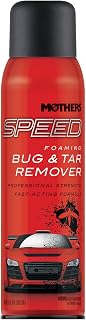
Mothers
Speed Foaming Bug & Tar Remover
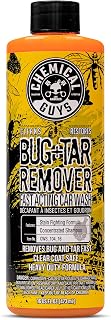
Chemical Guys
Bug and Tar Heavy Duty Car Wash (CWS104)
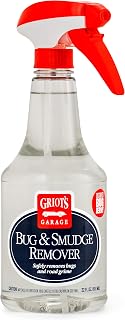
Griot's Garage
Bug & Smudge Remover
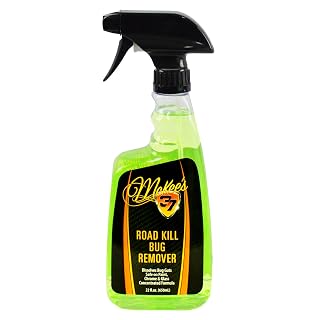
McKee's 37
Road Kill Bug Remover
As an Amazon Associate I earn from qualifying purchases. Full disclosure

Community
0 postsShare how you use this product
Drop a quick comment or post a full review with photos and a star rating.
Sign in to postNew here? Create a free account.