
The 10th Generation Honda Civic Clubhouse
10th-Gen Honda Civic (2016-2021) Owner's Hub
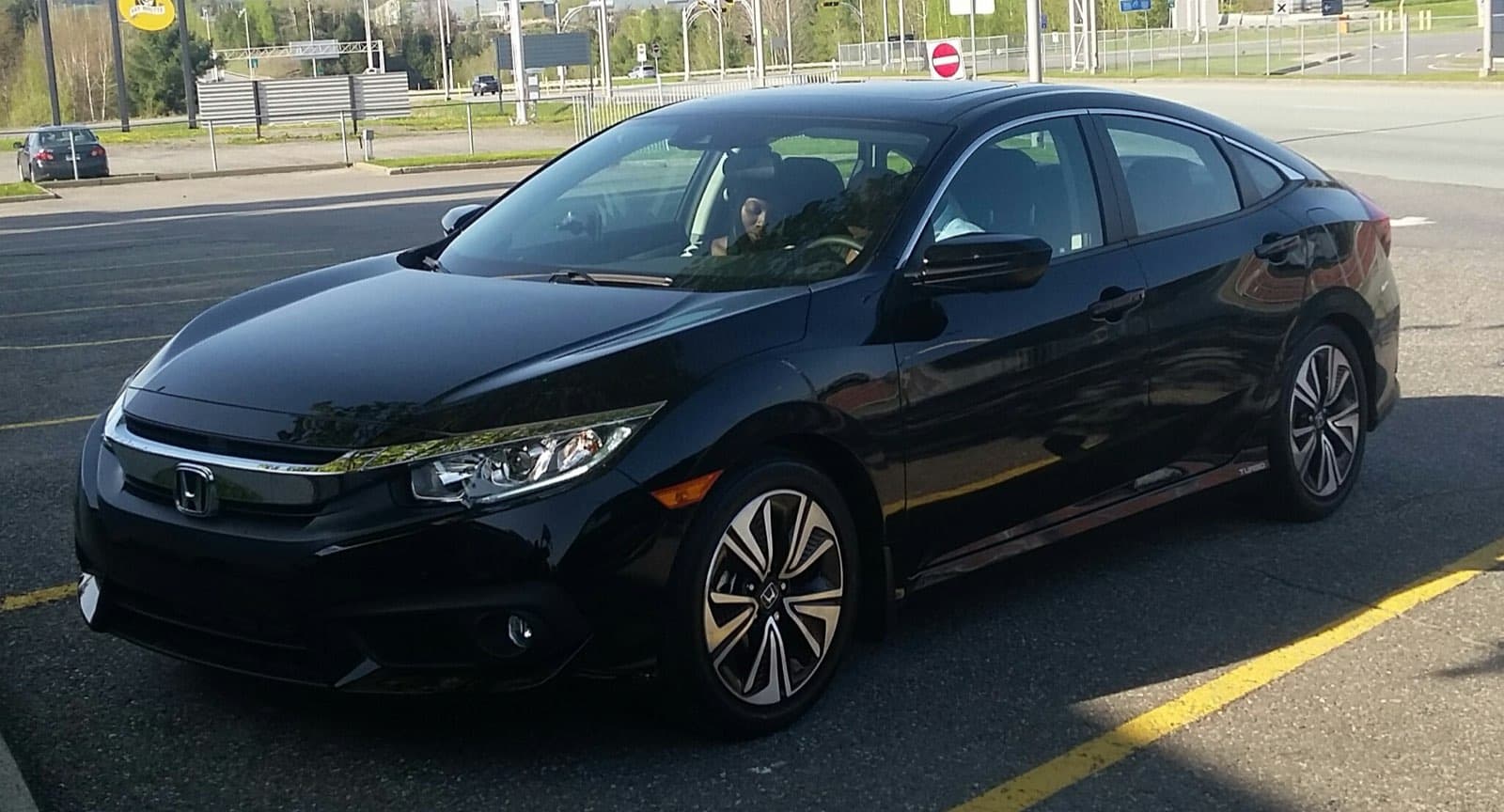
The 10th-gen Civic (2016-2021) is the deepest used-compact market in America: sedan, coupe (through 2020), and the first US Civic hatchback in a decade (2017 on). Two engines: the simple 2.0L K20C2 and the quicker 1.5L L15B7 turbo, whose one real flaw is oil dilution on cold-climate short trips. The A/C condenser is the other known repair. Every car is FWD; the manual survived on 2.0L LX/Sport sedans through 2020 and hatchbacks through 2021. Buy on records, not year.
- Production
- 2016-2021
- Engines
- 1.5L · 2L
- 1.5T EPA combined
- 35-36mpg
What your Civic takes
The parts and fluids that fit this generation. Specs we publish are confirmed against two independent sources; the rest fill in as we verify them.
- Tire size215/55R16✓ VerifiedView
- Wiper blades26" driver · 18" passenger · 14" rear✓ VerifiedView
- Engine oil0W-20 (3.7 qt) · 0W-20 (4.4 qt)✓ VerifiedView
- Spark plugs1.5L-I4: ILZKAR8H8S · 2.0L-I4: DILKAR7G11GS✓ VerifiedView
- Headlight bulbsH11 low · 9005 high · H8 fog✓ VerifiedView
- BatteryGroup 51R · 500 CCA min✓ VerifiedView
- Tire pressure32 psi✓ VerifiedView
- Key fob batteryCR1620 (flip) · CR2032 (smart)✓ VerifiedView
- Serpentine belt1.5L-I4: 7PK1715 · 2.0L-I4: 7PK1435✓ VerifiedView
- Fuel filter1.5L-I4: N/S · 2.0L-I4: N/S✓ VerifiedShop
- CoolantHonda Long Life Antifreeze/Coolant Type 2 · ~5.3 qtFrom owner's manualShop
- Brake fluidHonda Heavy Duty Brake Fluid DOT 3From owner's manualShop
- Transmission fluid1.5L-I4: Honda HCF-2 · 2.0L-I4: Honda HCF-2From owner's manualShop
- Wheel fitment5x114.3 · 64.1mm bore · M12x1.5From owner's manualShop
- Thermostat1.5L-I4: 172°F · 2.0L-I4: 172°FFrom owner's manualShop
- A/C refrigerant1.5L-I4: R-1234yf · 2.0L-I4: R-1234yfFrom owner's manualShop
- Oil filterParts in catalogShop
- Engine air filterParts in catalogShop
- Cabin air filterParts in catalogShop
- Brake padsParts in catalogShop
- Brake rotorsParts in catalogShop
- Power steering fluidElectric power steering — no fluid.N/A
- Differential fluidN/A — front-wheel-drive. The differential is integrated in the transaxle; there is no separately serviceable differential. The transaxle fluid is covered by transmission fluid (Honda CVT Fluid HCF-2 on CVT models, Honda MTF / API GL-4 on manual models).N/A
Floor mats
Our top custom-fit pick for the Honda Civic is the Husky Liners Weatherbeater Floor Mats 1st & 2nd rows.
Floor mats for the Honda Civic →Heritage · 10th Generation Civic
2016-2021- 1972
Civic is born
The first Civic launches and starts the best-selling nameplate run in Honda history.
- 2015
10th gen debuts
All-new platform unveiled in fall 2015; the sedan wins 2016 North American Car of the Year.
- 2017
Hatchback and Type R return
First US Civic hatchback since the 7th gen, and the first Civic Type R ever sold in America.
- 2019
The volume knob returns
Mid-cycle refresh restores physical controls and makes Honda Sensing standard on every trim.
- 2021
Generation run-out
The coupe is already gone and the sedan loses its manual; the 11th gen arrives for 2022.
Last verified: July 2026.
The 10th-gen Honda Civic (2016-2021) is the generation that made the Civic serious again: a stiffer, lower platform, the first US Civic hatchback since the early 2000s, and a 1.5L turbo that turned a commuter into a genuinely quick car. It sold in enormous numbers, which means the used market is deep and the ownership knowledge base is deeper. What owners argue about: the turbo engine's oil-dilution habit, the A/C condenser that fails out of warranty, and whether the CVT belongs in an enthusiast's driveway.
Should you buy one in 2026
A clean 10th-gen Civic runs roughly $13,000 to $23,000 used in 2026, and it is still one of the best used-compact buys at that money. Parts are cheap, the chassis is honest, and both engines are proven when maintained.
- Good for: commuters who want 35+ mpg without a hybrid premium, first cars that will not punish a maintenance lapse too harshly, and manual holdouts (2.0L LX/Sport sedans through 2020, hatchback Sport/Sport Touring through 2021).
- Bad for: anyone who tows anything (Honda publishes no US tow rating for this car), or buyers who want AWD; every 10th-gen Civic is front-wheel drive.
- Skip if: the car is a cold-climate 1.5T with no oil-change records, the A/C blows warm and the seller shrugs, or open recalls show unaddressed on the VIN.
The two engines, honestly
The 2.0L K20C2 is the simple one: naturally aspirated, port-injected, 158 hp, a timing chain, and no oil-dilution drama. It is slower, and on LX/Sport trims it came with a genuinely good 6-speed manual through 2020 (sedan) and a CVT otherwise. If your priority is a quarter-million-mile commuter, this is the engine.
The 1.5L L15B7 turbo is the volume engine: 174 hp, strong midrange, and real-world fuel economy in the high 30s. Its one documented flaw is fuel diluting the engine oil on cold-start, short-trip duty. Honda issued a software update and extended the powertrain warranty for affected VINs after a 2018-2019 investigation centered on cold-climate states. On a warmed-up highway car it is largely a non-issue; on a five-minute-commute car in Minnesota it deserves attention. Check the dipstick monthly: a rising level or gasoline smell means the oil is diluting, and shorter oil-change intervals are the practical defense.
Both engines spec 0W-20 full synthetic: 3.7 quarts with filter on the 1.5T, 4.4 on the 2.0L, and both share the same Honda 15400-PLM-A02 oil filter.
The maintenance calendar that actually works
- Every 5,000-7,500 miles: oil and filter, 0W-20 full synthetic. On a short-trip 1.5T, stay at the low end of that window; oil dilution is managed with fresh oil, not additives.
- Every 15,000-30,000 miles: engine air filter (the 1.5T and 2.0L use different parts) and cabin filter (80292-TBA-A11, shared by all trims). Both are glovebox-DIY jobs.
- Every 25,000-40,000 miles: CVT fluid drain-and-fill with Honda HCF-2 only. Honda calls it longer-lived; the CVT community consensus is that cheap, frequent HCF-2 changes are why high-mileage 10th-gen CVTs survive. Never substitute a generic ATF.
- Every 30,000-60,000 miles: manual-transmission fluid (Honda MTF) on 6MT cars.
- At 100,000 miles or so: spark plugs on both engines, brake fluid every 3 years regardless of mileage (Honda DOT 3), and the first coolant change (Honda Long Life Type 2, blue) around 10 years/120,000 miles, then every 5 years/60,000.
The A/C system deserves its own line: the condenser sits low in the nose, takes rock strikes, and develops refrigerant leaks often enough that Honda extended the condenser warranty and settled a class action covering this generation. If the A/C is weak on a test drive, price a condenser into your offer. The refrigerant is R-1234yf on every year of this generation, which makes a DIY recharge more expensive than the old R-134a days.
Recalls worth knowing
This generation carries a long recall sheet: the Denso low-pressure fuel pump campaigns (an impeller defect that can stall the engine), the 2016-only electric parking brake software fault, a 2017-2018 electric power steering unit that could briefly assist in the wrong direction, and a 2016 2.0L piston wrist-pin batch that could seize the engine. All are free fixes at any Honda dealer; the live recall checker below reads your generation's current NHTSA record. Run the VIN before you buy.
Common problems, ranked by severity
1. 1.5L turbo oil dilution (fuel in the oil)
expensiveDirect-injected 1.5T engines mix gasoline into the oil on cold-start, short-trip duty; the dipstick level rises and lubrication degrades. Inherent to the engine across the whole generation, worst in cold climates. Honda issued a software update and extended the powertrain warranty for affected VINs after its 2018-2019 investigation. Defense is simple: watch the dipstick and shorten oil-change intervals.
Years affected: 2016-2021
2. A/C condenser refrigerant leaks
expensiveThe condenser develops leaks often enough that Honda extended its warranty and settled a class action covering this generation. The R-1234yf refrigerant makes even a recharge pricey. Weak A/C on a test drive means pricing a condenser into your offer.
Years affected: 2016-2021
3. Denso fuel-pump recall (engine stall risk)
MinorA defective Denso low-pressure fuel-pump impeller can deform and stall the engine while driving. Covered by a multi-phase recall family (NHTSA 20V-314, 21V-215, 23V-858), so the fix is free, but an unrepaired car carries a real stall risk. Run the VIN through the recall checker before buying.
Years affected: 2016-2021
4. CVT judder at low speed
MinorSome CVT cars develop a low-speed shudder or judder, most reported on 1.5T models. A drain-and-fill with Honda HCF-2 fluid resolves many cases, which is why frequent CVT fluid service is the cheapest insurance on these cars. Never substitute a generic ATF.
Years affected: 2016-2021
5. Touch-only infotainment with no volume knob
MinorPre-refresh cars use a touch-only 7-inch head unit with a slider for volume, and it drew enough complaints that Honda restored a physical volume knob and hard HVAC buttons in the 2019 refresh. Early units also freeze and drop Bluetooth more than they should.
Years affected: 2016-2018
Year-by-year notes
- 2016
- Launch year: sedan (on sale Nov 2015) and coupe (Mar 2016). 2.0L NA or 1.5T (CVT-only at first). Wins North American Car of the Year. Touch-only audio, no volume knob.
- 2017
- Hatchback returns (first US Civic hatch since the 7th gen). The 1.5T gains a 6MT option. Si arrives (sedan/coupe). Type R lands in America for the first time (separate hub).
- 2018
- Carryover year. Last year of the EX-T name before the refresh folds the turbo into EX.
- 2019
- Mid-cycle refresh: Sport trim added to sedan/coupe, Honda Sensing becomes standard on every trim, and the physical volume knob plus hard HVAC buttons return.
- 2020
- Final coupe year. Hatchback gets its own refresh and the Sport Touring hatch gains a 6MT for the first time. Final year of the 10th-gen Si.
- 2021
- Run-out year: sedan and hatchback only. The sedan drops the manual entirely. Last 10th-gen year before the 2022 redesign.
Trim decoder
LX (2016-2021)
Base trim. 2.0L with 6MT or CVT through 2020; CVT-only for 2021. The value buy.
Sport (2019-2021)
Added in the 2019 refresh on sedan/coupe: 2.0L with available 6MT, 18-inch wheels. Hatchback Sport ran from 2017 with the 1.5T.
EX (2016-2021)
2.0L through 2018; 1.5T from 2019 when EX-T folded in. CVT-only every year.
EX-T (2016-2018)
The 1.5T mid trim, sedan/coupe only. Gained a 6MT option for 2017. Name retired in the 2019 refresh.
EX-L (2016-2021)
Leather, CVT-only. Badged EX-L Navi on the hatchback.
Touring (2016-2021)
Top sedan/coupe trim: 1.5T, CVT-only, LED headlights. The hatchback's top trim is Sport Touring.
Products that fit this vehicle
Hand-picked from the CarCareTruth catalog.
The shortlist
One top pick per category, fitting your Civic
Skip the comparison. The Best Of page shows the single highest-scored CarCareTruth product in every category that fits the 10th generation Civic.
See the Best Of →Sources
- Honda Civic (tenth generation) on Wikipedia (platform, trims, model history) · accessed 2026-07-09
- NHTSA recall lookup, Honda Civic MY2016-2021 (recallsByVehicle API) · accessed 2026-07-09
- EPA fuel economy data, 2016-2021 Honda Civic (combined figures) · accessed 2026-07-09
- 2019 Honda Civic Sedan Owner's Manual (oil, coolant, brake fluid, CVT specs) · accessed 2026-07-09
- Motor Authority: 2016 Honda Civic sedan pricing (launch MSRPs) · accessed 2026-07-09
- HondaPartsNow OEM catalog (oil filter 15400-PLM-A02 and related part fitment) · accessed 2026-07-09