CarCareTruth Score
Mediocre.
Saved to your guest loadout. Sign up to also save to your Cabinet (consumables) or Kit (tools you own).
As an Amazon Associate I earn from qualifying purchases. Full disclosure
The manufacturer's Safety Data Sheet classifies this product with one or more GHS Category 1 health hazards — the most severe tier. The hazard statements in quotes below are the verbatim GHS language from the SDS, as required by OSHA's Hazard Communication Standard. The line under each statement translates the GHS classification into plain language.
GHS Category 1 eye damage — classified as causing irreversible eye damage on contact.
If splashed in eyes:
Call Poison Control immediately at 1-800-222-1222 (US, 24/7, free) and have the product container with you. Poison Control's standing guidance is to not induce vomiting after chemical exposure; they will direct first-aid steps based on the specific product.
About this product's hazards. This product's Safety Data Sheet uses signal word DANGER.Read the manufacturer's SDS and follow all safety instructions before use. CarCareTruth ratings translate the manufacturer's safety sheet. They do not replace the SDS or substitute for a hazard assessment specific to your task.
Health score is for adult use as intended, per the manufacturer's SDS. It does not model child ingestion, accidental spill cleanup, or off-label use. See the safety panel below for full hazard classification, and /disclaimer for the full editorial scope.
GHS hazard codes are quoted from the manufacturer’s Safety Data Sheet. PPE tiers below translate those codes and the listed ingredient chemistry; they are not CarCareTruth recommendations.
Show details for all categories ▾Hide details ▴
Translated from the manufacturer’s Safety Data Sheet, Section 2
H318 (serious eye damage Cat 1) at mixture level forces eye protection during caliper bleeding or any operation where splash is possible. SDS §8 specifies splash-proof goggles.
U.S. regulatory standard
29 CFR 1910.133(a)(1); 1910.151(c)
“The employer shall ensure that each affected employee uses appropriate eye or face protection when exposed to eye or face hazards from… liquid chemicals, acids or caustic liquids…”
ANSI Z87.1 (chemical splash protection — incorporated via §1910.6)
OSHA standards apply to workplaces. Cited here as the U.S. reference threshold for the underlying hazard class.
CarCareTruth publishes the cited sources verbatim and does not advise what action a user should take. Consult the full SDS before use.
Only when: prolonged use
Translated from the manufacturer’s Safety Data Sheet, Section 8
H315 not present at mixture level; SDS §8 specifies chemical-resistant gloves (PVC-coated) to prevent prolonged or repeated skin contact · keyed to extended bleeding sessions and full system flush operations rather than incidental contact.
U.S. regulatory standard
29 CFR 1910.132(d); 1910.1200(f)
“The employer shall assess the workplace to determine if hazards are present, or are likely to be present, which necessitate the use of personal protective equipment.”
OSHA standards apply to workplaces. Cited here as the U.S. reference threshold for the underlying hazard class.
CarCareTruth publishes the cited sources verbatim and does not advise what action a user should take. Consult the full SDS before use.
Only when: in enclosed space
Translated from the manufacturer’s Safety Data Sheet, Section 8
SDS §8 affirmatively states 'None under normal use conditions' for respiratory protection. No H335/H331/H330/H334 at mixture level; vapor pressure <0.01 mmHg. A NIOSH organic-vapor cartridge is invoked only for misting at elevated temperature in enclosed spaces.
U.S. regulatory standard
29 CFR 1910.134; 1910.138; 1910.1000
“the primary objective shall be to prevent atmospheric contamination…”
OSHA standards apply to workplaces. Cited here as the U.S. reference threshold for the underlying hazard class.
UN GHS hazard statement
H373“May cause damage to organs through prolonged or repeated exposure”
UN GHS Rev. 9 (2021)
CarCareTruth publishes the cited sources verbatim and does not advise what action a user should take. Consult the full SDS before use.
No PPE specified in published sources for ventilation. Absence does not imply “not needed” — consult the full Safety Data Sheet.
PPE tiers translate the manufacturer’s SDS and U.S. regulatory standards. Not professional safety advice. How we report safety.
Scope of these PPE tiers. The tiers on this page translate the product's Safety Data Sheet where one is published, plus its ingredient chemistry, into a comparable rating. They describe a formulation, not a situation: a tier is not a safety determination for any specific user, task, quantity, or environment. The manufacturer's label and use instructions govern how the product is handled. Where the product is used at work, the employer's PPE program and hazard assessment under 29 CFR 1910.132 decide what protection is selected, not this page.
No warranties. CarCareTruth makes no warranties, express or implied, and expressly disclaims the implied warranties of merchantability and fitness for a particular purpose.
Last reviewed August 1, 2026
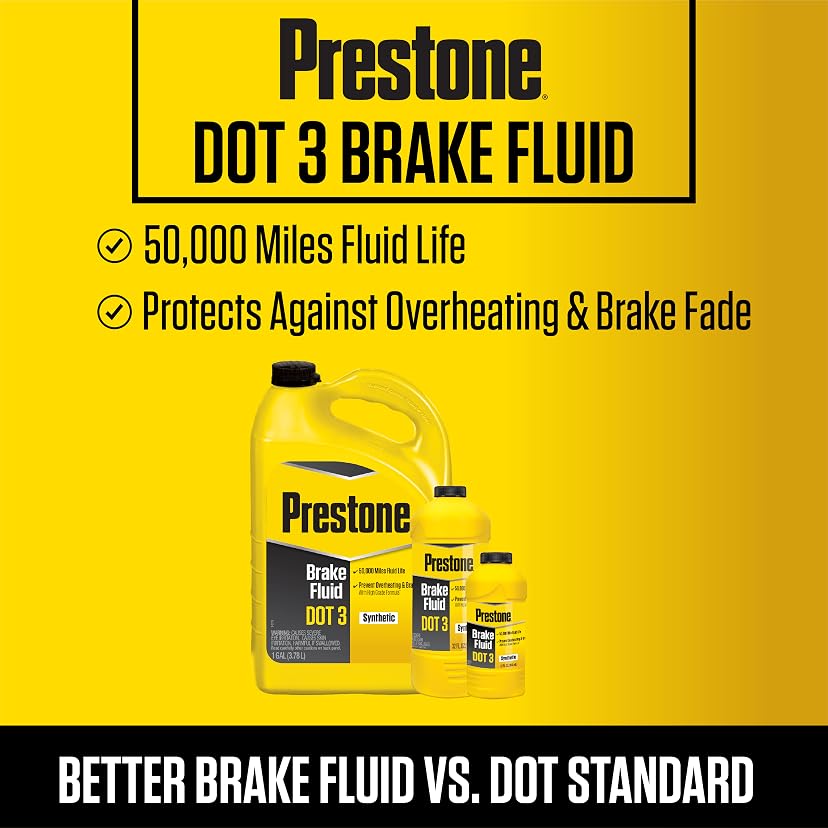
TL;DR A single-rated DOT 3 fluid that meets the FMVSS 116 dry floor (401°F) but publishes no wet boiling point · the 460°F the product spec figure has no TDS behind it. DANGER signal word from serious eye-damage chemistry, with a California Prop 65 reproductive-toxicity warning (H361) on the label.
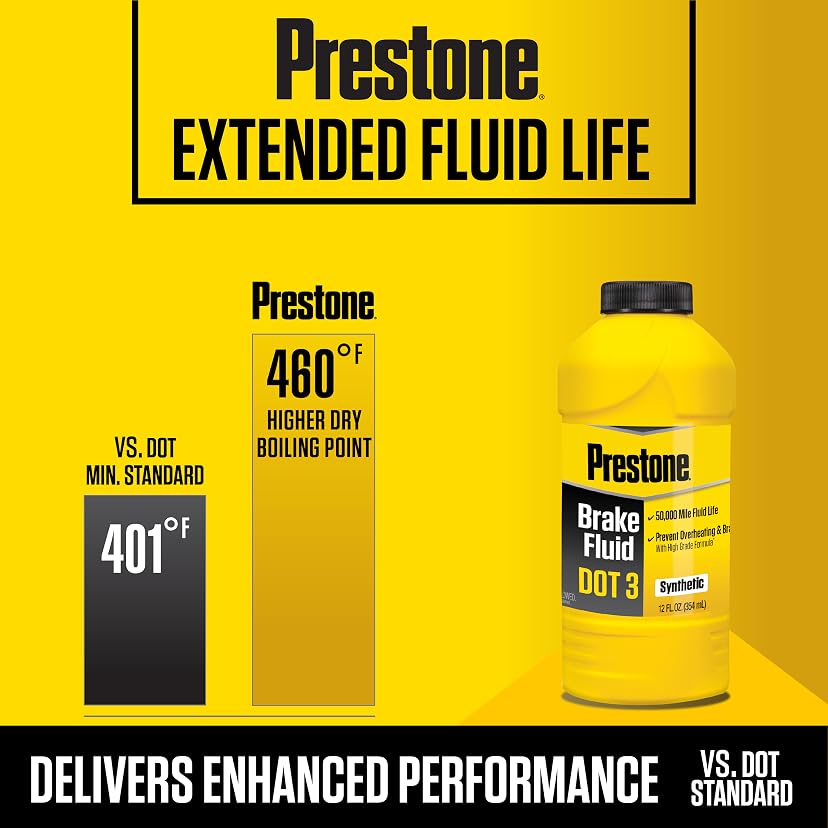
Prestone AS400 is a DOT 3 brake fluid under FMVSS 116, which sets the federal minimum at 401°F dry and 284°F wet. The SDS confirms boiling point above 401°F · the minimum itself, not a margin above it. The product spec field cites 460°F, but no TDS or third-party test backs that number. The wet boiling point · the figure that actually governs heat resistance after a year or two of moisture absorption · is not disclosed anywhere. For a DOT 3 daily driver the spec is met; there is no objective basis to claim better fade resistance than any other DOT 3 commodity.
Best for stock daily drivers where the owner's manual specifies DOT 3 and the goal is a routine fluid change at a common-brand price point. Skip it for any vehicle that specifies DOT 4 · DOT 3 boiling points are lower across the board. Skip it for track use, autocross, or towing in hilly terrain · those use cases warrant DOT 5.1 with documented dry boiling points well above 600°F.
DANGER signal word from H318 · the most severe eye-damage classification; a splash can cause permanent corneal injury. Wear splash-proof goggles during caliper bleeding; PVC gloves during a full flush. SDS §8 affirmatively states no respiratory protection is needed under normal use. H361 (suspected reproductive toxin) and H373 (kidney damage from prolonged exposure) drive the California Prop 65 warning in §15 · pregnant individuals should be especially careful with handling. The sweet taste of brake fluid is a documented attractant for pets and small children · store sealed and inaccessible, and never decant into an unlabeled container. Used fluid is drain-destined: collect for hazardous-waste disposal, never pour down a drain or storm sewer.
For the full SDS breakdown, see Is Brake Fluid Toxic?.
No. AS400 is rated DOT 3 only · not dual-rated DOT 3 and DOT 4. If your owner's manual specifies DOT 4, the DOT 4 fluid offers a higher minimum dry and wet boiling point (446°F dry / 311°F wet versus 401°F / 284°F for DOT 3). Using a DOT 3 in a DOT 4 system reduces heat resistance below what the OEM specified. Buy a DOT 4 fluid instead.
Yes. The product listing explicitly states the fluid is 'safe to use in all DOT 3 braking systems (ABS, disc, and drum).' All glycol-ether-based brake fluids (DOT 3, DOT 4, DOT 5.1) work with ABS and electronic stability control. The incompatible chemistry is DOT 5 silicone-based fluid, which this product is not.
The SDS Section 15 states this product contains chemicals known to the State of California to cause reproductive toxicity. The classification ties back to the H361 hazard code in Section 2 (suspected of damaging the unborn child). The product is legally sold in all 50 states; Prop 65 is a California-specific disclosure regime, not a ban. Pregnant individuals and anyone handling the fluid regularly should follow the gloves-and-goggles guidance in SDS Section 8.
Prestone does not publish a wet boiling point for this product. The SDS Section 9 reports only that the boiling point is greater than 401°F · that is the FMVSS 116 dry minimum for DOT 3 and is not a separate wet measurement. For DOT 3 the federal wet boiling point minimum is 284°F. Without a published wet figure or a third-party test sheet, the operationally relevant heat resistance after moisture absorption can't be confirmed for this product.
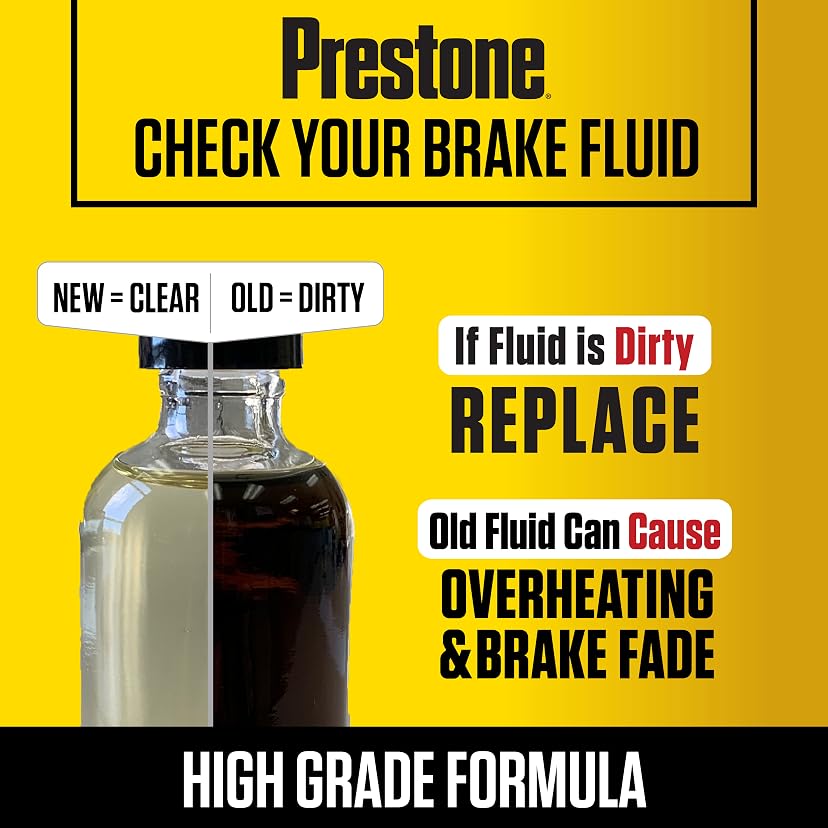
Most manufacturers recommend every 2-3 years or 30,000-45,000 miles regardless of how the fluid looks. Glycol-ether brake fluids absorb moisture from the air over time, which lowers the wet boiling point and reduces fade resistance. A brake fluid test strip from any auto parts store gives a more reliable answer than mileage alone.
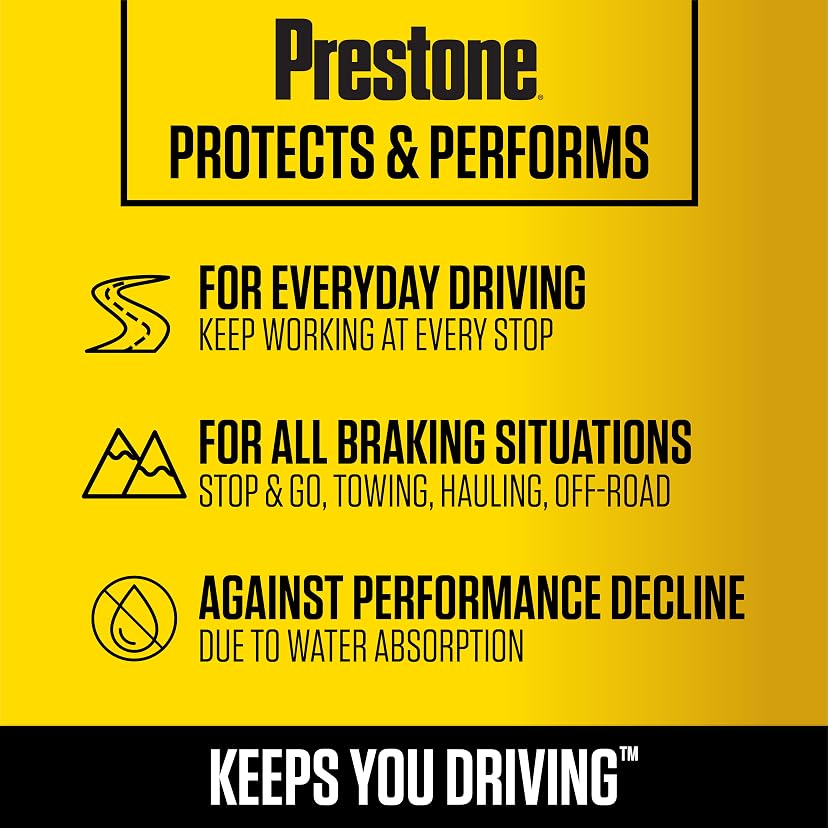
Marketing copy from Prestone, via Amazon. Not editorial.
Weekly pick
One product, one safety verdict, every week. No spam.

Castrol
React SRF Racing Brake Fluid
Motul
RBF 600 DOT 4 Factory Line Racing Brake Fluid
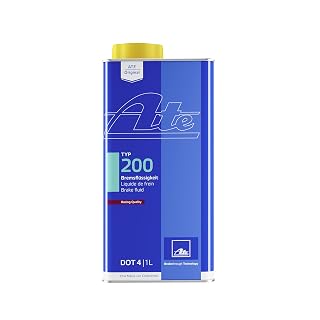
ATE
Original TYP 200 DOT 4 Racing Brake Fluid
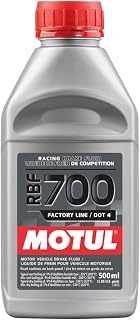
Motul
RBF 700 Factory Line Racing Brake Fluid
As an Amazon Associate I earn from qualifying purchases. Full disclosure

Community
0 postsShare how you use this product
Drop a quick comment or post a full review with photos and a star rating.
Sign in to postNew here? Create a free account.