CarCareTruth Score
Recommended, but it's tough on the environment.
Opens Amazon in a new tab. No account needed to look.
Saved to your guest loadout. Sign up to also save to your Cabinet (consumables) or Kit (tools you own).
As an Amazon Associate I earn from qualifying purchases. Full disclosure
Prices may varyHealth score is for adult use as intended, per the manufacturer's SDS. It does not model child ingestion, accidental spill cleanup, or off-label use. See the safety panel below for full hazard classification, and /disclaimer for the full editorial scope.
GHS hazard codes are quoted from the manufacturer’s Safety Data Sheet. PPE tiers below translate those codes and the listed ingredient chemistry; they are not CarCareTruth recommendations.
Show details for all categories ▾Hide details ▴
Only when: splash risk
Translated from the manufacturer’s Safety Data Sheet, Section 8
No eye-irritation H-code at mixture level. SDS §8 specifies safety glasses with side shields as general handling guidance, reflecting the splash risk inherent in caliper pressure-bleeding and overhead bleed work.
CarCareTruth publishes the cited sources verbatim and does not advise what action a user should take. Consult the full SDS before use.
Only when: prolonged use · sensitive individuals
Translated from the manufacturer’s Safety Data Sheet, Section 8
H317 (may cause an allergic skin reaction) is the one mixture-level hazard in the 2022 SDS. SDS §8 specifies impervious gloves for prolonged or repeated contact, with sensitization risk in previously exposed individuals.
U.S. regulatory standard
29 CFR 1910.138(a); 1910.132(d)
“appropriate hand protection when employees' hands are exposed to hazards such as those from skin absorption of harmful substances.”
OSHA standards apply to workplaces. Cited here as the U.S. reference threshold for the underlying hazard class.
CarCareTruth publishes the cited sources verbatim and does not advise what action a user should take. Consult the full SDS before use.
Only when: in enclosed space
Translated from the manufacturer’s Safety Data Sheet, Section 8
No inhalation H-codes at mixture level. SDS §8 invokes respiratory protection only where exposure limits are exceeded, which does not apply to open-garage brake service. Flash point 410°F makes vapor accumulation a non-issue at room temperature.
CarCareTruth publishes the cited sources verbatim and does not advise what action a user should take. Consult the full SDS before use.
No PPE specified in published sources for ventilation. Absence does not imply “not needed” — consult the full Safety Data Sheet.
PPE tiers translate the manufacturer’s SDS and U.S. regulatory standards. Not professional safety advice. How we report safety.
Scope of these PPE tiers. The tiers on this page translate the product's Safety Data Sheet where one is published, plus its ingredient chemistry, into a comparable rating. They describe a formulation, not a situation: a tier is not a safety determination for any specific user, task, quantity, or environment. The manufacturer's label and use instructions govern how the product is handled. Where the product is used at work, the employer's PPE program and hazard assessment under 29 CFR 1910.132 decide what protection is selected, not this page.
No warranties. CarCareTruth makes no warranties, express or implied, and expressly disclaims the implied warranties of merchantability and fitness for a particular purpose.
This product ranks #1 of 13 in Brake Fluid.
Last reviewed June 7, 2026
TL;DR DOT 3 / DOT 4 racing fluid with Castrol-published boiling points of 608°F dry and 518°F wet, well above the FMVSS 116 floor and clearing the DOT 5.1 wet minimum by 162°F. The 2022 US SDS is WARNING-level with one hazard (H317 skin sensitizer); a Prop 65 warning applies.
Castrol React SRF carries a DOT 3 + DOT 4 label. DOT 4 requires a minimum 446°F dry / 311°F wet boiling point under FMVSS 116; Castrol's product data sheet documents SRF at 608°F dry and 518°F wet, +162°F and +207°F above the floor. The wet figure also clears the DOT 5.1 wet minimum of 356°F by 162°F. Brake fluid absorbs moisture over time, lowering heat resistance; SRF's wet number gives substantial margin across long sessions and the 18-month interval Castrol sets for street use.
Best for HPDE, time-attack, and club racers who need a pedal that holds firm across long sessions, and for European-marque owners on a track-prepared car where commodity DOT 4 has shown fade. The price buys the 518°F wet figure. Skip for stock daily drivers under normal road use, where a quality DOT 4 at one-fifth the cost is sufficient. Skip if your vehicle specifies DOT 5 silicone.
The US Version 6.04 SDS classifies the fluid as WARNING with one mixture-level hazard: H317, may cause an allergic skin reaction. SDS §8 specifies impervious gloves for prolonged or repeated contact and safety glasses during caliper bleeding. A V7 reformulation issued in EU/AU markets shows the product as "Not classified, no signal word," but a US-format V7 has not shipped, so US bottles are rated against V6.04. Prop 65 warning applies; the back label discloses Diethanolamine, which California lists for cancer. The sweet taste of brake fluid is a documented ingestion attractant for pets and children, so store sealed and out of reach. Spent fluid is drain-destined and cannot go down household drains; take it to a collection site.
Two numbers: its Castrol-published dry boiling point of 608°F and wet boiling point of 518°F are both substantially above what FMVSS 116 requires for any DOT tier. The DOT 4 minimums are 446°F dry / 311°F wet, so SRF clears them by 162°F and 207°F. The wet figure even clears the DOT 5.1 wet minimum of 356°F by 162°F. SRF carries a DOT 3 + DOT 4 label, not DOT 5.1, because its cold viscosity at -40°C (1300 mm²/s) exceeds the DOT 5.1 limit. That's why it's marketed as a racing fluid rather than a DOT 5.1 commodity.
The wet boiling point is what you're buying. Most DOT 4 fluids sit near 311°F wet, the FMVSS 116 floor. SRF's 518°F wet figure stays well above the boil point of water even after the fluid has absorbed enough moisture to be classified as 'wet.' For HPDE, time-attack, and pro club racing, this is the difference between a pedal that holds firm session after session and one that goes soft halfway through. For a stock daily driver, a quality DOT 4 at one-fifth the price does the same job.
Yes. SRF is a synthetic silicate-ester fluid, glycol-compatible, not silicone. Castrol's PDS lists it as meeting FMVSS 116 DOT 3 and DOT 4, which by definition is the chemistry every ABS-equipped vehicle's master cylinder is designed for. (The product listing's 'Material: Silicone' specification is wrong. SRF is not DOT 5 silicone.) Castrol does not publish a separate ABS/ESC compatibility bulletin, but the DOT 4 label is the inherent statement of compatibility.
Castrol's PDS sets a maximum service interval of 18 months under street use, to preserve the wet boiling point margin that defines the product. Club racers commonly flush before every event or every two events, depending on session length and ambient temperature, because hard track use depresses the wet figure faster than a hygroscopic-only calendar would predict.
All three are top-tier racing fluids with high published boiling points. Castrol React SRF leads on published wet boiling point at 518°F. AP Racing PRF publishes 401°F wet, and Motul RBF 660 publishes around the upper-300s°F wet. Dry boiling points are closer across the three. The Castrol wet number is the historical reason SRF has been favored in long-format endurance racing where moisture absorption builds up over a race weekend. Verify current published figures from each manufacturer's TDS before committing, racing-fluid formulations get refreshed periodically.
The listing for Castrol React SRF Racing Brake Fluid carries a California Prop 65 warning. Castrol React SRF Racing Brake Fluid is a working automotive fluid rather than a passive part, so the warning points at the formulation itself. The manufacturer's Safety Data Sheet is the primary source for what is in it: the hazard classification and the PPE tiers on this page are translated from that sheet, and the full SDS is linked from the safety panel. California requires the warning whenever exposure to any of roughly 900 listed substances is possible. It does not name which substance applies to a given product, and it states no dose or risk level, so it is not on its own a measure of how hazardous this fluid is in normal use.
Marketing copy from Castrol, via Amazon. Not editorial.
Weekly pick
One product, one safety verdict, every week. No spam.
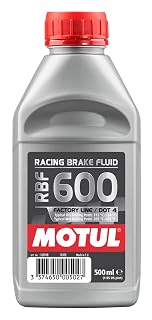
Motul
RBF 600 DOT 4 Factory Line Racing Brake Fluid
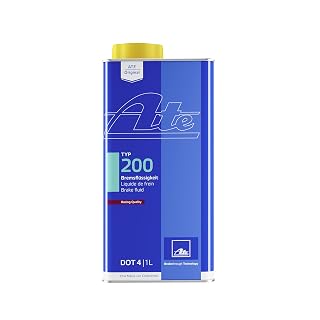
ATE
Original TYP 200 DOT 4 Racing Brake Fluid
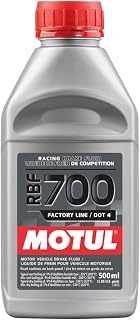
Motul
RBF 700 Factory Line Racing Brake Fluid
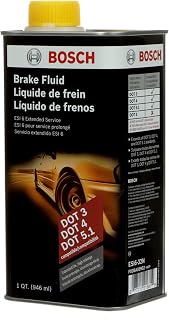
Bosch
ESI6 Extended Service Brake Fluid
As an Amazon Associate I earn from qualifying purchases. Full disclosure

Community
0 postsShare how you use this product
Drop a quick comment or post a full review with photos and a star rating.
Sign in to postNew here? Create a free account.