CarCareTruth Score
Decent, but it's tough on the environment.
Opens Amazon in a new tab. No account needed to look.
Saved to your guest loadout. Sign up to also save to your Cabinet (consumables) or Kit (tools you own).
As an Amazon Associate I earn from qualifying purchases. Full disclosure
Prices may varyHealth score is for adult use as intended, per the manufacturer's SDS. It does not model child ingestion, accidental spill cleanup, or off-label use. See the safety panel below for full hazard classification, and /disclaimer for the full editorial scope.
GHS hazard codes are quoted from the manufacturer’s Safety Data Sheet. PPE tiers below translate those codes and the listed ingredient chemistry; they are not CarCareTruth recommendations.
Show details for all categories ▾Hide details ▴
Only when: splash risk
Translated from the manufacturer’s Safety Data Sheet, Section 2
Cat 2B eye irritation (H320) at mixture level. SDS §8 calls for eye or face protection. The Cat 2B classification is one notch milder than H319 (Cat 2A) and does not force the required tier; splash risk is real during pressure bleeding and overhead caliper work.
U.S. regulatory standard
29 CFR 1910.133(a)(1)
“appropriate eye or face protection when exposed to eye or face hazards from… liquid chemicals…”
ANSI Z87.1 (incorporated via §1910.6)
OSHA standards apply to workplaces. Cited here as the U.S. reference threshold for the underlying hazard class.
CarCareTruth publishes the cited sources verbatim and does not advise what action a user should take. Consult the full SDS before use.
Only when: prolonged use
Translated from the manufacturer’s Safety Data Sheet, Section 8
No H315 or H317 at mixture level. SDS §8 calls for appropriate gloves; the situational tier covers extended bleeding sessions and full system flushes where prolonged contact is plausible.
CarCareTruth publishes the cited sources verbatim and does not advise what action a user should take. Consult the full SDS before use.
Only when: in enclosed space
Translated from the manufacturer’s Safety Data Sheet, Section 8
No H335, H331, H330, or H334 at mixture level. SDS §8 invokes a respirator only 'if a risk assessment indicates this is necessary', which is generic conditional language. Open-air garage service with the door open does not invoke respiratory protection.
CarCareTruth publishes the cited sources verbatim and does not advise what action a user should take. Consult the full SDS before use.
No PPE specified in published sources for ventilation. Absence does not imply “not needed” — consult the full Safety Data Sheet.
PPE tiers translate the manufacturer’s SDS and U.S. regulatory standards. Not professional safety advice. How we report safety.
California Prop 65 warning
This product's Amazon listing carries a California Prop 65 warning. The manufacturer's Safety Data Sheet (§15) does not list a Prop 65 substance for this product — we show the warning for transparency and flag the discrepancy rather than silently picking a side.
Scope of these PPE tiers. The tiers on this page translate the product's Safety Data Sheet where one is published, plus its ingredient chemistry, into a comparable rating. They describe a formulation, not a situation: a tier is not a safety determination for any specific user, task, quantity, or environment. The manufacturer's label and use instructions govern how the product is handled. Where the product is used at work, the employer's PPE program and hazard assessment under 29 CFR 1910.132 decide what protection is selected, not this page.
No warranties. CarCareTruth makes no warranties, express or implied, and expressly disclaims the implied warranties of merchantability and fitness for a particular purpose.
This product ranks #11 of 13 in Brake Fluid.Three above it ↓
Last reviewed May 25, 2026
TL;DR A single-rated DOT 3 fluid with an SDS-documented dry boiling point above 450°F, about 49°F above the FMVSS 116 floor of 401°F. No wet boiling point is published anywhere, so post-moisture heat resistance can't be verified.
Lucas Oil 10826 is a DOT 3 brake fluid under FMVSS 116, which sets the federal floor at 401°F dry and 284°F wet. The SDS Section 9 documents a dry boiling point greater than 450°F, roughly 49°F above the DOT 3 minimum (one degree shy of the rubric's threshold for a meaningful margin). That figure is an SDS-stated floor rather than a TDS-published specific value, so the actual peak could be higher. The wet boiling point, which governs heat resistance after a year or two of moisture absorption, is not disclosed by Lucas Oil at all. Note that the SDS in use is the 2014 Version 1 from KMK Regulatory; no revision has been issued in twelve years.
Best for stock daily drivers whose owner's manual specifies DOT 3 and where the case-of-12 fits a shop or fleet use case. Skip it for vehicles that specify DOT 4 or DOT 5.1, and skip for track use or hilly towing where DOT 5.1 with documented boiling points above 600°F is right.
WARNING signal word from H320 (Cat 2B eye irritation) only, the milder of the two GHS eye-irritation tiers, and the only hazard code at mixture level. SDS Section 8 calls for eye or face protection during operations where splash is plausible, such as pressure bleeding. SDS Section 15 explicitly states "No products were found" under California Prop 65, and a CAS cross-check of all four ingredients confirms no Prop 65 substances; the product listing-level Prop 65 flag is generic shipping disclosure, not chemistry. The sweet taste of glycol-ether brake fluid attracts pets and small children; store sealed and inaccessible, and never decant. Used fluid is drain-destined: collect for hazardous-waste disposal, never pour down a drain or storm sewer.
No. The 10826 is single-rated DOT 3 only and is not certified to DOT 4. DOT 4 requires a higher minimum dry boiling point (446°F) and a higher wet boiling point (311°F) than DOT 3 (401°F dry, 284°F wet). If your owner's manual specifies DOT 4, buy a DOT 4 fluid instead.
The SDS Section 9 reports a boiling point greater than 450°F (232.22°C), about 49°F above the FMVSS 116 DOT 3 dry minimum of 401°F. That is an SDS-stated floor rather than a specific TDS-published value; Lucas Oil does not publish a separate TDS with a precise dry BP figure.
No. Lucas Oil does not publish a wet boiling point for this product on the manufacturer page, in the SDS Section 9, or on the product listing. The FMVSS 116 DOT 3 wet minimum is 284°F; without a manufacturer figure or third-party test sheet, the operationally relevant heat resistance after moisture absorption cannot be verified.
Yes by chemistry class: all glycol-ether brake fluids (DOT 3, DOT 4, DOT 5.1) work with ABS and electronic stability control. Lucas Oil does not include an explicit ABS or ESC compatibility statement on the product page or the SDS. The fluid to avoid in ABS-equipped vehicles is DOT 5 silicone-based, which this product is not.
The SDS Section 15 explicitly states 'No products were found' under California Prop 65, and a CAS-level cross-check of all four ingredients against the Prop 65 list returned no hits. The product listing flag is generic California-shipping disclosure rather than a chemistry-grounded warning for this specific formula. Three of four evidence sources (SDS Section 15, ingredient cross-check, and bottle imagery) are clear; the Amazon flag is the outlier.
Most manufacturers recommend every 2-3 years or 30,000-45,000 miles regardless of how the fluid looks. Glycol-ether brake fluids absorb moisture from the air over time, lowering the wet boiling point and reducing fade resistance. A brake fluid test strip from any auto parts store gives a more reliable answer than mileage alone.
Weekly pick
One product, one safety verdict, every week. No spam.
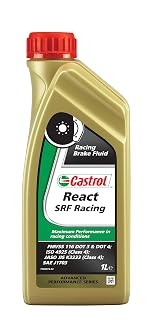
Castrol
React SRF Racing Brake Fluid
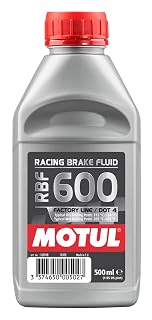
Motul
RBF 600 DOT 4 Factory Line Racing Brake Fluid
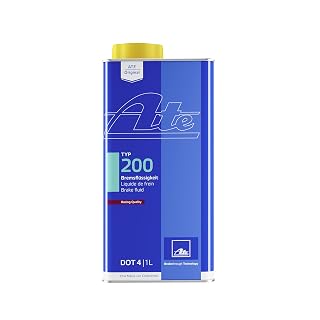
ATE
Original TYP 200 DOT 4 Racing Brake Fluid
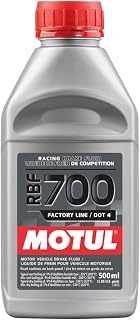
Motul
RBF 700 Factory Line Racing Brake Fluid
As an Amazon Associate I earn from qualifying purchases. Full disclosure

Community
0 postsShare how you use this product
Drop a quick comment or post a full review with photos and a star rating.
Sign in to postNew here? Create a free account.