CarCareTruth Score
Recommended.
Saved to your guest loadout. Sign up to also save to your Cabinet (consumables) or Kit (tools you own).
As an Amazon Associate I earn from qualifying purchases. Full disclosure
Health score is for adult use as intended, per the manufacturer's SDS. It does not model child ingestion, accidental spill cleanup, or off-label use. See the safety panel below for full hazard classification, and /disclaimer for the full editorial scope.
GHS hazard codes are quoted from the manufacturer’s Safety Data Sheet. PPE tiers below translate those codes and the listed ingredient chemistry; they are not CarCareTruth recommendations.
Show details for all categories ▾Hide details ▴
Only when: splash risk
Translated from the manufacturer’s Safety Data Sheet, Section 8
SDS §2 carries no eye-hazard GHS code and no signal word; the product is not classified as hazardous. SDS §8 still calls for safety eyewear (safety glasses with sideshields) as a general risk-assessment precaution against splashes when handling the product, not a specific eye-hazard finding. Surfaced here as a splash precaution during tube application, not because the chemistry demands eye protection.
CarCareTruth publishes the cited sources verbatim and does not advise what action a user should take. Consult the full SDS before use.
Only when: prolonged use
Translated from the manufacturer’s Safety Data Sheet, Section 8
SDS §2 classifies the product as not hazardous, with no H315/H314 skin code. §8 calls for chemical-resistant gloves 'if a risk assessment indicates this is necessary' when handling the product · generic SDS boilerplate, not a specific dermal-hazard finding. The petroleum mineral-oil base can cause mild irritation with prolonged or repeated skin contact, so gloves are a reasonable precaution for repeated hinge/track application, even though §11 reports no toxicological data for skin contact.
CarCareTruth publishes the cited sources verbatim and does not advise what action a user should take. Consult the full SDS before use.
Only when: in enclosed space
Translated from the manufacturer’s Safety Data Sheet, Section 8
SDS §8 names a respirator (air-purifying or supplied-air) as a control 'if a risk assessment indicates this is necessary' · standard SDS boilerplate, not a specific inhalation-hazard finding. §2 explicitly states that because the carcinogenic base-oil components are present in grease form, inhalation risk is minimal, and the product carries no signal word or inhalation H-code. §9 shows negligible vapor pressure (flash point over 200°C, boiling point over 300°C), consistent with essentially no airborne exposure during normal use. Surfaced here as a situational precaution for enclosed, poorly ventilated spaces, not because the chemistry requires respiratory protection for routine application.
CarCareTruth publishes the cited sources verbatim and does not advise what action a user should take. Consult the full SDS before use.
No PPE specified in published sources for ventilation. Absence does not imply “not needed” — consult the full Safety Data Sheet.
PPE tiers translate the manufacturer’s SDS and U.S. regulatory standards. Not professional safety advice. How we report safety.
Scope of these PPE tiers. The tiers on this page translate the product's Safety Data Sheet where one is published, plus its ingredient chemistry, into a comparable rating. They describe a formulation, not a situation: a tier is not a safety determination for any specific user, task, quantity, or environment. The manufacturer's label and use instructions govern how the product is handled. Where the product is used at work, the employer's PPE program and hazard assessment under 29 CFR 1910.132 decide what protection is selected, not this page.
No warranties. CarCareTruth makes no warranties, express or implied, and expressly disclaims the implied warranties of merchantability and fitness for a particular purpose.
Last reviewed June 14, 2026
TL;DR A reliable NLGI #2 tube grease that owners broadly trust · community confirms lasting lubrication on garage door tracks, door hinges, and hood latches. The narrow-tip squeeze tube reaches hinge pins directly without mess. The SDS has no hazard classifications; the Prop 65 warning on the label is the only chemistry flag.
Squeeze a small bead into the hinge pin or along the track channel · the thick paste stays where it lands without dripping. The NLGI #2 consistency handles load-bearing contact points: automotive chassis, spring-loaded garage door tracks, trunk hinges under repeated cycling. Broad, highly rated community performance leaves little ambiguity; the "stay-in-place formula" claim holds up in practice. Label confirms water resistance and heat resistance, though no low-temperature TDS rating is published. Not recommended by the manufacturer for wheel bearings.
Right choice for anyone lubricating garage door tracks, exterior door hinges, hood and trunk latches, or metal bushings and sliders. Skip it for rubber seals or most plastic contact surfaces · white lithium grease can degrade certain polymers. For electrical connectors, use dielectric grease instead. For rubber-contact applications like door weatherstripping, use a silicone spray.
No signal word, no hazard codes at the mixture level. Paste form keeps airborne exposure minimal, so skin contact during application is the primary real-world exposure scenario; the SDS still names a respirator as a boilerplate precaution for enclosed, poorly ventilated spaces. The label carries a California Prop 65 warning; the 2014 SDS does not corroborate it. Petroleum base is not biodegradable.
No. White lithium grease is for metal-on-metal contact only. It can degrade certain rubber seals and plastics over time. For rubber door seals or plastic tracks, use a silicone-based lubricant instead. For electrical connectors, dielectric grease is the right choice.
Yes · Lucas specifically lists garage door openers, springs, tracks, and hinges as recommended applications on the back label. The NLGI #2 consistency is thick enough to stay in place on a vertical track without running, and the narrow tip nozzle can reach into track channels directly.
The SDS is from 2014 · it predates many subsequent Prop 65 listings. The product listing and current product label carry the Prop 65 warning, likely because the mineral oil base (hydrotreated heavy paraffinic distillates) has since been listed. SDS Section 2 notes the formulation contains carcinogenic ingredients that are present in grease form with minimal inhalation exposure. The 2014 SDS Section 15 does not reflect the current label state.
Marketing copy from Lucas Oil, via Amazon. Not editorial.
Weekly pick
One product, one safety verdict, every week. No spam.
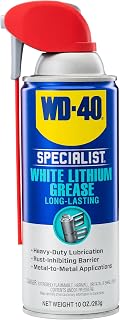
WD-40
Specialist White Lithium Grease Spray, 10 OZ
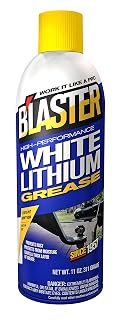
B'laster
16-LG High-Performance White Lithium Grease
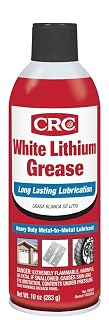
CRC
5037 White Lithium Grease (10 oz aerosol)
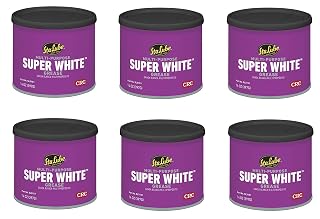
Sta-Lube
Super White Multi-Purpose Lithium Grease
As an Amazon Associate I earn from qualifying purchases. Full disclosure

Community
0 postsShare how you use this product
Drop a quick comment or post a full review with photos and a star rating.
Sign in to postNew here? Create a free account.