CarCareTruth Score
Decent.
Saved to your guest loadout. Sign up to also save to your Cabinet (consumables) or Kit (tools you own).
As an Amazon Associate I earn from qualifying purchases. Full disclosure
The manufacturer's Safety Data Sheet classifies this product with one or more GHS Category 1 health hazards — the most severe tier. The hazard statements in quotes below are the verbatim GHS language from the SDS, as required by OSHA's Hazard Communication Standard. The line under each statement translates the GHS classification into plain language.
GHS Category 1 aspiration toxicity — thin, oily liquids can slip into the lungs if swallowed, causing chemical pneumonia.
If swallowed:
The aspiration hazard (H304) is about the liquid being swallowed and reaching the airway, not about breathing fumes during normal use.
Call Poison Control immediately at 1-800-222-1222 (US, 24/7, free) and have the product container with you. Poison Control's standing guidance is to not induce vomiting after chemical exposure; they will direct first-aid steps based on the specific product.
About this product's hazards. This product's Safety Data Sheet uses signal word DANGER.Read the manufacturer's SDS and follow all safety instructions before use. CarCareTruth ratings translate the manufacturer's safety sheet. They do not replace the SDS or substitute for a hazard assessment specific to your task.
Health score is for adult use as intended, per the manufacturer's SDS. It does not model child ingestion, accidental spill cleanup, or off-label use. See the safety panel below for full hazard classification, and /disclaimer for the full editorial scope.
GHS hazard codes are quoted from the manufacturer’s Safety Data Sheet. PPE tiers below translate those codes and the listed ingredient chemistry; they are not CarCareTruth recommendations.
Show details for all categories ▾Hide details ▴
Only when: when spraying · misting overhead
Beyond SDS: translated from the ingredient chemistry
No H318 or H319 in SDS §2 mixture-level GHS classification. SDS §8 calls for protective eyewear using an imperative not backed by a mixture-level eye-hazard H-code -- editorial_override to situational. Aerosol mist during spray or overhead application is the specific trigger.
CarCareTruth publishes the cited sources verbatim and does not advise what action a user should take. Consult the full SDS before use.
Only when: prolonged use
Beyond SDS: translated from the ingredient chemistry
No H314, H315, or H317 in SDS §2 mixture-level classification. SDS §8 calls for nitrile or butyl gloves 'if prolonged skin contact is likely' -- conditional language matching a situational tier. Brief application contact is low-risk; prolonged exposure allows the petroleum carrier to defat skin.
CarCareTruth publishes the cited sources verbatim and does not advise what action a user should take. Consult the full SDS before use.
Only when: in enclosed space
Beyond SDS: translated from the ingredient chemistry
No H335, H334, H331, or H330 in SDS §2. SDS §8 states 'Normally no personal respiratory protection is necessary' -- an explicit de-escalation. Aerosol form factor requires minimum situational; the enclosed-space trigger applies given propane/butane propellant and petroleum-distillate mist in a closed garage.
U.S. regulatory standard
29 CFR 1910.1200(f); 1910.132(d)
“The employer shall assess the workplace to determine if hazards are present, or are likely to be present, which necessitate the use of personal protective equipment.”
OSHA standards apply to workplaces. Cited here as the U.S. reference threshold for the underlying hazard class.
CarCareTruth publishes the cited sources verbatim and does not advise what action a user should take. Consult the full SDS before use.
No PPE specified in published sources for ventilation. Absence does not imply “not needed” — consult the full Safety Data Sheet.
PPE tiers translate the manufacturer’s SDS and U.S. regulatory standards. Not professional safety advice. How we report safety.
California Prop 65 warning
This product's Amazon listing carries a California Prop 65 warning. The manufacturer's Safety Data Sheet (§15) does not list a Prop 65 substance for this product — we show the warning for transparency and flag the discrepancy rather than silently picking a side.
Scope of these PPE tiers. The tiers on this page translate the product's Safety Data Sheet where one is published, plus its ingredient chemistry, into a comparable rating. They describe a formulation, not a situation: a tier is not a safety determination for any specific user, task, quantity, or environment. The manufacturer's label and use instructions govern how the product is handled. Where the product is used at work, the employer's PPE program and hazard assessment under 29 CFR 1910.132 decide what protection is selected, not this page.
No warranties. CarCareTruth makes no warranties, express or implied, and expressly disclaims the implied warranties of merchantability and fitness for a particular purpose.
Last reviewed June 5, 2026
TL;DR Standard aerosol white lithium grease for door hinges, garage tracks, and latches; well-reviewed by owners for eliminating squeaks. The DANGER label comes from an aspiration hazard if the product is swallowed (do not induce vomiting), plus a flammable propellant, not from a contact hazard. No California Prop 65 per SDS Section 15.
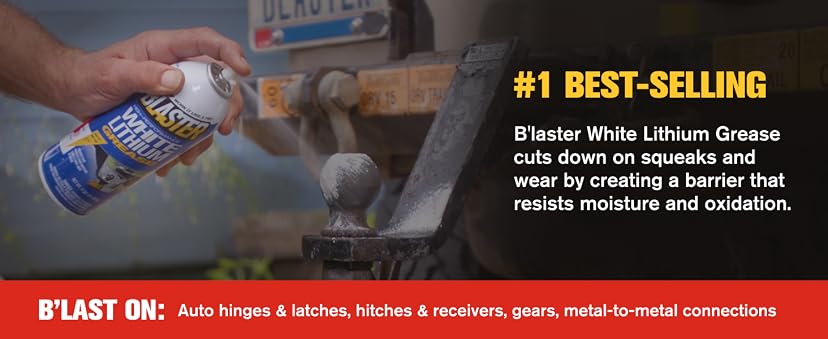
B'laster 16-LG deposits a thick white grease film on metal contact points. Press the aerosol straw into a hinge joint, track channel, or latch cam and apply a short burst -- the carrier flashes off and the grease stays put. Zinc oxide below 1% adds corrosion protection. No NLGI grade or numeric temperature rating is published; the label claims extreme temperature suitability without a spec. Owners broadly confirm consistent performance on hinges, tracks, and latches with no documented pattern of rapid re-squeak.
Right for garage door tracks, exterior door hinges, hood and trunk latches, and any metal slider under repeated load. Skip it for rubber seals and most plastics -- the petroleum carrier can degrade rubber over time. Use silicone spray for rubber and plastic contact surfaces; use dielectric grease for electrical connectors.
The DANGER signal word covers two separate hazards: aspiration toxicity if the product is swallowed (petroleum-distillate carrier; do not induce vomiting), and the flammable LPG propellant (keep away from ignition sources). SDS Section 8 states "Normally no personal respiratory protection is necessary." Eye and skin PPE are situational -- aerosol mist and prolonged handling are the triggers. No Prop 65 substances per SDS Section 15. The aerosol propellant contributes meaningful VOC; the stay-on-car application pathway limits environmental exposure, placing the environmental score in the Average band.
Yes -- garage door tracks are one of the labeled use cases. The aerosol straw allows targeted application to the roller contact points without flooding the track. Apply a short burst along the metal track and wipe off excess.
The DANGER signal word covers two separate hazards. H304 (aspiration) means the petroleum-distillate carrier can cause lung damage if swallowed and aspirated -- do not induce vomiting if ingested. The flammable LPG propellant codes (H221, H227) mean the can is pressurized and flammable -- keep away from open flames, heat sources, and sparks. SDS Section 8 explicitly states 'Normally no personal respiratory protection is necessary.' The DANGER label reflects swallowing and fire risks, not a contact hazard during normal use.
No. SDS Section 15 explicitly lists 'None' under California Proposition 65. This product does not carry a Prop 65 cancer or reproductive harm warning per the manufacturer's GHS filing. Some product listings may show a generic Prop 65 flag from the retailer's automated system, but SDS Section 15 is the authoritative source.
No -- white lithium grease is for metal-on-metal contact: hinges, tracks, latches, and gears. The petroleum carrier can degrade rubber seals over time with prolonged contact. Use silicone spray for rubber or plastic contact surfaces; use dielectric grease for electrical connectors.
Both are aerosol white lithium greases with petroleum-distillate carriers and DANGER signal words driven by the aspiration hazard, and neither carries a Prop 65 warning. B'laster 16-LG uses LPG propellant (propane/butane) and includes zinc oxide as a corrosion inhibitor. WD-40 Specialist White Lithium uses a calcium sulfonate additive and publishes a VOC of approximately 217 g/L. Both are comparable performers for garage door tracks and door hinges.
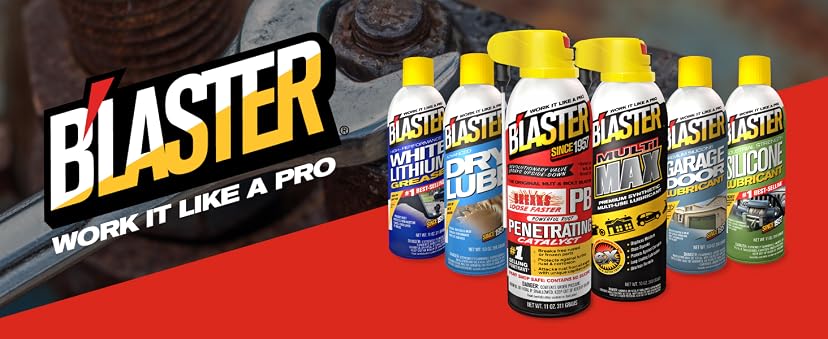
Marketing copy from B'laster, via Amazon. Not editorial.
Weekly pick
One product, one safety verdict, every week. No spam.
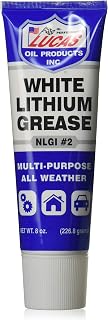
Lucas Oil
White Lithium Grease 8 oz. Squeeze Tube
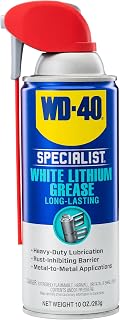
WD-40
Specialist White Lithium Grease Spray, 10 OZ
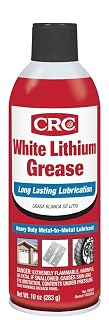
CRC
5037 White Lithium Grease (10 oz aerosol)
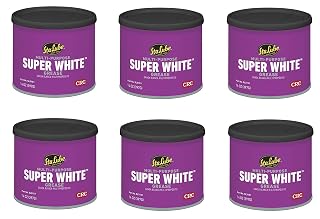
Sta-Lube
Super White Multi-Purpose Lithium Grease
As an Amazon Associate I earn from qualifying purchases. Full disclosure

Community
0 postsShare how you use this product
Drop a quick comment or post a full review with photos and a star rating.
Sign in to postNew here? Create a free account.