
The 2nd Generation Toyota Tacoma Clubhouse
2nd-Gen Toyota Tacoma (2005-2015) Owner's Hub
The 2nd-gen Tacoma (2005-2015) is the last mid-size Toyota built before the truck got soft. Body-on-frame, hydraulic steering, optional touchscreen only on 2013+ Entune trims. The 4.0L 1GR-FE V6 routinely runs 250k-350k miles on the original long block. The 2.7L 4-cylinder is fine in 2005-2010 5W-30 trim; the 2011-2015 0W-20 version burns oil past 100k on a chunk of trucks. Frame rust on early Northeast trucks is the buy-or-skip line.
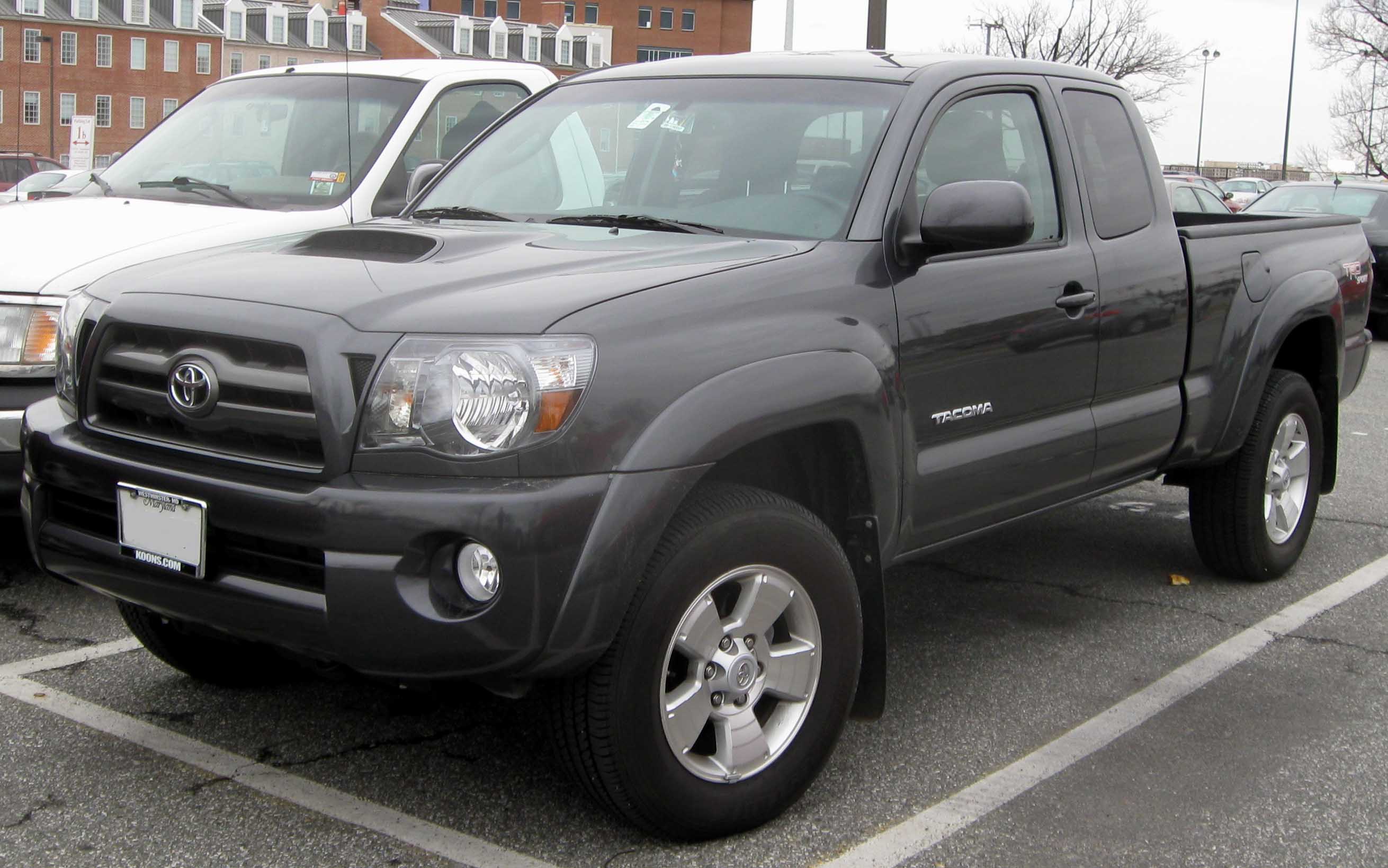
- Production
- 2005-2015
- Engines
- 2.7L · 4L
- V6 typical life
- 250k+mi
What your Tacoma takes
The parts and fluids that fit this generation. Specs we publish are confirmed against two independent sources; the rest fill in as we verify them.
- Wiper blades22" driver · 21" passenger✓ VerifiedView
- Tire pressure29 psi✓ VerifiedView
- Power steering fluidATF Dexron II or III✓ VerifiedView
- Wheel fitment16x7 ET30✓ VerifiedView
- Thermostat1GR-FE: 180°F✓ VerifiedView
- Engine oil5W-30 (2005-2010), 0W-20 (2011-2015) (6.1 qt) · 5W-30 (5.5 qt)From owner's manualShop
- Spark plugs2TR-FE: SK20HR11 · 1GR-FE: K20HR-U11From owner's manualShop
- Headlight bulbs9003 (low + high)From owner's manualShop
- CoolantToyota Super Long Life Coolant (SLLC) · ~9.1 qtFrom owner's manualShop
- Transmission fluid2TR-FE: Toyota ATF Type T-IV · 1GR-FE: Toyota WSFrom owner's manualShop
- Key fob batteryCR2032From owner's manualShop
- Differential fluidRear: 75W-85 GL-5 (Toyota Genuine Differential Gear Oil LT) (~3.66 qt) · Front: 75W-85 GL-5 (Toyota Genuine Differential Gear Oil LT) (~1.59 qt)From owner's manualShop
- Engine air filterParts in catalogShop
- BatteryParts in catalogShop
- Brake rotorsParts in catalogShop
- Tire sizeNot catalogued yetFind yours soon
- Oil filterNot catalogued yetFind yours
- Cabin air filterNot catalogued yetFind yours
- Brake fluidNot catalogued yetFind yours soon
- Serpentine beltNot catalogued yetFind yours soon
- Brake padsNot catalogued yetFind yours soon
- A/C refrigerantNot catalogued yetFind yours soon
- Fuel filterNot catalogued yetFind yours soon
Floor mats
Our top custom-fit pick for the Toyota Tacoma is the WeatherTech Custom Fit FloorLiners 1st & 2nd rows.
Floor mats for the Toyota Tacoma →Heritage · 2nd Generation Tacoma
2005-2015- 1995
Tacoma is born
The Tacoma nameplate launches, replacing the long-running Toyota Pickup (the Hilux name had been retired in the US since 1976).
- 2005
2nd gen launches
New body-on-frame platform, two engines, three cab configs, the bones owners still love.
- 2011
2.7L drops to 0W-20
CAFE 2012-2016 forces the viscosity change. The oil-consumption clock starts here.
- 2015
Final 2nd-gen year
TRD Pro debuts. X-Runner was discontinued after 2013 in mainland US. Last 2nd-gen model year before the 3rd-gen reveal.
- 2016
Frame settlement extension
Toyota extends the rust warranty to 12 years on 2005-2010 trucks. That window has now closed.
Last verified: May 2026.
The 2nd-gen Toyota Tacoma (2005-2015) is the last mid-size pickup Toyota built before the truck got soft. It is the body-on-frame, hydraulic-steering, hose-it-out version of the Tacoma (touchscreens didn't arrive until the 2013 Entune refresh), and it is the reason the resale market on these is bonkers. What owners argue about: which engine to buy, whether the frame-rust campaign is really over, and whether the 2011 viscosity change ruined the 2.7L.
Should you buy one in 2026
A clean 2nd-gen Tacoma in 2026 still trades for $18,000 to $28,000 used, which is insane for a 12-year-old truck. The reason it holds value: nothing on it is throwaway. Parts at the Toyota counter, fixable in the driveway, no $4,000 infotainment module to brick at 200k.
- Good for: daily driving with weekend truck duty, jobsite use, towing a 5,000 lb boat or a single-axle utility trailer, anyone who plans to keep one truck for 15 years and wrench on it in the driveway.
- Bad for: people who want lane-keep, Apple CarPlay, a quiet cabin on the highway, or fuel economy better than 19 mpg combined.
- Skip if: the frame has scaled rust through the boxed sections, the title shows a Northeast salt-belt history with no Toyota frame-replacement record, or the seller cannot produce oil-change receipts on a 2.7L.
The two engines, honestly
Two engines covered the entire 2nd-gen run: the 2.7L 2TR-FE inline-4 and the 4.0L 1GR-FE V6. They are not the same conversation.
The 4.0L 1GR-FE is the engine. Iron-block, aluminum heads, port-injected, timing chain, 236 hp, 266 lb-ft (2005 was rated 245 hp under the older SAE standard; rerated to 236 hp for 2006+). It pulls hard from 2,000 rpm, runs forever, and is the reason a 200k-mile 2nd-gen V6 still trades for $18,000. A typical 1GR-FE runs 250,000 to 350,000 miles on the original long block before anything serious lets go, and that is the normal story on these, not the exceptional one. It runs 5W-30 across all 11 model years. Past 100k it weeps at the valve covers and the cam-tower seams, but that is a leak, not consumption. Different problem.
The 2.7L 2TR-FE is fine, not great. 159 hp, 180 lb-ft, plenty for a city truck or a contractor who never tows. The 2005-2010 trucks specced 5W-30 and aged well. The 2011-and-later trucks dropped to 0W-20 for CAFE compliance, and a chunk of those engines started burning oil past 100k miles. The mechanism is low-tension piston rings plus carbon in the ring lands plus a thin oil film that cannot seal against worn rings. Pull the plugs on cylinders 2 and 3 first when you're inspecting one; those are the cylinders that oil-foul first on a tired 2TR-FE, and a wet-black plug from cylinder 2 tells you everything before you spend a dollar on a leakdown test. The deep version of that story lives in the oil consumption guide. Read it before you buy a 2011+ 4-cylinder.
If you can stretch $3,000 to $4,000 for the V6, stretch. A clean 1GR-FE will outlast two 2.7Ls and you will get most of that premium back at resale.
The maintenance calendar that actually works
This is what an experienced 2nd-gen owner runs, not the Toyota booklet. The dealer schedule is a profit center; the real-world cadence keeps these trucks alive past 250,000 miles.
- Every 5,000 miles: oil and filter, and rotate tires at the same visit. Full synthetic 5W-30 on the V6 and 2005-2010 2.7L; 0W-20 on the 2011+ 2.7L. High-mileage formulations past 100,000 miles. Cheaper than a quart of pride.
- Every 30,000 miles: inspect front brake pads, check differential and transfer-case fluids. Toyota calls these "lifetime"; they are not.
- Every 60,000 miles: replace the PCV valve ($15 part, single highest-leverage item on the V6), cabin air filter, engine air filter. V6 spark plugs at the same interval (factory iridiums; can stretch to 100k if the budget demands).
- At 100,000 miles: valve-cover gasket inspect on the V6, secondary air pump bracket inspect, brake fluid flush, first coolant change (Toyota Super Long Life, pink, no substitute).
- Every 50,000 miles after the first coolant change: coolant drain-and-fill. Toyota SLLC is 100k first, then 50k for life.
- At 120,000 miles: front lower ball joints if originals.
- At 150,000 miles: differentials front and rear, transfer case fluid.
- Every 30k after 150k: transmission fluid drain-and-fill on automatics (Toyota Type T-IV on the 2.7L's 4-speed, Toyota WS on the V6's 5-speed; no flush). Three drain-and-fills over 90k is better than one full flush.
Skip the dealer's "throttle body service" and "fuel system service." Both are $180 upsells that do less than a $7 can of Sea Foam in the intake. The 1GR-FE does not need either one before 200,000 miles.
Common problems, ranked by severity
1. Frame rust (2005-2010 salt-belt trucks)
catastrophicToyota ran two extended-warranty campaigns on 2nd-gen frames. Both inspection windows are now closed. A salt-belt truck without a documented frame replacement needs a flashlight-and-pick inspection of every box section and crossmember. Perforation behind the cab or at the leaf-spring hangers is a totaled truck.
Years affected: 2005-2010
2. 2.7L 2TR-FE oil consumption (2011-2015)
expensivePast 100,000 miles these can burn a quart every 1,500 miles and get worse. Caused by carbon in the piston-ring lands plus low-tension rings designed for the 0W-20 viscosity. Diagnose with a 1,200-mile measurement before medicating.
Years affected: 2011-2015 · Read the deep guide
3. Lower ball joints (high-mileage wear)
expensiveToyota recalled lower ball joints on 2001-mid-2004 Tacomas (1st gen, not this gen). 2nd-gen trucks were never part of the recall, but the lowers still wear out by 120,000 miles and can fail catastrophically if ignored. A failed lower ball joint drops the wheel off the truck. About $400 a side at a shop, half that DIY.
Years affected: 2005-2015
4. 4.0L V6 valve-cover and cam-tower weep
MinorPast 100,000 miles the rubber valve-cover gaskets harden and the FIPG bead at the cam towers cracks. Valve covers are a Saturday afternoon. Cam-tower reseal is labor-heavy because the cam carriers come off.
Years affected: 2005-2015
5. Secondary air injection pump (4.0L V6)
MinorThe pump and bracket under the airbox corrode. Failure throws a P2440 or P2442 code and a check-engine light. $400 used pump or $1,200 new from Toyota; the real fix is a bracket reseal.
Years affected: 2005-2015
Year-by-year notes
- 2005
- New platform launch. 2.7L and 4.0L debut. Note: the lower ball joint recall covered 1st-gen Tacomas (2001 through mid-2004), not the 2nd gen.
- 2006
- Carryover. Still 5W-30 on both engines.
- 2007
- Carryover. Mechanically identical to 2005-2006.
- 2008
- Carryover year. Minor option-package shuffling.
- 2009
- Minor facelift (grille refresh). Vehicle Stability Control (VSC) becomes standard across the lineup.
- 2010
- Last year of 5W-30 on the 2.7L. Last good 4-cylinder year for resale.
- 2011
- Facelift outside. 2.7L viscosity drops to 0W-20. Oil consumption clock starts here.
- 2012
- Carryover. Bluetooth standard. Backup camera optional.
- 2013
- Backup camera standard. New 6.1-inch touchscreen display audio standard, full Entune app suite optional on V6 Double Cab. Steering wheel and center stack redesigned.
- 2014
- Carryover. Last year before the 3rd-gen redesign was leaked.
- 2015
- Final 2nd-gen year. TRD Pro arrives. X-Runner gone. Best long-term V6 to buy if you can find one.
Trim decoder
Base / SR5 (2005-2015)
Vinyl floor on Base, carpet on SR5. Cloth seats. The hose-it-out trim.
PreRunner (2005-2015)
2WD with the 4x4 body, suspension geometry, and ride height. Same track width as the 4x4; wider than a base 2WD, but not wider than a 4x4. Looks like a 4x4, drives like a Camry on stilts.
TRD Sport (2005-2015)
Hood scoop, 17-inch wheels, sport-tuned shocks. No oil cooler, no locker.
TRD Off-Road (2005-2015)
Bilstein shocks, A-TRAC, rear electronic locker, factory V6 oil cooler. The locker and the oil cooler are the reason to buy this trim.
X-Runner (2005-2013)
Lowered, 18-inch wheels, X-brace, 6-speed manual, V6 only, RWD. Street truck. Rare. Discontinued after 2013 in mainland US.
Frame-rust VIN check
Separate from the NHTSA recalls above: this is the frame-rust class-action settlement. Paste your VIN to check eligibility — nothing is sent to a server, all logic runs in your browser.
Check your VIN against the frame settlement
We decode the 10th character of your VIN in your browser to figure out the model year. Nothing leaves this page — your VIN is not stored, logged, or transmitted.
Should you buy this one?
A four-question triage for a specific truck you're considering. Verdict cites the actual weaknesses of this gen.
Should you buy this one?
You're looking at a listing. Tell us four things about the truck and we'll tell you whether it's worth the drive — cited against the known weaknesses of this generation. Nothing leaves your browser.
Model year
Odometer
Climate history
Engine
What owners actually buy
Hand-picked from the CarCareTruth catalog, ordered to match the spec card above. Every score is health + chemistry + effectiveness, in one number.
Engine oil (5W-30: V6 all years, 2.7L through 2010)
Wiper blades (22" driver / 21" passenger)
Verified fit: 22″ driver · 21″ passenger · no rear wiper
Confirmed across 3 independent fitment sources. See blades that fit & add the right sizes to your cart →
Brake fluid (DOT 3)
Car wash soap (pH-neutral)
Paint protection (hybrid ceramic spray)
Spark plugs (Denso SK20HR11 / NGK ILFR6T11)
Headlight bulbs (9003 / H4)
Battery (Group 24F AGM)
Engine air filter (Toyota 17801-0P010 V6 / 17801-0C040 I4)
The 2nd generation Tacoma board
Where owners talk. Live group at /groups/2nd-gen-tacoma.
The Board
2nd Generation Tacoma Owners
1 members
- just now
PinnedBe the first to post in the 2nd Generation Tacoma group.
Open thread · 0 replies
The shortlist
One top pick per category, fitting your Tacoma
Skip the comparison. The Best Of page shows the single highest-scored CarCareTruth product in every category that fits the 2nd generation Tacoma.
See the Best Of →Read next
The 2nd generation Tacoma oil-consumption deep dive
Why 2011+ 2.7L engines burn 0W-20, why V6s leak 5W-30 past 100k, the diagnosis order Toyota dealers actually use, and the scored oils that fit.
Read the guide →Sources
- Toyota Owner's Manuals (2005-2015 Tacoma), accessed via the Toyota Owners portal · accessed 2026-05-25
- NHTSA Office of Defects Investigation complaint database · accessed 2026-05-25
- Toyota Tacoma frame rust recall (Wikipedia section with sources for the 2008 and 2016 settlements) · accessed 2026-05-25
- Toyota Tacoma on Wikipedia (production years, trims, model history) · accessed 2026-05-25