CarCareTruth Score
Decent.
Opens Amazon in a new tab. No account needed to look.
Saved to your guest loadout. Sign up to also save to your Cabinet (consumables) or Kit (tools you own).
As an Amazon Associate I earn from qualifying purchases. Full disclosure
Prices may varyThe manufacturer's Safety Data Sheet classifies this product with one or more GHS Category 1 health hazards — the most severe tier. The hazard statements in quotes below are the verbatim GHS language from the SDS, as required by OSHA's Hazard Communication Standard. The line under each statement translates the GHS classification into plain language.
GHS Category 1 aspiration toxicity — thin, oily liquids can slip into the lungs if swallowed, causing chemical pneumonia.
If swallowed:
The aspiration hazard (H304) is about the liquid being swallowed and reaching the airway, not about breathing fumes during normal use.
Call Poison Control immediately at 1-800-222-1222 (US, 24/7, free) and have the product container with you. Poison Control's standing guidance is to not induce vomiting after chemical exposure; they will direct first-aid steps based on the specific product.
About this product's hazards. This product's Safety Data Sheet uses signal word DANGER.Read the manufacturer's SDS and follow all safety instructions before use. CarCareTruth ratings translate the manufacturer's safety sheet. They do not replace the SDS or substitute for a hazard assessment specific to your task.
Health score is for adult use as intended, per the manufacturer's SDS. It does not model child ingestion, accidental spill cleanup, or off-label use. See the safety panel below for full hazard classification, and /disclaimer for the full editorial scope.
GHS hazard codes are quoted from the manufacturer’s Safety Data Sheet. PPE tiers below translate those codes and the listed ingredient chemistry; they are not CarCareTruth recommendations.
Show details for all categories ▾Hide details ▴
Translated from the manufacturer’s Safety Data Sheet, Section 8
H319 serious eye irritation classification in SDS §2 means safety glasses or chemical goggles are appropriate during application; SDS §8 specifically calls for EN 166 eye protection.
U.S. regulatory standard
29 CFR 1910.133(a)(1)
“The employer shall ensure that each affected employee uses appropriate eye or face protection when exposed to eye or face hazards from… liquid chemicals…”
ANSI Z87.1 (incorporated via §1910.6)
OSHA standards apply to workplaces. Cited here as the U.S. reference threshold for the underlying hazard class.
CarCareTruth publishes the cited sources verbatim and does not advise what action a user should take. Consult the full SDS before use.
Translated from the manufacturer’s Safety Data Sheet, Section 8
H317 skin sensitizer and H315 skin irritation classifications in SDS §2, combined with the DANGER signal word from the H304 aspiration-hazard carrier, mean nitrile or similar chemical-resistant gloves are required per SDS §8 (nitrile, FKM, or PVC glove material specified with an 8-hour breakthrough time).
U.S. regulatory standard
29 CFR 1910.138(a)
“appropriate hand protection when employees' hands are exposed to hazards such as those from… chemicals which produce an adverse effect on the skin or eyes…”
OSHA standards apply to workplaces. Cited here as the U.S. reference threshold for the underlying hazard class.
CarCareTruth publishes the cited sources verbatim and does not advise what action a user should take. Consult the full SDS before use.
Only when: in enclosed space
Translated from the manufacturer’s Safety Data Sheet, Section 2
SDS §8 states respiratory protection is not required under correct use with adequate ventilation, but §7 calls for 'adequate ventilation' as a precaution. Applying in an enclosed garage bay without airflow is the trigger; open-air or open-garage application does not need a respirator.
U.S. regulatory standard
29 CFR 1910.1200(f); 1910.132(d)
“The employer shall assess the workplace to determine if hazards are present, or are likely to be present, which necessitate the use of personal protective equipment.”
OSHA standards apply to workplaces. Cited here as the U.S. reference threshold for the underlying hazard class.
CarCareTruth publishes the cited sources verbatim and does not advise what action a user should take. Consult the full SDS before use.
No PPE specified in published sources for ventilation. Absence does not imply “not needed” — consult the full Safety Data Sheet.
PPE tiers translate the manufacturer’s SDS and U.S. regulatory standards. Not professional safety advice. How we report safety.
Scope of these PPE tiers. The tiers on this page translate the product's Safety Data Sheet where one is published, plus its ingredient chemistry, into a comparable rating. They describe a formulation, not a situation: a tier is not a safety determination for any specific user, task, quantity, or environment. The manufacturer's label and use instructions govern how the product is handled. Where the product is used at work, the employer's PPE program and hazard assessment under 29 CFR 1910.132 decide what protection is selected, not this page.
No warranties. CarCareTruth makes no warranties, express or implied, and expressly disclaims the implied warranties of merchantability and fitness for a particular purpose.
This product ranks #8 of 17 in Tire Dressing.Three above it ↓
Last reviewed July 31, 2026
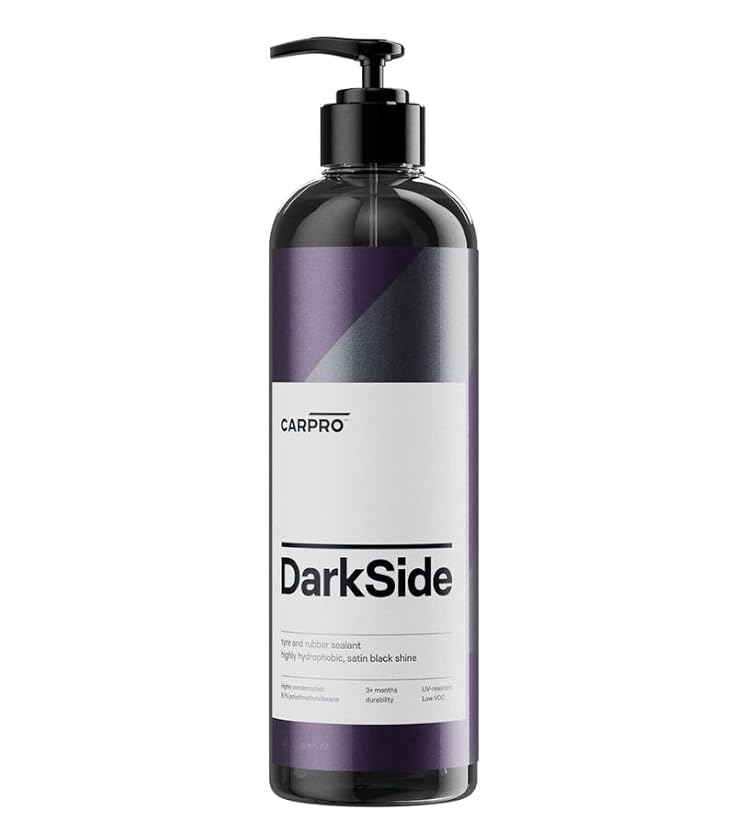
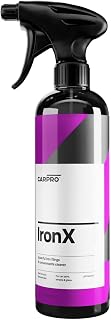
TL;DR CarPro DarkSide is a 60% polydimethylsiloxane tire sealant with a satin-black finish, community-confirmed at about 6 weeks on a regularly washed daily driver, short of the 3-month label claim. The petroleum-distillate carrier brings a DANGER signal word and an aspiration hazard (H304), so gloves are required per SDS §2.
DarkSide is a liquid sealant spread thin on a clean, dry tire sidewall with a foam or microfiber applicator, then cured 1-2 hours before driving. Forum owners describe application as close to foolproof, with no sling onto wheels when applied thin. The finish is satin black, not glossy, and the initial sheen fades within a week while the tire stays darker through the rest of the window. Against the label's 3+ month claim, three independent detailing forums land closer to 6 weeks on a regularly washed daily driver; garaged cars washed less often get closer to the full claim.
Buyers who want easy application and a satin darkening rather than a wet-look gloss are the strongest fit, especially daily drivers who reapply monthly anyway. Buyers chasing maximum gloss or the longest durability window should look at a wet-look gel or longer-lived coating instead.
The DANGER signal word comes from an aspiration hazard (H304) in the petroleum carrier: if swallowed, do not induce vomiting, and seek medical attention immediately. Skin sensitizer and irritation codes (H315, H317, H319) from a citral fragrance trace mean gloves and eye protection matter, with ventilation in enclosed bays. The 5.0/10 health score is set by the H304 aspiration-hazard ceiling, which floors the score at 5.0 regardless of the DANGER signal word and the H315/H317/H319 deductions stacked underneath it. Both key ingredients pass OECD ready-biodegradability thresholds per SDS testing, though the petroleum carrier still carries an aquatic-toxicity flag, so wipe up excess rather than rinsing toward a storm drain.
The bottle claims 3+ months, but independent detailing-forum testing (AutoGeek Online, CarPro Forum, DetailingWorld) consistently reports around 6 weeks on a daily driver washed regularly; the label claim is closer to reality on a garaged car that gets washed less often.
Satin, not glossy. The listing itself calls it a 'satin black shine,' and community owners confirm the initial sheen fades within about a week while the darkened tire color holds through the rest of the durability window. Buyers wanting a wet-look gloss should look elsewhere.
No. The SDS lists a DANGER signal word driven by an aspiration hazard (H304) in the petroleum-distillate carrier, plus a skin sensitizer classification (H317) from the citral fragrance. Nitrile or similar chemical-resistant gloves are called for per SDS Section 8.
Independent forum reviews do not report sling as a common issue when the product is applied thinly and given time to dry (roughly 1-2 hours per the directions) before the car is driven.
CarPro publishes a Safety Data Sheet listing the two hazard-relevant ingredients with CAS numbers and concentration ranges: a hydrotreated petroleum distillate carrier (35-40%) and citral fragrance (0.2-0.3%). Only a European Union format SDS was found; no separate US document was located.
Marketing copy from CarPro, via Amazon. Not editorial.
Weekly pick
One product, one safety verdict, every week. No spam.

Chemical Guys
VRP Vinyl, Rubber, and Plastic Dressing
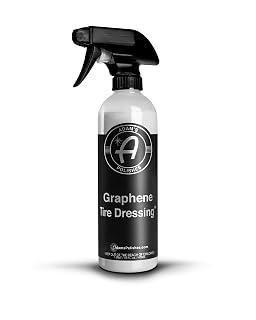
Adam's Polishes
Graphene Tire Dressing
Chemical Guys
Silk Shine Tire and Trim Dressing
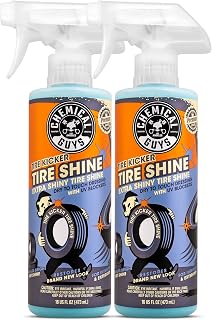
Chemical Guys
Tire Kicker Sprayable Extra Glossy Tire Shine
As an Amazon Associate I earn from qualifying purchases. Full disclosure

Community
0 postsShare how you use this product
Drop a quick comment or post a full review with photos and a star rating.
Sign in to postNew here? Create a free account.