
The 12th Generation Ford F-150 Clubhouse
Ford F-150 (12th Gen, 2009-2014) Owner's Hub
The last all-steel-body F-150 and the first to offer the 3.5L EcoBoost twin-turbo V6 (2011+). The 2011 model year was a clean-sheet powertrain swap: out went the 4.6L and 5.4L 3V Tritons, in came the 3.7L V6, 5.0L Coyote V8, 3.5L EcoBoost, and 6.2L Boss. The 5.4L 3V Triton cam phasers and timing chain are the generation-defining headache on early trucks; the EcoBoost intercooler condensation stumble and a 2013-2014 brake-master-cylinder recall define the later ones.
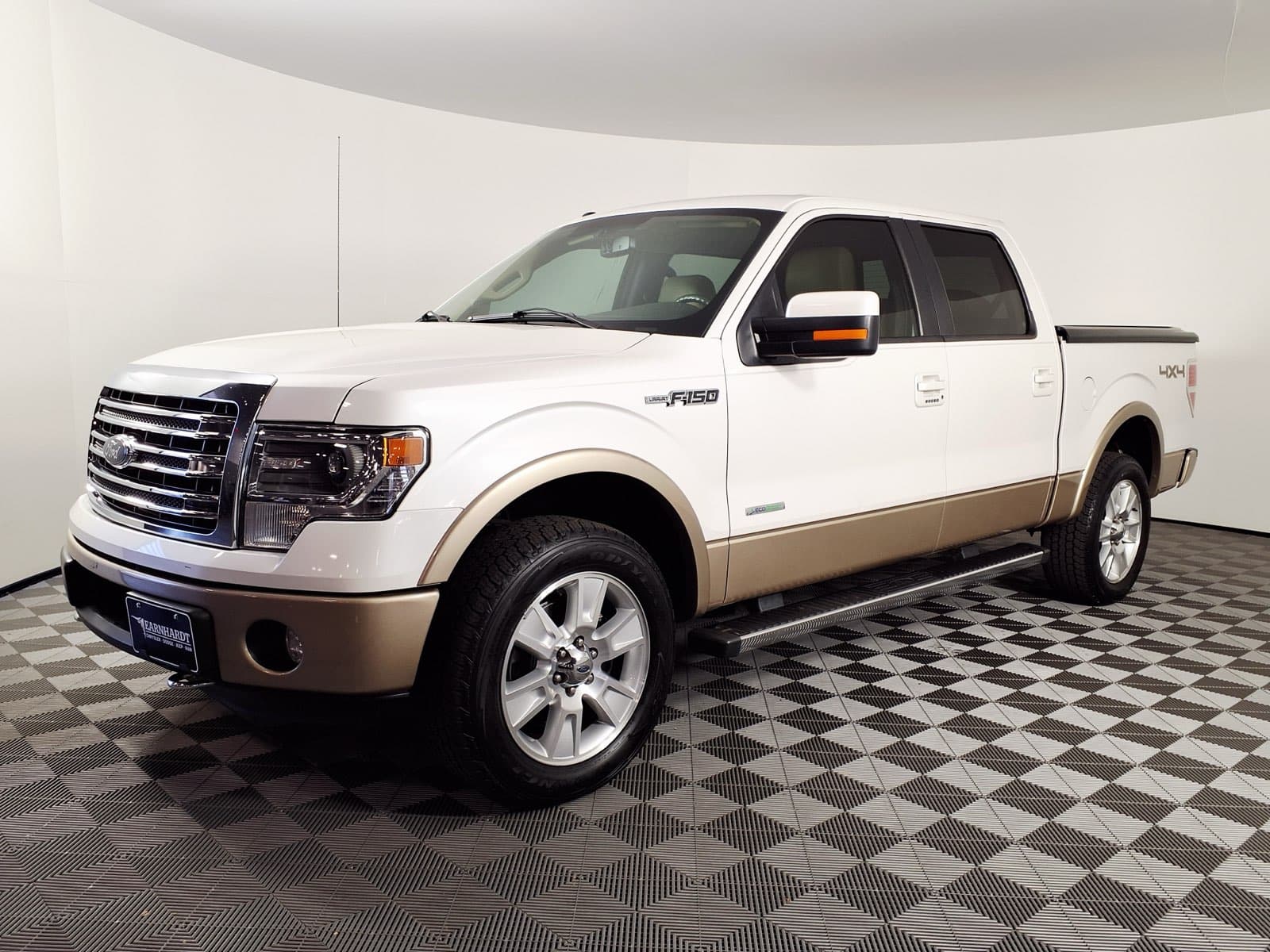
- Production
- 2009-2014
- Engines
- 3.7L · 4.6L · 4.6L · 5L · 5.4L · 6.2L · 3.5L
- Max tow rating
- 11,300lb
What your F-150 takes
The parts and fluids that fit this generation. Specs we publish are confirmed against two independent sources; the rest fill in as we verify them.
- BatteryGroup 65 · 750 CCA min✓ VerifiedView
- Tire pressure35 psi✓ VerifiedView
- Wheel fitment17x7.5 ET44✓ VerifiedView
- Wiper blades22" driver · 22" passengerFrom owner's manualShop
- Engine oil5W-20 (6 qt) · 5W-20 (7.7 qt) · 5W-20 (7 qt) · 5W-30 (6 qt)From owner's manualShop
- Headlight bulbsH13 (low + high)From owner's manualShop
- CoolantMotorcraft Specialty Orange (WSS-M97B44-D2)From owner's manualShop
- Brake fluidDOT 3 (Motorcraft PM-1-C; DOT 4 backward-compatible)From owner's manualShop
- Transmission fluidMercon LV (all engines; 6R80 6-speed and 4R75E 4-speed)From owner's manualShop
- Power steering fluidMercon VFrom owner's manualShop
- Differential fluidRear: 75W-140 (Motorcraft SAE 75W-140 Rear Synthetic Axle Lubricant, WSL-M2C192-A) (~2.75 qt) · Front: 80W-90 (Motorcraft SAE 80W-90 Premium Rear Axle Lubricant, WSP-M2C197-A) (~1.75 qt) · T-case: Motorcraft Transfer Case Fluid (XL-12) (~1.6 qt)From owner's manualShop
- Oil filterParts in catalogShop
- Engine air filterParts in catalogShop
- Spark plugsParts in catalogShop
- Brake rotorsParts in catalogShop
- Tire sizeNot catalogued yetFind yours soon
- Cabin air filterNot catalogued yetFind yours
- Key fob batteryNot catalogued yetFind yours soon
- Serpentine beltNot catalogued yetFind yours soon
- Brake padsNot catalogued yetFind yours soon
- ThermostatNot catalogued yetFind yours soon
- A/C refrigerantNot catalogued yetFind yours soon
- Fuel filterNot catalogued yetFind yours soon
Floor mats
Our top custom-fit pick for the Ford F-150 is the 3D MAXpider KAGU Custom Fit Floor Mats 1st & 2nd rows.
Floor mats for the Ford F-150 →Heritage · 12th Generation F-150
2009-2014- 1948
F-Series is born
The first F-Series launches as the Ford Bonus-Built line, the start of the longest-running truck nameplate in America.
- 2009
12th gen launches
New P415 platform, the last all-steel body, the 6R80 6-speed, and the Triton V8 lineup carried over from the prior truck.
- 2010
Raptor and the 6.2L
The SVT Raptor debuts, the first factory desert truck, with the 5.4L Triton V8 and Fox internal-bypass shocks. The 411-hp 6.2L Boss V8 becomes its engine for 2011.
- 2011
EcoBoost arrives
The 3.5L twin-turbo V6 joins the new 3.7L V6 and 5.0L Coyote V8, ending the Triton era and proving a turbo six could sell in a full-size truck.
- 2014
Final steel-body year
The last year before the all-aluminum 13th gen. A clean 12th-gen V8 truck is the last steel F-150 you can buy.
Last verified: June 2026.
The 12th-generation Ford F-150 (2009-2014, the P415 platform) is the last all-steel F-150 and the first one you could buy with a turbocharged six. It is the truck that proved a small twin-turbo V6 could outsell a V8 in America's best-selling vehicle, and it is the bridge between the old Triton-powered trucks and the aluminum era that followed. What owners argue about: which of the two engine families to buy, whether the 5.4L cam-phaser rattle is a dealbreaker, and whether the EcoBoost's maintenance bill cancels out its towing edge.
Should you buy one in 2026
A clean 12th-gen F-150 in 2026 trades between $9,000 and $32,000 used depending on engine, cab, and rust. The value is in the simplicity: body-on-frame, port or direct injection, a 6-speed automatic that predates the troublesome 10-speed, and parts on every shelf in the country.
- Good for: towing a 5,000 to 11,300 lb trailer, daily driving with weekend truck duty, anyone who wants to wrench in the driveway and keep a truck 15 years.
- Bad for: people who want a quiet, refined cabin, modern driver aids, or better than 18 mpg combined.
- Skip if: the frame shows scaled rust in the salt belt, a 2009-2010 5.4L rattles on cold start with no records, or a 2013-2014 EcoBoost still has its brake recall open.
The two engine eras, honestly
This generation is really two trucks. The 2009-2010 trucks ran the Triton V8 family: the 4.6L 2V, 4.6L 3V, and the 5.4L 3V. The 2011 model year threw all of that out and brought in the 3.7L V6, the 5.0L Coyote V8, the 3.5L EcoBoost twin-turbo V6, and the 6.2L Boss V8. They are not the same conversation.
The 5.4L 3V is the engine to be careful with. It is a strong truck motor, but the variable-cam-timing phasers and the timing-chain tensioners wear and bleed down overnight, which is why so many cold-start with a few seconds of diesel-like rattle. Caught early it is a known, fixable job; ignored it stretches the chain and throws timing codes. A 2009-2010 truck without oil records is a gamble.
The 2011-and-later engines are the smarter buys. The 5.0L Coyote V8 is the no-drama choice: naturally aspirated, no turbos, no phaser anxiety, and it pulls hard to redline. The 3.5L EcoBoost is the tow champion and the economy leader, but it asks for more: direct injection cakes the intake valves with carbon, early chains can stretch, and the plugs come out at 60,000 miles instead of 100,000. The 3.7L V6 is the base-fleet engine, fine for a light-duty truck that never tows. The 6.2L Boss in the Raptor and the loaded trims is a thirsty hot-rod V8 that almost never breaks.
If you tow heavy and will keep up with maintenance, buy the EcoBoost. If you want to change the oil and forget the truck, buy the Coyote.
The maintenance calendar that actually works
This is the cadence that keeps a 12th-gen alive past 200,000 miles, not the dealer booklet.
- Every 5,000 to 7,500 miles: oil and filter, and rotate tires. Full synthetic 5W-20 on every engine except the 3.5L EcoBoost, which takes 5W-30. Run the short end of the interval on an EcoBoost or any truck that tows.
- Every 30,000 miles: engine air filter, inspect front brakes, check transfer-case and differential fluid on 4x4 trucks.
- Every 60,000 miles: spark plugs on the 3.5L EcoBoost (the turbo duty cycle earns the short interval). The naturally aspirated engines can stretch toward 100,000.
- At 100,000 miles: spark plugs on the V8s, first coolant change (Motorcraft Specialty Orange, WSS-M97B44-D2, no substitute), brake fluid flush, and a transmission drain-and-fill (Mercon LV on the 6R80).
- Every 30,000 to 50,000 miles after that: transmission drain-and-fill. Three small drain-and-fills beat one machine flush on the 6R80.
- On a 2013-2014 EcoBoost: confirm the brake master-cylinder recall (16V345) was performed before you trust the pedal.
Skip the dealer's "induction service" and "fuel system service" upsells. On the EcoBoost the real intake-carbon fix is a walnut-blast at high mileage, not a can of cleaner poured down the throttle body.
Common problems, ranked by severity
1. Brake master cylinder leak (3.5L EcoBoost, 2013-2014)
catastrophicOn 2013-2014 EcoBoost trucks the master-cylinder rear cup seal can roll and leak brake fluid into the booster, cutting front-brake function. This is a formal recall (NHTSA 16V345 / Ford 16S24), later expanded. Confirm the recall remedy was performed before buying.
Years affected: 2013-2014
2. 5.4L 3V Triton cam phaser rattle and timing chain (2009-2010)
expensiveA cold-start diesel-like rattle for a few seconds as the VCT phasers and chain tensioners wear and bleed oil pressure overnight. Left unchecked it leads to chain stretch and timing faults. Repair runs $2,500 to $5,500. Use the correct 5W-20 and change it on time to slow it.
Years affected: 2009-2010
3. 3.5L EcoBoost timing chain stretch and intake carbon (2011-2014)
expensiveEarly-build EcoBoost chains stretch and set a cam-correlation code, and direct injection cakes the intake valves with carbon that needs walnut blasting. Long oil intervals make both worse; the 60k-mile plug interval reflects the turbo duty cycle.
Years affected: 2011-2014
4. EcoBoost intercooler condensation stumble (2011-2012)
MinorIn humid or damp weather, after sustained highway cruising or hard towing, condensate pools in the intercooler and causes a stumble or misfire under hard acceleration. The fix relocates the air deflector to vaporize the trapped water (Ford TSB 13-8-1).
Years affected: 2011-2012
5. 5.4L 3V spark plug removal (2009-2010)
MinorThe two-piece plug seizure that snapped plugs on 2004-2008 trucks is mostly resolved here; the 12th-gen 5.4L shipped with the improved one-piece SP-546. The soak-and-back-off removal procedure (TSB 08-7-6) still applies to any original plugs left in the head past 100k miles.
Years affected: 2009-2010
Year-by-year notes
- 2009
- All-new 12th-gen launch. Engines: 4.6L 2V, 4.6L 3V, 5.4L 3V. The 6R80 6-speed arrives on the 3V engines; the 4.6L 2V keeps the 4R75E 4-speed.
- 2010
- Carryover lineup. The SVT Raptor arrives, powered by the 5.4L Triton V8; the 411-hp 6.2L Boss V8 becomes the Raptor engine for 2011.
- 2011
- Major powertrain overhaul: the 4.6L and 5.4L Tritons are gone. New 3.7L V6, 5.0L Coyote V8, and 3.5L EcoBoost V6; the 6.2L goes broadly available. All on the 6R80. Coolant standardizes on Specialty Orange WSS-M97B44-D2.
- 2012
- Carryover. A transmission downshift recall covers some Aug 2011 to Mar 2012 builds.
- 2013
- Facelift: new front fascia, grille, and interior tech. The 3.5L EcoBoost becomes standard on the new Limited.
- 2014
- Final year of the generation. The 2015 redesign brings the all-aluminum 13th gen (P552).
Trim decoder
XL (2009-2014)
Work-spec base trim. Vinyl floor, manual windows on early years.
XLT (2009-2014)
The volume trim. Cloth seats, chrome bumpers, the truck most 12th-gens are.
Lariat (2009-2014)
Leather, dual-zone climate, the comfort step before Platinum/Limited.
SVT Raptor (2010-2014)
The factory desert truck: 5.4L Triton in 2010, 6.2L Boss V8 from 2011, Fox internal-bypass shocks, wide track.
Platinum (2009-2014)
Top luxury trim. HID headlights on later years, the 3.5L EcoBoost or 6.2L V8.
What owners actually buy
Hand-picked from the CarCareTruth catalog, ordered to match the spec card above. Every score is health + chemistry + effectiveness, in one number.
Engine oil (5W-20; 5W-30 on the 3.5L EcoBoost)
Oil filter (Motorcraft FL-500S or FL-820S, by engine)
Engine air filter (Motorcraft FA-1883)
Spark plugs (Motorcraft, by engine)
Wiper blades (22 inch driver / 22 inch passenger)
Brake fluid (DOT 3)
Headlight bulbs (H13 / 9008)
Battery (BCI Group 65)
The shortlist
One top pick per category, fitting your F-150
Skip the comparison. The Best Of page shows the single highest-scored CarCareTruth product in every category that fits the 12th generation F-150.
See the Best Of →Sources
- Ford F-Series (twelfth generation) on Wikipedia (production years, engines, trims) · accessed 2026-06-30
- 2010 Ford F-150 Owner's Guide (capacities and specifications) · accessed 2026-06-30
- 2013 Ford F-150 Owner's Guide (capacities and specifications) · accessed 2026-06-30
- NHTSA recalls portal (12th-gen F-150 campaigns, including 16V345 brake master cylinder) · accessed 2026-06-30
- Ford TSB 13-8-1 EcoBoost intercooler condensation fix (CarBuzz summary) · accessed 2026-06-30