CarCareTruth Score
Recommended.
Opens Amazon in a new tab. No account needed to look.
Saved to your guest loadout. Sign up to also save to your Cabinet (consumables) or Kit (tools you own).
As an Amazon Associate I earn from qualifying purchases. Full disclosure
Prices may varyHealth score is for adult use as intended, per the manufacturer's SDS. It does not model child ingestion, accidental spill cleanup, or off-label use. See the safety panel below for full hazard classification, and /disclaimer for the full editorial scope.
GHS hazard codes are quoted from the manufacturer’s Safety Data Sheet. PPE tiers below translate those codes and the listed ingredient chemistry; they are not CarCareTruth recommendations.
Show details for all categories ▾Hide details ▴
Only when: when spraying · splash risk
Translated from the manufacturer’s Safety Data Sheet, Section 8
SDS §8 names eye/face protection for this product. SDS §2 carries no eye hazard code (no H318, no H319) and classifies the mixture as not meeting the criteria for classification, so nothing in the chemistry forces a higher tier. The realistic exposure is trigger-spray mist at panel height and decanting from the gallon size, which is why this is surfaced as a situational precaution rather than left off the page.
CarCareTruth publishes the cited sources verbatim and does not advise what action a user should take. Consult the full SDS before use.
Only when: prolonged use · sensitive individuals
Translated from the manufacturer’s Safety Data Sheet, Section 8
SDS §8 names gloves and specifies chemical protection gloves tested to EN 374. SDS §2 carries no skin hazard code (no H314, H315, or H317), and the formula is water-based at pH 6.5-7.5 with glycol ether co-solvents under 0.5 wt%, so brief contact during a spray-and-wipe pass has no classified pathway. Repeated all-day handling and already-compromised or sensitive skin are the conditions where the SDS §8 glove line matters.
CarCareTruth publishes the cited sources verbatim and does not advise what action a user should take. Consult the full SDS before use.
Only when: in enclosed space · when spraying
Translated from the manufacturer’s Safety Data Sheet, Section 8
SDS §8 names respiratory protection in case of inadequate ventilation, and §7 says to use only in well-ventilated areas. SDS §2 carries no inhalation hazard code (no H330, H331, H334, or H335) and the carrier is water at roughly 4.4 g/L VOC, so this is a ventilation-dependent precaution rather than a mixture-level respiratory hazard. Pump-spray mist inside a closed garage is the condition that makes the §8 line relevant.
CarCareTruth publishes the cited sources verbatim and does not advise what action a user should take. Consult the full SDS before use.
Only when: in enclosed space
Translated from the manufacturer’s Safety Data Sheet, Section 8
SDS §8 lists general ventilation as the appropriate engineering control and §7 says to use only in well-ventilated areas. Applied outdoors or in an open bay this is already satisfied; a closed garage is the case worth calling out.
CarCareTruth publishes the cited sources verbatim and does not advise what action a user should take. Consult the full SDS before use.
PPE tiers translate the manufacturer’s SDS and U.S. regulatory standards. Not professional safety advice. How we report safety.
Scope of these PPE tiers. The tiers on this page translate the product's Safety Data Sheet where one is published, plus its ingredient chemistry, into a comparable rating. They describe a formulation, not a situation: a tier is not a safety determination for any specific user, task, quantity, or environment. The manufacturer's label and use instructions govern how the product is handled. Where the product is used at work, the employer's PPE program and hazard assessment under 29 CFR 1910.132 decide what protection is selected, not this page.
No warranties. CarCareTruth makes no warranties, express or implied, and expressly disclaims the implied warranties of merchantability and fitness for a particular purpose.
This product ranks #1 of 29 in Ceramic Spray Coating.
Last reviewed June 29, 2026
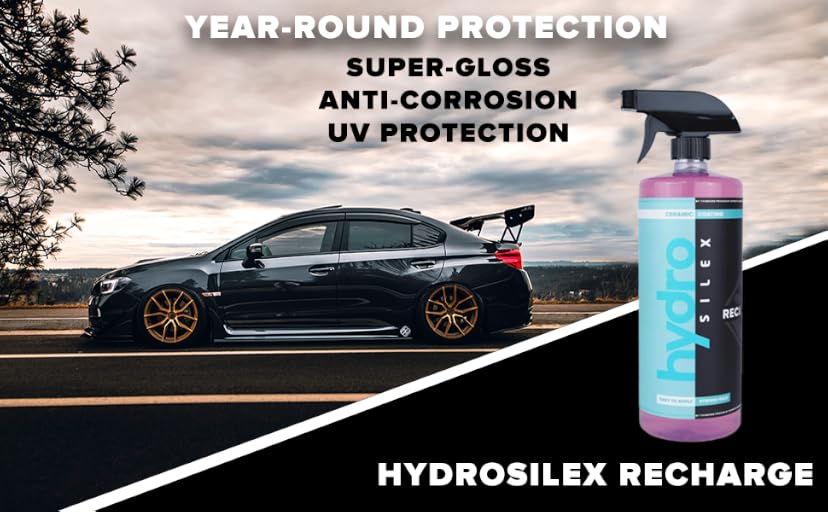
TL;DR Holds water-beading through 3-4 months on a daily driver, which is strong for a spray-and-wipe format even if the "up to 1 year" label is not community-confirmed. Gloss improvement is real but modest. Application is nearly foolproof: spray on, buff off, no flash window.
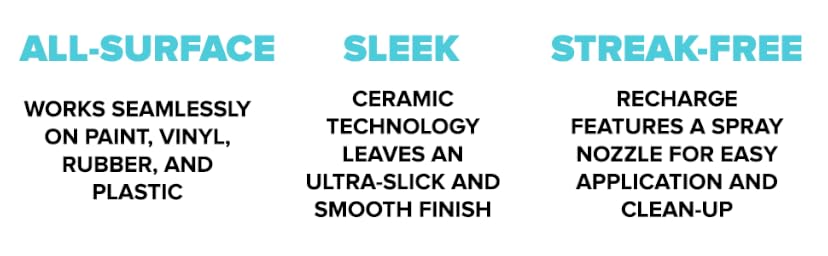
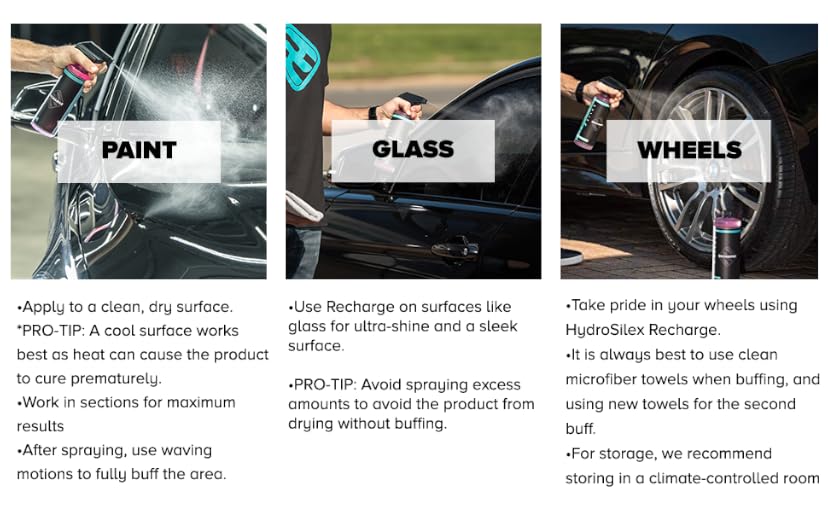
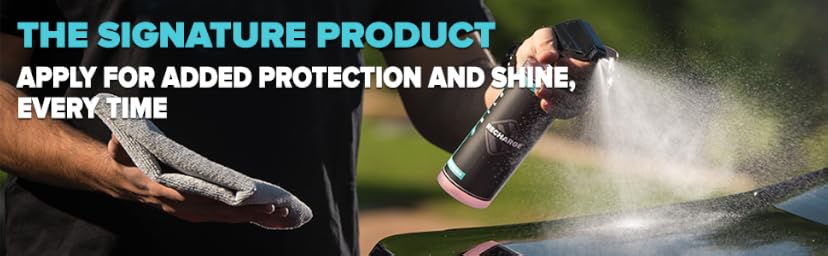
HydroSilex Recharge bonds to your clear coat and sheds water. Spray on a panel, buff off with a microfiber, move to the next panel. There is no flash window and no mandatory prep, though a fresh wash and clay pass before application visibly extends hold time. At application the water-beading effect is immediate and distinct. Owners consistently report 3-4 months of effective hydrophobic protection on regularly-washed daily drivers, well above the category average. The "up to 1 year" label claim is not community-confirmed; a season is the realistic expectation. Gloss improvement is real on dark paint but modest rather than dramatic.
Best for daily-driver owners who want ceramic-level water-beading for a season without the prep or cure time of a full coating process. Skip it if you need multi-year protection: a dedicated spray sealant will outlast any spray-and-wipe ceramic at a similar price, though the application is more demanding.
The SDS classifies this formula as not meeting the criteria for classification under GHS/OSHA HazCom 2012; no signal word and no health hazard codes at the mixture level. Water-based at under 5 g/L VOC, non-flammable, pH neutral. SDS §8 still names eye/face protection, EN 374 gloves, and a respirator for poor ventilation, so those show up here as situational precautions with their conditions spelled out rather than being left off. The formula cures on the paint surface; SDS §12 shows no aquatic toxicity classification; CARB compliant for low VOC.
The label claims up to 1 year, but community data from long-term owner reviews and r/AutoDetailing threads consistently puts real-world durability at 3-4 months on a regularly-washed daily driver. That is roughly three times shorter than the label maximum. The coating works, and the water-beading after application is real and noticeable, but it fades meaningfully after about a season on a car that sees regular washing.
Nothing is mandatory. The SDS classifies the mixture as not meeting the criteria for classification; no signal word, no GHS pictograms, no health hazard codes at the mixture level, and the formula is water-based with a trace glycol ether co-solvent under 0.5% by weight. That said, SDS §8 does name eye/face protection, gloves, and respiratory protection for poor ventilation, so all three appear on this page as situational precautions with the conditions attached: eye protection when spraying at face height or decanting from the gallon jug, gloves for repeated all-day handling or sensitive skin, and ventilation or a respirator if you are spraying inside a closed garage. Outdoors, on a car, for one pass, gloves are the only one most owners bother with.
No. SDS §3 lists no fluorinated ingredients. The active, aminodimethylsiloxane, is a nitrogen-functional silicone polymer, not a fluorinated compound. The co-solvents (butoxypropanol and diethylene glycol monobutyl ether) are also non-fluorinated. The PFAS-free conclusion is based on affirmative SDS §3 disclosure, not an absence of evidence.
The manufacturer recommends a fresh wash before application, and ideally clay-bar decontamination or an IPA panel wipe for longer-lasting results. These prep steps are not listed as mandatory in the TDS, but community feedback consistently shows better hold time on properly decontaminated paint. A clay bar and panel wipe are not included with the bottle; they are available separately and are not required for first-time use.
Marketing copy from HydroSilex, via Amazon. Not editorial.
Guide
Ceramic Coating vs Wax vs Sealant: Which Lasts Longest
Carnauba wax lasts 4 to 8 weeks, synthetic sealant 3 to 6 months, DIY ceramic coating 12 to 36 months, professional ceramic 3 to 7 years. The chemistry is the reason. Hybrid ceramic sprays sit with the sealants on durability, not with the ceramics.
Guide
How Long Does Ceramic Coating Actually Last on a Car
A pro-installed coating on a garaged car can hold five to seven years. A DIY 9H kit on an outdoor daily driver lands closer to one to two. Durability is set by prep quality, wash chemistry, parking, and UV dose, not by the warranty number on the box.
Weekly pick
One product, one safety verdict, every week. No spam.
Currently in the top 2 of its category — appears as a pick in:

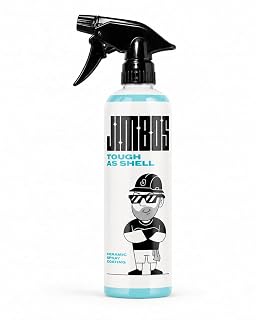
Jimbo's Detailing
Tough As Shell Ceramic Spray
SONAX
BrilliantShine Detailer
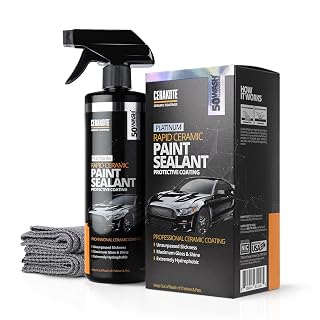
Cerakote
Platinum Rapid Ceramic Paint Sealant Spray
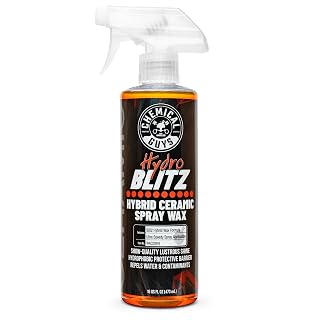
Chemical Guys
HydroBlitz Hybrid Ceramic Spray Wax
As an Amazon Associate I earn from qualifying purchases. Full disclosure

Community
0 postsShare how you use this product
Drop a quick comment or post a full review with photos and a star rating.
Sign in to postNew here? Create a free account.