CarCareTruth Score
Decent.
Opens Amazon in a new tab. No account needed to look.
Saved to your guest loadout. Sign up to also save to your Cabinet (consumables) or Kit (tools you own).
As an Amazon Associate I earn from qualifying purchases. Full disclosure
Prices may varyAbout this product's hazards. This product's Safety Data Sheet uses signal word DANGER.Read the manufacturer's SDS and follow all safety instructions before use. CarCareTruth ratings translate the manufacturer's safety sheet. They do not replace the SDS or substitute for a hazard assessment specific to your task.
Health score is for adult use as intended, per the manufacturer's SDS. It does not model child ingestion, accidental spill cleanup, or off-label use. See the safety panel below for full hazard classification, and /disclaimer for the full editorial scope.
GHS hazard codes are quoted from the manufacturer’s Safety Data Sheet. PPE tiers below translate those codes and the listed ingredient chemistry; they are not CarCareTruth recommendations.
Show details for all categories ▾Hide details ▴
Only when: when spraying
Translated from the manufacturer’s Safety Data Sheet, Section 8
H319 (eye irritation Cat 2A) is in the SDS §2 mixture classification. Aerosol mist during spray application can cause temporary eye irritation. SDS §8 specifies safety glasses with side shields or goggles.
U.S. regulatory standard
29 CFR 1910.133(a)(1)
“The employer shall ensure that each affected employee uses appropriate eye or face protection when exposed to eye or face hazards from… liquid chemicals…”
ANSI Z87.1 (incorporated via §1910.6)
OSHA standards apply to workplaces. Cited here as the U.S. reference threshold for the underlying hazard class.
CarCareTruth publishes the cited sources verbatim and does not advise what action a user should take. Consult the full SDS before use.
Only when: prolonged use · when spraying
Translated from the manufacturer’s Safety Data Sheet, Section 8
SDS §8 specifies nitrile, neoprene, or polyvinyl alcohol (PVA) gloves for contact with liquid. H315 (skin irritation) is not in the SDS §2 mixture classification · the skin tier reflects SDS §8 guidance for the H361 (reproductive toxin) concern and prolonged or repeated contact scenarios, not acute irritation chemistry.
U.S. regulatory standard
29 CFR 1910.1000; 1910.1200
“Each employer shall assure that no employee is exposed [in excess of the PEL]…”
OSHA standards apply to workplaces. Cited here as the U.S. reference threshold for the underlying hazard class.
UN GHS hazard statement
H361“Suspected of damaging fertility or the unborn child”
UN GHS Rev. 9 (2021)
CarCareTruth publishes the cited sources verbatim and does not advise what action a user should take. Consult the full SDS before use.
Translated from the manufacturer’s Safety Data Sheet, Section 2
H336 (narcosis · drowsiness/dizziness, STOT SE Cat 3) is in the SDS §2 mixture classification. Aerosol form factor with engine-bay use (semi-enclosed space). SDS §8 directs use in a well-ventilated area and specifies an organic-vapor cartridge respirator when ventilation cannot be achieved.
U.S. regulatory standard
29 CFR 1910.134; 1910.138; 1910.1000
“the primary objective shall be to prevent atmospheric contamination…”
OSHA standards apply to workplaces. Cited here as the U.S. reference threshold for the underlying hazard class.
UN GHS hazard statement
H373“May cause damage to organs through prolonged or repeated exposure”
UN GHS Rev. 9 (2021)
CarCareTruth publishes the cited sources verbatim and does not advise what action a user should take. Consult the full SDS before use.
The published Safety Data Sheet for this product does not specify ventilation protection for consumer use.
Workplace context
29 CFR 1910.134(a); 1910.1000
“the primary objective shall be to prevent atmospheric contamination [via] accepted engineering control measures (for example, enclosure or confinement of the operation, general and local ventilation…).”
Triggered by GHS H336 on the SDS.
OSHA standards apply to workplaces. Cited here as the U.S. reference threshold for the underlying hazard class.
PPE tiers translate the manufacturer’s SDS and U.S. regulatory standards. Not professional safety advice. How we report safety.
Scope of these PPE tiers. The tiers on this page translate the product's Safety Data Sheet where one is published, plus its ingredient chemistry, into a comparable rating. They describe a formulation, not a situation: a tier is not a safety determination for any specific user, task, quantity, or environment. The manufacturer's label and use instructions govern how the product is handled. Where the product is used at work, the employer's PPE program and hazard assessment under 29 CFR 1910.132 decide what protection is selected, not this page.
No warranties. CarCareTruth makes no warranties, express or implied, and expressly disclaims the implied warranties of merchantability and fitness for a particular purpose.
This product ranks #1 of 6 in Throttle Body Cleaner.
Last reviewed May 26, 2026
TL;DR Single-pass throttle plate and bore cleaning confirmed by community threads on F150 and Camry forums. SDS chemistry shows under 5% aromatic content · the chemistry that backs the sensor-compatible reputation. The explicit O2-sensor-safe and catalytic-converter-safe label claims were not confirmed from a back-panel image, which explains the quality score penalty. DANGER signal word is health-driven (H361 suspected reproductive harm, H373 STOT RE); eye protection situational for spray application; lungs-recommended PPE.
Remove the intake duct, prop the plate open, spray short bursts, wipe with a microfiber · the fast-evaporating light-solvent formula dissolves carbon, varnish, and oily PCV film from the plate and bore. No community reports of MAF codes, O2 codes, or visible coating wear on modern throttle bodies. Over-spray risk: liquid that puddles in the intake tract can trigger codes; let it evaporate 1-2 minutes before reinstalling the duct.
Right buy for a modern-EFI owner (Camry, Civic, Silverado, F150) doing routine throttle-body maintenance. Skip it for GDI intake-valve carbon · aerosol TB cleaner can't reach those deposits; a GDI-specific cleaner or walnut-blast service is the right tool. Skip it for carb work · CRC #03077 handles that use case.
DANGER signal word is driven by H361 (suspected reproductive harm), H373 (repeated-exposure STOT RE), H336 (narcotic effects), and H319 (eye irritation). SDS §8 specifies safety glasses and lists nitrile gloves; an organic-vapor cartridge respirator is directed when ventilation cannot be achieved. California Proposition 65 warning confirmed by SDS §15. The CARB-compliant rating is a regulatory-accounting outcome · the Federal VOC of 141.1 g/L is the actual atmospheric-emissions figure. H412 (chronic aquatic Cat 3): do not discharge residue to drains or waterways.
The SDS chemistry · specifically the low aromatic content (under 5% by weight) · is consistent with formulas that are marketed as O2-sensor-safe. The product's long community track record on F150, Camry, and Civic-class engines shows no documented pattern of O2 sensor codes after use. However, the explicit O2-sensor-safe and catalytic-converter-safe label claim has not yet been confirmed from a back-panel image in CarCareTruth's research; the claim may appear on the back panel (which reads 'MORE INFO ON BACK PANEL') but could not be independently verified from available the product listing images as of 2026-05-19. The SDS chemistry provides a strong positive basis for compatibility.
Yes · the throttle body on a GDI engine is a port-side component that TB cleaner can reach normally. The caveat for GDI engines is that the real carbon problem is on the intake valves (upstream of the injectors, not reached by aerosol TB cleaner). Cleaning the throttle body with CRC #05078 is appropriate for throttle-related symptoms; for intake-valve carbon on GDI engines, a dedicated GDI cleaner service or walnut-blast media service is the correct approach.
The DANGER signal word is driven by health-tier H-codes · specifically H336 (narcotic effects from vapor), H361 (suspected reproductive harm from the trace aromatic content), and H373 (STOT RE from long-term vapor exposure) · not only by flammability. The formula is genuinely less aggressive than a typical carb cleaner (lower aromatic content, no H335 respiratory irritation, no H318 serious eye damage), but the Prop 65 substances and reproductive-concern classification from trace solvents push it into DANGER territory.
Yes. SDS Section 15 confirms the Prop 65 warning applies: listed substances include acetaldehyde, benzene, cumene, and toluene. The back-panel label is expected to carry the required California Proposition 65 warning · the back panel was not available in the product listing imagery at the time of CarCareTruth's review, but SDS §15 is authoritative for compliance status.
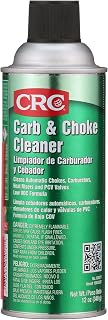
These are different formulas for different use cases. #03077 (Carb & Choke Cleaner) is designed for carburetor work · more aggressive aromatic content, formulated for carb bowl varnish and pilot-jet deposits. #05078 (Throttle Body & Air-Intake Cleaner) uses a lighter solvent system de-tuned for modern fuel-injected throttle bodies where sensor compatibility matters. If you're cleaning a throttle body on a fuel-injected engine, #05078 is the right product. For carb work, reach for #03077.
Marketing copy from CRC, via Amazon. Not editorial.
Weekly pick
One product, one safety verdict, every week. No spam.


Toyota
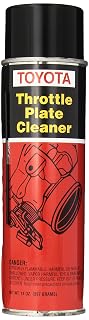
Genuine Toyota Fluid Throttle Plate Cleaner (14 oz)
Berryman
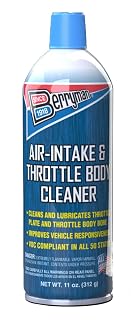
2209 B-12 Chemtool Air-Intake Cleaner (11 oz aerosol)
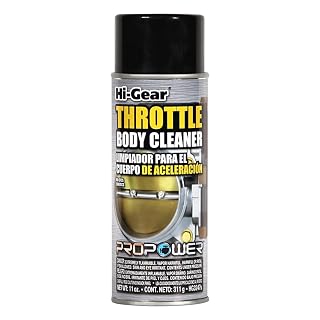
Hi-Gear
ProPower Throttle Body Cleaner (11 fl oz)
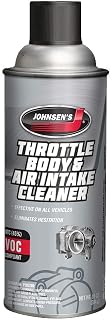
Johnsen's
4724 Throttle Body and Air Intake Cleaner
As an Amazon Associate I earn from qualifying purchases. Full disclosure

Community
0 postsShare how you use this product
Drop a quick comment or post a full review with photos and a star rating.
Sign in to postNew here? Create a free account.