CarCareTruth Score
Decent, but wear gloves and ventilate.
Opens Amazon in a new tab. No account needed to look.
Saved to your guest loadout. Sign up to also save to your Cabinet (consumables) or Kit (tools you own).
As an Amazon Associate I earn from qualifying purchases. Full disclosure
Prices may varyAbout this product's hazards. This product's Safety Data Sheet uses signal word danger. Read the manufacturer's SDS and follow all safety instructions before use. CarCareTruth ratings translate the manufacturer's safety sheet. They do not replace the SDS or substitute for a hazard assessment specific to your task.
Health score is for adult use as intended, per the manufacturer's SDS. It does not model child ingestion, accidental spill cleanup, or off-label use. See the safety panel below for full hazard classification, and /disclaimer for the full editorial scope.
GHS hazard codes are quoted from the manufacturer’s Safety Data Sheet. PPE tiers below translate those codes and the listed ingredient chemistry; they are not CarCareTruth recommendations.
Show details for all categories ▾Hide details ▴
Only when: when spraying
Translated from the manufacturer’s Safety Data Sheet, Section 2
SDS §2 classifies H319 (causes serious eye irritation). H319 without H318 translates to situational tier per the carb-cleaner rubric; aerosol mist can cause temporary eye irritation on direct contact. SDS §8 directs safety glasses with wrap-around lens or goggles.
U.S. regulatory standard
29 CFR 1910.133(a)(1)
“The employer shall ensure that each affected employee uses appropriate eye or face protection when exposed to eye or face hazards from… liquid chemicals…”
ANSI Z87.1 (incorporated via §1910.6)
OSHA standards apply to workplaces. Cited here as the U.S. reference threshold for the underlying hazard class.
CarCareTruth publishes the cited sources verbatim and does not advise what action a user should take. Consult the full SDS before use.
Translated from the manufacturer’s Safety Data Sheet, Section 2
SDS §2 classifies H315 (causes skin irritation). SDS §8 lists chemical-resistant gloves among protective measures for skin contact during spray application.
U.S. regulatory standard
29 CFR 1910.138(a)
“appropriate hand protection when employees' hands are exposed to hazards such as those from… chemicals which produce an adverse effect on the skin or eyes…”
OSHA standards apply to workplaces. Cited here as the U.S. reference threshold for the underlying hazard class.
CarCareTruth publishes the cited sources verbatim and does not advise what action a user should take. Consult the full SDS before use.
Especially relevant: in enclosed space · prolonged use
Translated from the manufacturer’s Safety Data Sheet, Section 2
SDS §2 classifies H336 (may cause drowsiness or dizziness) from narcotic vapor effects. The §2 mixture classification does not include H335 (respiratory irritation), H331 (toxic if inhaled), H334 (respiratory sensitization), or H330 (fatal if inhaled), so the chemistry does not force the required tier. SDS §7 directs use only outdoors or in a well-ventilated area; SDS §8 directs an organic-vapor cartridge respirator when ventilation is inadequate or for prolonged or repeated application.
U.S. regulatory standard
29 CFR 1910.134; 1910.138; 1910.1000
“the primary objective shall be to prevent atmospheric contamination…”
OSHA standards apply to workplaces. Cited here as the U.S. reference threshold for the underlying hazard class.
UN GHS hazard statement
H373“May cause damage to organs through prolonged or repeated exposure”
UN GHS Rev. 9 (2021)
CarCareTruth publishes the cited sources verbatim and does not advise what action a user should take. Consult the full SDS before use.
The published Safety Data Sheet for this product does not specify ventilation protection for consumer use.
Workplace context
29 CFR 1910.134(a); 1910.1000
“the primary objective shall be to prevent atmospheric contamination [via] accepted engineering control measures (for example, enclosure or confinement of the operation, general and local ventilation…).”
Triggered by GHS H336 on the SDS.
OSHA standards apply to workplaces. Cited here as the U.S. reference threshold for the underlying hazard class.
PPE tiers translate the manufacturer’s SDS and U.S. regulatory standards. Not professional safety advice. How we report safety.
This product ranks #1 of 12 in Carburetor Cleaner.
Last reviewed June 10, 2026
TL;DR Cuts through moderate fuel-bowl gum and pilot-jet varnish in a single pass on small-engine and motorcycle carburetors; community consensus on lawnmower, generator, and vintage motorcycle forums confirms the reputation. The SDS classifies it DANGER with five health-tier hazard codes (skin and eye irritation, narcotic effects, suspected developmental toxicant, and target-organ toxicity through repeated exposure) plus a Prop 65 warning for toluene. SDS §8 directs chemical-resistant gloves and eye protection when aerosol contact is possible; SDS §7 directs use only outdoors or in a well-ventilated area.
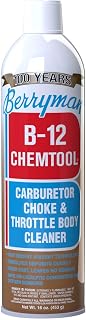
Spray in short bursts into the carburetor passage; the fast-evaporating formula dissolves gum and varnish within a minute and leaves passages dry and ready for air-gun blow-out. Community small-engine forums consistently report single-pass clearing on mildly-to-moderately gummed carbs with one season of stale fuel; the honest limit is that years of heavy lacquer varnish in passages needs an overnight soak or ultrasonic cleaning, not an aerosol spray. The brand-claimed compatibility with catalytic converters and oxygen sensors holds up; the SDS composition carries no chlorine, silicone, or metallics that would foul sensors. This is the same formula (SDS blend 1AA-CA11) as Berryman's 16 oz Chemtool listing, just under a different the product listing family.
The right buy for a home mechanic with a sit-started lawnmower, generator, or outboard that stumbles on idle after a winter of stale fuel. Skip it if the carb has been sitting multiple years with heavy brown-lacquer varnish; that calls for Berryman's own B-9 Chemdip or ultrasonic cleaning. Also skip if you need a genuinely low-emission option: the CARB-compliant status here is a regulatory accounting result because acetone is CARB-exempt, not a sign of low absolute emissions; the formula puts approximately 600 g/L of volatile organic mass into the air.
The SDS DANGER classification is driven by real chemistry: H315 (skin irritation), H319 (eye irritation), H336 (narcotic vapor effects), H361d (suspected developmental toxicant, toluene), and H373 (repeated-exposure organ toxicity) alongside flammability hazards. The Prop 65 warning reflects toluene's California listing for developmental toxicity. The lungs PPE tier translates to recommended because the §2 mixture classification lacks H335, H331, and H334; SDS §8 directs an organic-vapor cartridge respirator when ventilation is inadequate or for prolonged application. The eyes tier is situational because H319 without H318 means temporary irritation on aerosol contact, not the permanent-damage risk that forces required. The CARB-compliant label is a regulatory exemption result; SDS §12 confirms solvents are rapidly degradable in aerobic conditions but mobile in soils, and SDS §13 directs disposal away from soil and storm drains.
Berryman's front-of-can claim is 'Safe for Oxygen Sensors and Catalytic Converters,' and the chemistry supports it. The SDS §3 composition contains no chlorine, silicone, or metallic additives that are known to foul O2 sensors or poison three-way catalysts. The solvents evaporate cleanly per SDS §9. The practical caution from small-engine forums: keep spray off plastic throttle-position sensor housings where prolonged solvent contact can craze the housing, not a chemistry failure but a dwell-time concern.
It handles mild-to-moderate fuel-bowl gum and pilot-jet deposits reliably in a single pass; community evidence from lawnmower and small-engine repair forums confirms this consistently on sit-started seasonal equipment with one season of stale fuel. For multi-year storage with heavy brown-lacquer varnish in the passages, an aerosol spray-in-place product is rarely enough. The correct tool for that level of deposit is an overnight soak in a dedicated carb-dip solution (Berryman's own B-9 Chemdip is the same brand's heavy-duty option) or ultrasonic cleaning.
The Prop 65 warning is driven by toluene (CAS 108-88-3), which is present at less than 10% of the formula but is a listed California Prop 65 substance for developmental toxicity. California's safe-harbor levels require the warning at the concentration toluene appears in this blend. The SDS §15 explicitly states the product is subject to Prop 65 labeling requirements. This is a real label requirement, not boilerplate; the chemistry justifies it.
Yes. The SDS lists the flash point at less than 20 degrees F closed-cup, so vapors will ignite from any spark, hot surface, or open flame at normal garage temperatures. The H280 hazard code (contains gas under pressure; may explode if heated) reflects the carbon dioxide propellant. SDS §7 directs storage below 122 degrees F (50 degrees C) and kept locked up. Do not leave the can on the engine bay floor near a hot exhaust manifold, in a closed car in summer, or near any active ignition source.
Many aerosol carb cleaners use a combustible propellant such as propane or isobutane, which adds to the flammable-aerosol classification. This product uses inert carbon dioxide (4-7% per SDS §3), which is non-flammable. The DANGER signal word and H222 (extremely flammable aerosol) classification still apply because the active solvents themselves are extremely flammable. The CO2 choice means the propellant fraction does not add to combustible mass, but the SDS §7 handling rule is the same: keep away from heat, sparks, and open flames.
Marketing copy from Berryman, via Amazon. Not editorial.
Weekly pick
One product, one safety verdict, every week. No spam.


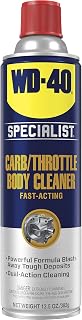
WD-40
Specialist Carb/Throttle Body & Parts Cleaner
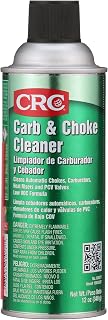
CRC
Carb & Choke Cleaner (12 oz aerosol)
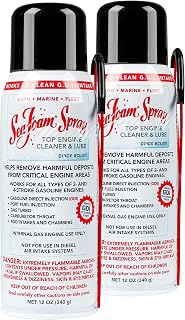
Sea Foam
Spray SS14 Top Engine Cleaner & Lube
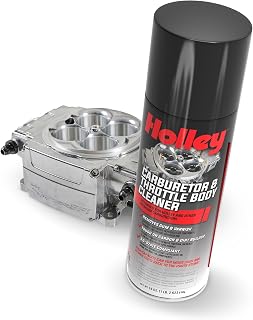
Holley
Carburetor and Throttle Body Cleaner Spray
As an Amazon Associate I earn from qualifying purchases. Full disclosure

Community
0 postsShare how you use this product
Drop a quick comment or post a full review with photos and a star rating.
Sign in to postNew here? Create a free account.