CarCareTruth Score
Decent.
Opens Amazon in a new tab. No account needed to look.
Saved to your guest loadout. Sign up to also save to your Cabinet (consumables) or Kit (tools you own).
As an Amazon Associate I earn from qualifying purchases. Full disclosure
Prices may varyHealth score is for adult use as intended, per the manufacturer's SDS. It does not model child ingestion, accidental spill cleanup, or off-label use. See the safety panel below for full hazard classification, and /disclaimer for the full editorial scope.
GHS hazard codes are quoted from the manufacturer’s Safety Data Sheet. PPE tiers below translate those codes and the listed ingredient chemistry; they are not CarCareTruth recommendations.
Show details for all categories ▾Hide details ▴
Translated from the manufacturer’s Safety Data Sheet, Section 8
SDS Section 8 names eye/face protection directly: 'Safety Glasses with side shields' are recommended for use. Section 2 carries no eye-hazard GHS code, but Section 11 confirms dust generated while buffing or cutting can cause real eye irritation (redness, swelling, tearing), so this is a genuine precaution, not boilerplate.
CarCareTruth publishes the cited sources verbatim and does not advise what action a user should take. Consult the full SDS before use.
Only when: prolonged use
Beyond SDS: translated from the ingredient chemistry
SDS Section 8 states 'No protective gloves required,' and Section 2 carries no skin-hazard code. This row is a cautious step beyond the SDS: routine pad-loading and panel-wiping during extended multi-panel correction sessions is a realistic prolonged-contact scenario, so nitrile gloves are a reasonable precaution even though the SDS itself does not call for them.
CarCareTruth publishes the cited sources verbatim and does not advise what action a user should take. Consult the full SDS before use.
Translated from the manufacturer’s Safety Data Sheet, Section 8
SDS Section 8 names respirator options (half or full facepiece air-purifying, rated for organic vapors and particulates) pending an exposure assessment, and Section 11 reports real respiratory tract irritation from inhalation (cough, sneezing, nasal discharge, headache, sore throat). Section 2 carries no inhalation hazard code, but the aluminum oxide dust generated during DA buffing is a genuine exposure route, so a dust mask or good ventilation is a real precaution here, not a formality.
CarCareTruth publishes the cited sources verbatim and does not advise what action a user should take. Consult the full SDS before use.
No PPE specified in published sources for ventilation. Absence does not imply “not needed” — consult the full Safety Data Sheet.
PPE tiers translate the manufacturer’s SDS and U.S. regulatory standards. Not professional safety advice. How we report safety.
This product ranks #4 of 9 in Compound & One-Step.Three above it ↓
Last reviewed June 14, 2026
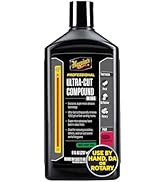
TL;DR Genuine medium-cut performance: handles oxidation, light swirls, and 3000-grit marring on most clearcoats, but expect to step up to a heavier compound for deep defects or hard German clears. Forgiving on a DA, finishes clean enough to seal directly on lighter paint.
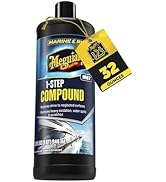
Two-line stripes on a foam cutting pad, a single panel at slow DA speed, then wipe off: the whole panel takes 3-5 minutes. It is a medium-cut compound built around mineral micro-abrasives in a water-based emulsion, documented in community correction threads to clear oxidation and 3000-grit marring on softer clearcoats. Heavy swirls or 1500-grit sanding marks on harder Asian and German clears push it to its limit. Dusting is light under hot or dry conditions and wipe-off is clean even on darker paint. The label's "removes scratches and oxidation" claim is broadly accurate within that tier.
Buy if you are correcting a daily driver: light to moderate swirls, oxidation, or maintenance polishing before a wax or sealant. The forgiving DA workflow and clean wipe-off make it well-suited for first-time paint correction. Skip it if your defects catch a fingernail, if you are working hard German clearcoats, or if you need to remove sanding marks coarser than 2500-grit: Meguiar's M105 or a dedicated heavy-cut compound is the right tool there.
The 2024 SDS classifies this compound as not hazardous under OSHA HCS 29 CFR 1910.1200, with no signal word, no GHS pictograms, and no hazard codes. SDS §3 confirms no CMIT/MIT preservative, so there is no asthmagen concern. SDS §8 names "Safety Glasses with side shields" for eye protection, and §11 confirms dust from buffing or cutting can cause real eye irritation, so eye protection is a genuine precaution here, not a formality. SDS §8 also lists respirator options (air-purifying, rated for organic vapors and particulates) pending an exposure assessment, and §11 reports real respiratory tract irritation from inhaling aluminum oxide dust kicked up during DA buffing; the compound carries no H335, H331, or asthmagen classification, so this lands at a recommended rather than required tier. SDS §8 states no gloves are required, though extended multi-panel sessions are a realistic prolonged-contact scenario worth a cautious nitrile-glove step beyond the SDS. The water-based emulsion has VOC of 129.8 g/L (moderate; CARB compliant). A Prop 65 warning appears on the product listing, likely for trace crystalline silica in the aluminum oxide abrasive; the deduction is reflected in the health score. No PFAS.
It removes oxidation, light swirls, and 3000-grit-or-finer marring on most clearcoats. Deep scratches that catch a fingernail typically need a heavier-cut compound (Meguiar's M105 class) before stepping down to Ultimate Compound. On softer clearcoats it can handle 2500-grit sanding marks in 2-3 passes; on hard German clears it reaches its limit faster.
Both work. The TDS specifies hand application with a microfiber applicator pad and DA polisher application with a foam cutting pad. Community evidence shows the DA produces noticeably faster correction; hand application works for spot defects and light marring. Rotary polishers also work but require pad and speed control to avoid burning.
Light dusting under hot or dry conditions; the water-based emulsion holds together better than traditional petroleum-distillate compounds. Wipe-off is clean on most paint colors. Working in shade and at moderate temperature minimizes dusting.
Yes; the SDS confirms no silicone or wax additives in the formula, so it does not interfere with wax, sealant, or coating bonding. After compounding, wipe down with isopropyl alcohol or a panel-prep spray to remove residual oils before applying the LSP.
Foam cutting pads on a DA polisher are the standard recommendation. Microfiber cutting pads accelerate cut on harder clears, and foam polishing pads can be used for finishing. Wool pads are compatible with rotary polishers but may produce holograms that require a follow-up polish.
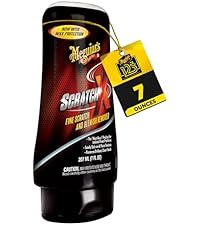
Marketing copy from Meguiar's, via Amazon. Not editorial.
Weekly pick
One product, one safety verdict, every week. No spam.


















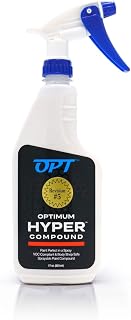
Optimum
Hyper Compound
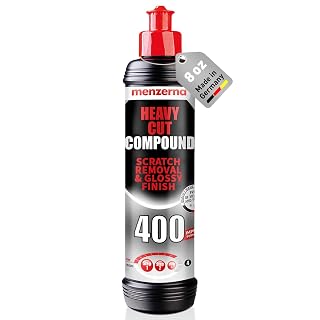
Menzerna
Heavy Cut Compound 400
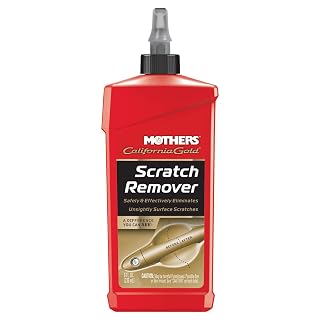
Mothers
California Gold Scratch Remover

Adam's Polishes
Paint Correcting Polish
As an Amazon Associate I earn from qualifying purchases. Full disclosure

Community
0 postsShare how you use this product
Drop a quick comment or post a full review with photos and a star rating.
Sign in to postNew here? Create a free account.