CarCareTruth Score
Decent.
Opens Amazon in a new tab. No account needed to look.
Saved to your guest loadout. Sign up to also save to your Cabinet (consumables) or Kit (tools you own).
As an Amazon Associate I earn from qualifying purchases. Full disclosure
Prices may varyHealth score is for adult use as intended, per the manufacturer's SDS. It does not model child ingestion, accidental spill cleanup, or off-label use. See the safety panel below for full hazard classification, and /disclaimer for the full editorial scope.
GHS hazard codes are quoted from the manufacturer’s Safety Data Sheet. PPE tiers below translate those codes and the listed ingredient chemistry; they are not CarCareTruth recommendations.
Show details for all categories ▾Hide details ▴
Only when: high-speed DA/rotary use
Translated from the manufacturer’s Safety Data Sheet, Section 2
H319 (eye irritation Category 2) in SDS §2. Applied by pad at low contact velocity; centrifugal splatter during DA polisher use is the realistic eye-contact route. No H318 (serious eye damage).
U.S. regulatory standard
29 CFR 1910.133(a)(1)
“The employer shall ensure that each affected employee uses appropriate eye or face protection when exposed to eye or face hazards from… liquid chemicals…”
ANSI Z87.1 (incorporated via §1910.6)
OSHA standards apply to workplaces. Cited here as the U.S. reference threshold for the underlying hazard class.
CarCareTruth publishes the cited sources verbatim and does not advise what action a user should take. Consult the full SDS before use.
Translated from the manufacturer’s Safety Data Sheet, Section 8
SDS §8 calls for chemical-resistant gloves during repeated or prolonged contact plus suitable protective clothing. §11 documents that the pH 2.5 acid formula may cause skin irritation on contact. No skin-specific GHS hazard code appears in §2 (no H315), so this reflects the documented irritation effect and handling guidance, not a mixture-level corrosivity classification.
CarCareTruth publishes the cited sources verbatim and does not advise what action a user should take. Consult the full SDS before use.
Only when: in enclosed space
Translated from the manufacturer’s Safety Data Sheet, Section 2
No H335 or H336 in SDS §2. No volatile co-solvent in SDS §3; estimated VOC < 10 g/L. No inhalation H-code at mixture level. Situational for extended use in an enclosed, unventilated garage.
CarCareTruth publishes the cited sources verbatim and does not advise what action a user should take. Consult the full SDS before use.
No PPE specified in published sources for ventilation. Absence does not imply “not needed” — consult the full Safety Data Sheet.
PPE tiers translate the manufacturer’s SDS and U.S. regulatory standards. Not professional safety advice. How we report safety.
Scope of these PPE tiers. The tiers on this page translate the product's Safety Data Sheet where one is published, plus its ingredient chemistry, into a comparable rating. They describe a formulation, not a situation: a tier is not a safety determination for any specific user, task, quantity, or environment. The manufacturer's label and use instructions govern how the product is handled. Where the product is used at work, the employer's PPE program and hazard assessment under 29 CFR 1910.132 decide what protection is selected, not this page.
No warranties. CarCareTruth makes no warranties, express or implied, and expressly disclaims the implied warranties of merchantability and fitness for a particular purpose.
This product ranks #4 of 8 in Glass Water Spot Remover.Three above it ↓
Last reviewed August 1, 2026
TL;DR Clears water spots, mineral deposits, and surface contamination from automotive glass using acid chemistry · owner reception is good, not great, with owners reporting crystal-clear results on neglected windshields. No abrasive in the formula, so wiper arc scratches are outside its capability. Works by hand or DA polisher per The Rag Company's product video.
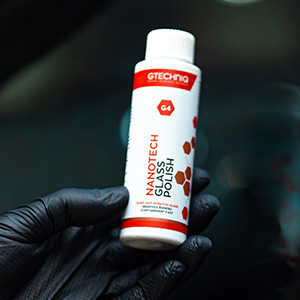
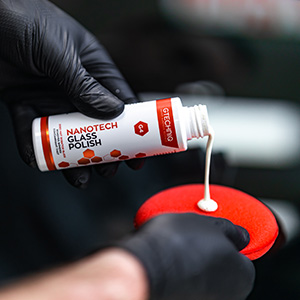
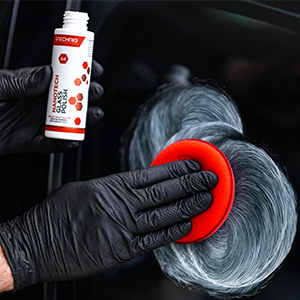
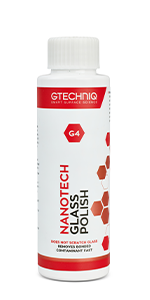
The G4 uses acid chemistry at low pH to dissolve water spots, mineral deposits, and glass contamination rather than grinding with an abrasive. Apply a small amount to a foam or felt pad, work across the glass in overlapping passes, and wipe off with a clean microfiber. Results are optically clear with no residue in seals. owners confirm consistently clean glass on long-neglected windshields · problems a standard glass cleaner cannot address. Wiper arc scratches remain: with no cutting agent, mechanical defects are not corrected.
Right for a car owner dealing with water spots, hard water haze, or accumulated glass contamination. Also a useful prep step before applying a glass coating or water repellent. Skip it for wiper arc scratches · acid chemistry does not remove mechanical glass defects regardless of passes. For scratches, a cerium oxide polishing compound is the appropriate tool.
The US GHS SDS (Version 1.0, July 2020) classifies the G4 as WARNING with H319 (eye irritation Cat 2A). No DANGER signal word, no H318, no H317, no H335, no Prop 65. The health score reflects two things working together: this is an acid formula (pH 2.5, citric acid chemistry, not a benign water-based polish), and the SDS carries a confirmed Cat 2A eye-irritation code. That combination lands it in the mid-range, not the top of the scale. Safety glasses are appropriate during DA polisher use, where centrifugal splatter is the realistic eye-contact route. The formula is water-based, non-flammable, and confirmed biodegradable per SDS §12. One surfactant ingredient carries ingredient-level aquatic toxicity, reflected in the environment score via the drain-destined laundering pathway.
No. Despite the name 'Glass Polish,' the G4 contains no abrasive · the SDS §3 lists only acid chemistry and a surfactant. The product works by chemically dissolving mineral deposits, water spots, and surface contamination at pH 2.5. Mechanical glass defects like wiper arc scratches require a cerium oxide-based abrasive compound to physically grind down the glass surface around the scratch. The G4 cannot do that. For actual wiper arc scratches, look at a dedicated cerium oxide glass polishing compound.
Water spots, mineral deposits, hard water buildup, and surface contamination · the problems that acid chemistry can dissolve. The product works at pH 2.5, which is aggressive enough to break down calcium and magnesium deposits from tap water and sprinkler overspray. Owner reception is good, not great, with owners reporting clear, streak-free glass after use. If your windshield has accumulated film, haze from water mineral buildup, or chemical contamination, this is a strong performer.
Yes. The Rag Company's Amazon product video demonstrates G4 application technique and confirms compatibility with machine application. The milky liquid consistency works with a glass-specific foam or felt pad on a DA polisher. Use a small working amount · this is a 3.4 fl oz bottle and concentrates quickly on a pad.
The US GHS SDS (Version 1.0, issued 2020-07-01) classifies the G4 as WARNING with H319 (causes serious eye irritation · Cat 2A only). No H318 serious eye damage, no H317 skin sensitization, no H335 respiratory irritation, no DANGER signal word, and no Prop 65 warning. The product is a water-based, non-flammable formula with a flash point listed as 'not applicable.' SDS emergency contact: +44 (0)1933 445 260 (Gtechniq UK) / Gtechniq North America, Cumming GA.
Gtechniq does not address coating compatibility explicitly on the product listing, and the SDS does not speak to this. Acid chemistry at pH 2.5 has the potential to degrade hydrophobic glass coatings or rain-repellent treatments · this is a standard caution for acid-based glass products. If your windshield has a Rain-X or similar hydrophobic treatment applied, test on a small section first or use a dedicated pH-neutral glass cleaner instead.
Marketing copy from Gtechniq, via Amazon. Not editorial.
Weekly pick
One product, one safety verdict, every week. No spam.


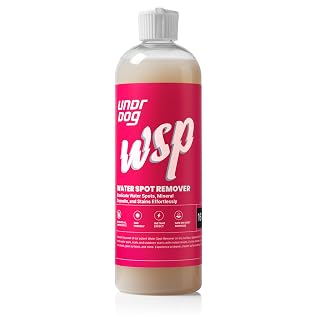
Undrdog
WSP Water Spot Remover
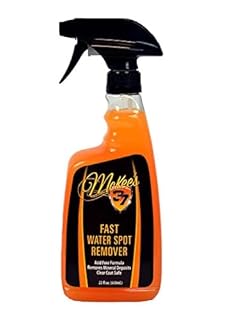
McKee's 37
FAST Water Spot Remover
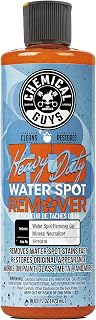
Chemical Guys
Heavy Duty Water Spot Remover
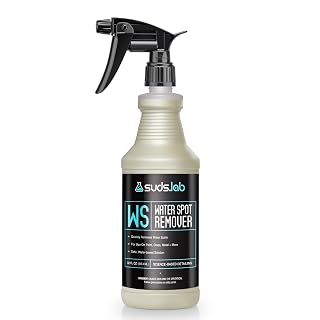
Suds Lab
WS Heavy Duty Water Spot Gel Remover
As an Amazon Associate I earn from qualifying purchases. Full disclosure

Community
0 postsShare how you use this product
Drop a quick comment or post a full review with photos and a star rating.
Sign in to postNew here? Create a free account.