CarCareTruth Score
Decent, but it's tough on the environment.
Saved to your guest loadout. Sign up to also save to your Cabinet (consumables) or Kit (tools you own).
As an Amazon Associate I earn from qualifying purchases. Full disclosure
The manufacturer's Safety Data Sheet classifies this product with one or more GHS Category 1 health hazards — the most severe tier. The hazard statements in quotes below are the verbatim GHS language from the SDS, as required by OSHA's Hazard Communication Standard. The line under each statement translates the GHS classification into plain language.
GHS Category 1 aspiration toxicity — thin, oily liquids can slip into the lungs if swallowed, causing chemical pneumonia.
If swallowed:
The aspiration hazard (H304) is about the liquid being swallowed and reaching the airway, not about breathing fumes during normal use.
Call Poison Control immediately at 1-800-222-1222 (US, 24/7, free) and have the product container with you. Poison Control's standing guidance is to not induce vomiting after chemical exposure; they will direct first-aid steps based on the specific product.
About this product's hazards. This product's Safety Data Sheet uses signal word DANGER.Read the manufacturer's SDS and follow all safety instructions before use. CarCareTruth ratings translate the manufacturer's safety sheet. They do not replace the SDS or substitute for a hazard assessment specific to your task.
Health score is for adult use as intended, per the manufacturer's SDS. It does not model child ingestion, accidental spill cleanup, or off-label use. See the safety panel below for full hazard classification, and /disclaimer for the full editorial scope.
GHS hazard codes are quoted from the manufacturer’s Safety Data Sheet. PPE tiers below translate those codes and the listed ingredient chemistry; they are not CarCareTruth recommendations.
Show details for all categories ▾Hide details ▴
Only when: when spraying · in enclosed space
Beyond SDS: translated from the ingredient chemistry
No H319 or H318 at mixture level in SDS §2. The SDS §8 individual-protection table cites 'Wear safety glasses; chemical goggles (if splashing is possible). CSA Z94.3' · splash-contingent guidance, not a mandatory eye-protection trigger. Pump-spray application at close range to fabric inside the vehicle cabin is the situational pathway.
CarCareTruth publishes the cited sources verbatim and does not advise what action a user should take. Consult the full SDS before use.
Only when: prolonged use
Beyond SDS: translated from the ingredient chemistry
No H315, H317, or H314 at mixture level in SDS §2. SDS §8 recommends FKM, butyl, CR, NBR, or PVC gloves with ≥8 h breakthrough time · boilerplate solvent-handling guidance for the naphtha carrier. Brief spray with incidental hand contact is low-risk; extended manual spreading without gloves is the situational trigger because the naphtha carrier can defat skin on prolonged contact.
CarCareTruth publishes the cited sources verbatim and does not advise what action a user should take. Consult the full SDS before use.
Beyond SDS: translated from the ingredient chemistry
No H335 at mixture level. Tier recorded as `recommended` because the formula contains naphtha 65-70% with a 60 °C flash point as the carrier and the active is inferred to be a fluoroalkylsilane (a PFAS compound). Per the fabric-protectant rubric, PFAS-containing pump-spray products earn a recommended lungs tier to reflect aerosolization of fluorinated active into the cabin breathing zone · the PFAS health deduction has already scored the axis; this PPE tier communicates the practical action.
U.S. regulatory standard
29 CFR 1910.1200(f); 1910.132(d)
“The employer shall assess the workplace to determine if hazards are present, or are likely to be present, which necessitate the use of personal protective equipment.”
OSHA standards apply to workplaces. Cited here as the U.S. reference threshold for the underlying hazard class.
CarCareTruth publishes the cited sources verbatim and does not advise what action a user should take. Consult the full SDS before use.
No PPE specified in published sources for ventilation. Absence does not imply “not needed” — consult the full Safety Data Sheet.
PPE tiers translate the manufacturer’s SDS and U.S. regulatory standards. Not professional safety advice. How we report safety.
Scope of these PPE tiers. The tiers on this page translate the product's Safety Data Sheet where one is published, plus its ingredient chemistry, into a comparable rating. They describe a formulation, not a situation: a tier is not a safety determination for any specific user, task, quantity, or environment. The manufacturer's label and use instructions govern how the product is handled. Where the product is used at work, the employer's PPE program and hazard assessment under 29 CFR 1910.132 decide what protection is selected, not this page.
No warranties. CarCareTruth makes no warranties, express or implied, and expressly disclaims the implied warranties of merchantability and fitness for a particular purpose.
Last reviewed June 14, 2026
TL;DR A permanent-cure fabric coating with thin community evidence · the small review corpus is bimodal, with many owners reporting it works and a notable minority reporting it did not, and durability falls well short of the "up to 12 months" claim. Chemistry is most likely fluoroalkylsilane (PFAS-family); the manufacturer prohibits sale or use in California. DANGER signal word from H304 (aspiration) and H226 (flammable liquid).
CQUARTZ Fabric 2.0 pump-sprays onto clean, dry fabric and cures permanently into a hydrophobic coating that cannot be removed once set. The 100 mL bottle covers one vehicle interior, and owners report defective sprayers in the small package. Community evidence is sparse and bimodal: some owners report it does not last long, plus light coloring on dark factory floor mats. Multiple owners flag a strong solvent smell.
A possible fit for detailers in the CarPro line who want a permanent coating on a small surface where permanence is desirable. Buyers in California cannot purchase it. Buyers who want to avoid PFAS chemistry should skip it · the California sales prohibition strongly implies fluoroalkylsilane. Non-fluorinated alternatives: 303 Fabric Guard, Chemical Guys HydroThread.
These are the GHS classifications from the SDS. The PPE tiers below are translated from these codes and the underlying ingredient chemistry · not from generic SDS Section 8 boilerplate. DANGER is driven by H304 (aspiration hazard via swallowing) and H226 (flammable liquid, Cat 3 · physical hazard, not a health score driver). SDS Section 3 discloses only the carrier: Naphtha (petroleum), hydrotreated heavy (CAS 64742-48-9) at 65-70%. The active is inferred to be a fluoroalkylsilane from three signals: California sales prohibition (AB 1817 textile-PFAS regulatory framework), silicon dioxide as a thermal-decomposition product (silane chemistry), and the permanent-cure mechanism. The environment score reflects PFAS persistence as "forever chemicals." Lungs PPE is recommended because PFAS-containing pump-spray aerosolizes fluorinated active into the cabin breathing zone; community owners independently recommend "open, ventilated places."
Almost certainly yes, though the manufacturer does not explicitly confirm it. The Safety Data Sheet (Rev 2.3, 2023-04-04) discloses only the petroleum naphtha carrier solvent (CAS 64742-48-9) at 65-70%; the active hydrophobic agent is held below the SDS disclosure threshold as a trade secret. Three corroborating signals point to a fluoroalkylsilane (PFAS-family) active: (1) the product listing prohibits sale or use of the product in California, consistent with California's fluoropolymer-on-textile restrictions under AB 1817; (2) the SDS lists silicon dioxide as a thermal-decomposition product, confirming silane-based chemistry; (3) the product cures permanently onto fabric and cannot be removed · characteristic of crosslinked fluorinated silane chemistry. If you specifically want a non-fluorinated fabric protector, see 303 Fabric Guard or Chemical Guys HydroThread.
The product listing carries a manufacturer disclaimer reading: 'This product is not for sale or use in the State of California. If you use or sell this product in the state of California you accept full responsibility per California law.' California has restricted the sale of fluoroalkylsilane and other fluorinated textile-treatment chemistries through AB 1817 (PFAS in textiles) and the DTSC Safer Consumer Products program. The sales prohibition is the manufacturer's response to that regulatory framework · it is not a Proposition 65 warning, and no Prop 65 substance is named in the Safety Data Sheet.
The product listing claims protection 'for up to 12 months.' Community feedback is sparse and mixed: some owners report the bead test working immediately after application, while others report it does not last long. The manufacturer rates the product against 'mechanical wear for up to a year' but provides no community-verified durability benchmark, and the product corpus is small relative to other fabric protectants. Plan for reapplication well before 12 months until more long-term community data accumulates.
No · neither the Canadian WHMIS Safety Data Sheet nor the EU CLP version names any Proposition 65 substance in §15, and no Prop 65 warning text is visible on the bottle imagery. The product listing's 'not for sale in California' disclaimer is a separate manufacturer compliance hedge against California's fluoropolymer/textile-PFAS restrictions, not a Prop 65 substance warning.
Per the manufacturer's directions: spray onto clean, dry fabric in a thin, even coat · 100 mL covers roughly one vehicle interior depending on surface area. Allow to cure undisturbed; once cured, the coating cannot be removed. Apply with vehicle doors open · the petroleum carrier solvent has a strong odor and the SDS notes spray application generates mist. Community owners specifically recommend applying in 'open, ventilated places' rather than inside a closed cabin.
Marketing copy from CarPro, via Amazon. Not editorial.
Weekly pick
One product, one safety verdict, every week. No spam.
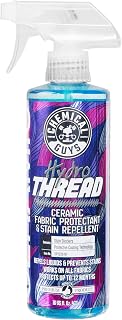
Chemical Guys
HydroThread Ceramic Fabric Protectant & Stain Repellent
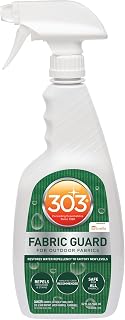
303 Products
303 Fabric Guard (32 oz)
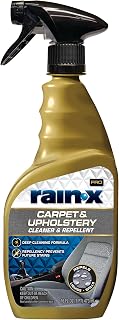
Rain-X
Pro Carpet & Upholstery Cleaner & Repellent
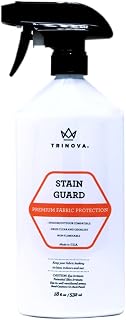
TriNova
Stain Guard Premium Fabric Protection
As an Amazon Associate I earn from qualifying purchases. Full disclosure

Community
0 postsShare how you use this product
Drop a quick comment or post a full review with photos and a star rating.
Sign in to postNew here? Create a free account.