CarCareTruth Score
Mediocre.
Opens Amazon in a new tab. No account needed to look.
Saved to your guest loadout. Sign up to also save to your Cabinet (consumables) or Kit (tools you own).
As an Amazon Associate I earn from qualifying purchases. Full disclosure
Prices may varyThe manufacturer's Safety Data Sheet classifies this product with one or more GHS Category 1 health hazards — the most severe tier. The hazard statements in quotes below are the verbatim GHS language from the SDS, as required by OSHA's Hazard Communication Standard. The line under each statement translates the GHS classification into plain language.
GHS Category 1 carcinogenicity — classified as suspected of causing cancer with repeated or prolonged exposure.
If exposed or you feel unwell:
Call Poison Control immediately at 1-800-222-1222 (US, 24/7, free) and have the product container with you. Poison Control's standing guidance is to not induce vomiting after chemical exposure; they will direct first-aid steps based on the specific product.
About this product's hazards. This product's Safety Data Sheet uses signal word DANGER.Read the manufacturer's SDS and follow all safety instructions before use. CarCareTruth ratings translate the manufacturer's safety sheet. They do not replace the SDS or substitute for a hazard assessment specific to your task.
Health score is for adult use as intended, per the manufacturer's SDS. It does not model child ingestion, accidental spill cleanup, or off-label use. See the safety panel below for full hazard classification, and /disclaimer for the full editorial scope.
GHS hazard codes are quoted from the manufacturer’s Safety Data Sheet. PPE tiers below translate those codes and the listed ingredient chemistry; they are not CarCareTruth recommendations.
Show details for all categories ▾Hide details ▴
Only when: when spraying · in enclosed space
Translated from the manufacturer’s Safety Data Sheet, Section 2
No H318/H319 in SDS Section 2 mixture classification. SDS Section 11 notes eye contact is 'irritating, and may injure eye tissue if not removed promptly,' and Section 8 specifies safety eyewear against liquid splash, a generic instruction not backed by an eye-specific GHS code at the mixture level. Pump-spray application at close range inside the vehicle cabin places splash/mist contact in a plausible exposure pathway.
CarCareTruth publishes the cited sources verbatim and does not advise what action a user should take. Consult the full SDS before use.
Only when: prolonged use
Translated from the manufacturer’s Safety Data Sheet, Section 2
No H314/H315/H317 in SDS Section 2 mixture classification. SDS Section 11 rates skin-contact hazard as 'low' for typical handling; Section 8 recommends gloves to prevent prolonged contact.
CarCareTruth publishes the cited sources verbatim and does not advise what action a user should take. Consult the full SDS before use.
Only when: in enclosed space · when spraying
Translated from the manufacturer’s Safety Data Sheet, Section 2
No H330/H331/H334 in SDS Section 2 mixture classification (H331 for this product is an ingredient-level Section 3 disclosure only and does not roll up to the mixture). SDS Section 8 still specifies engineering controls, cross-ventilation, and a respiratory-protection program meeting OSHA 1910.134 / ANSI Z88.2 whenever workplace conditions warrant a respirator's use, a conditional (not mixture-classification-driven) instruction. Spray application inside an enclosed vehicle cabin places mist in the breathing zone.
U.S. regulatory standard
29 CFR 1910.1003; substance-specific 1910.1001–1910.1052
“Each employer shall ensure that no employee is exposed [in excess of the substance-specific PEL]…”
OSHA standards apply to workplaces. Cited here as the U.S. reference threshold for the underlying hazard class.
CarCareTruth publishes the cited sources verbatim and does not advise what action a user should take. Consult the full SDS before use.
No PPE specified in published sources for ventilation. Absence does not imply “not needed” — consult the full Safety Data Sheet.
PPE tiers translate the manufacturer’s SDS and U.S. regulatory standards. Not professional safety advice. How we report safety.
Scope of these PPE tiers. The tiers on this page translate the product's Safety Data Sheet where one is published, plus its ingredient chemistry, into a comparable rating. They describe a formulation, not a situation: a tier is not a safety determination for any specific user, task, quantity, or environment. The manufacturer's label and use instructions govern how the product is handled. Where the product is used at work, the employer's PPE program and hazard assessment under 29 CFR 1910.132 decide what protection is selected, not this page.
No warranties. CarCareTruth makes no warranties, express or implied, and expressly disclaims the implied warranties of merchantability and fitness for a particular purpose.
This product ranks #9 of 9 in Fabric Protectant.Three above it ↓
Last reviewed July 31, 2026
TL;DR Fluoropolymer-based (PFAS) formula. The SDS carries a DANGER signal word driven by a suspected-cancer classification (H350, Cat 1B), a far more serious hazard profile than the bottle's front-panel "Harmful if Inhaled" warning suggests. Independent, SKU-specific evidence on repellency and durability is thin.
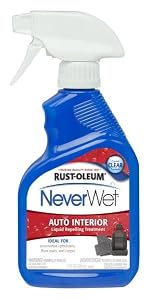
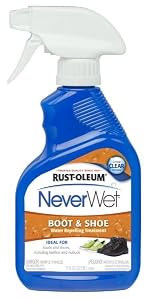
NeverWet Auto Interior is a pump-spray, clear liquid-repelling treatment marketed for upholstery, floor mats, and carpet, sprayed on and left to dry before liquid exposure. SKU-specific bead-test and durability data is thin; detailing forums discuss the broader NeverWet coating technology more than this formula, and describe a coating that can wear through with regular contact. Treat the manufacturer's claims as unverified until more owner data accumulates.
Buyers wanting a low-cost, widely-stocked fabric spray for occasional stain protection may consider it, with modest durability expectations. Buyers who want to avoid PFAS chemistry should look at non-fluorinated alternatives. Anyone aiming to minimize suspected-carcinogen exposure while spraying inside an enclosed cabin should strongly consider a different product.
These are the GHS classifications from the SDS; the PPE tiers below translate that data, not generic Section 8 boilerplate. The mixture is classified DANGER, driven solely by H350 (Carcinogenicity Cat 1B); Section 3's ingredient-level classifications do not roll up into the Section 2 mixture box. Section 15 confirms fluoropolymer (PFAS) via a SARA 313 listing, though the compound's identity is trade-secret. Eyes, skin, and lungs are all situational for the enclosed-cabin spray application, and a Prop 65 warning is corroborated by the SDS's disclosure of ethylene glycol methyl ether. The environment score reflects the PFAS chemistry, which caps the rating regardless of low VOC (11 g/L) and near-neutral pH (7.8).
No. The Safety Data Sheet's Section 15 (SARA 313 reporting table) lists a fluoropolymer as a reportable substance, confirming PFAS chemistry. The specific fluoropolymer compound and its exact concentration are withheld as a trade secret in the SDS, but the fluoropolymer classification itself is not in dispute.
The Safety Data Sheet's Section 2 hazard classification is DANGER, driven by H350 (Carcinogenicity Category 1B, may cause cancer) from one of the disclosed Section 3 ingredients. The bottle's visible front-panel text ('Harmful if Inhaled') reads like a milder warning than the SDS classification actually supports; the SDS is the authoritative hazard document.
Yes. The product listing carries an active Proposition 65 warning, and the Safety Data Sheet's Section 3 independently discloses Ethylene Glycol Methyl Ether at 0.1 to 1.0%, a substance listed under California Prop 65 for developmental and male reproductive toxicity.
Section 8 calls for engineering controls, cross-ventilation by opening doors and windows, and a respiratory protection program meeting OSHA 1910.134 and ANSI Z88.2 whenever workplace conditions warrant a respirator's use. This is a conditional instruction rather than a mixture-level inhalation-toxicity classification, since the Section 2 hazard box for this product does not include an inhalation-toxicity H-code.
Marketing copy from Rust-Oleum, via Amazon. Not editorial.
Weekly pick
One product, one safety verdict, every week. No spam.

Chemical Guys
HydroThread Ceramic Fabric Protectant & Stain Repellent
303 Products
303 Fabric Guard (32 oz)
Rain-X
Pro Carpet & Upholstery Cleaner & Repellent
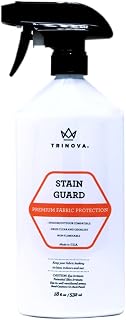
TriNova
Stain Guard Premium Fabric Protection
As an Amazon Associate I earn from qualifying purchases. Full disclosure

Community
0 postsShare how you use this product
Drop a quick comment or post a full review with photos and a star rating.
Sign in to postNew here? Create a free account.