CarCareTruth Score
Decent, but it's tough on the environment.
Opens Amazon in a new tab. No account needed to look.
Saved to your guest loadout. Sign up to also save to your Cabinet (consumables) or Kit (tools you own).
As an Amazon Associate I earn from qualifying purchases. Full disclosure
Prices may varyHealth score is for adult use as intended, per the manufacturer's SDS. It does not model child ingestion, accidental spill cleanup, or off-label use. See the safety panel below for full hazard classification, and /disclaimer for the full editorial scope.
GHS hazard codes are quoted from the manufacturer’s Safety Data Sheet. PPE tiers below translate those codes and the listed ingredient chemistry; they are not CarCareTruth recommendations.
Show details for all categories ▾Hide details ▴
Only when: splash risk
Translated from the manufacturer’s Safety Data Sheet, Section 8
No eye irritation H-code (H319/H320) is classified in this SDS §2 for the 50/50 prediluted product. SDS §8 specifies eye/face protection where contact is possible. The pour-fill and top-off use case carries splash risk during drain work · the primary trigger for eye protection given the H302 and H361 chemistry present.
CarCareTruth publishes the cited sources verbatim and does not advise what action a user should take. Consult the full SDS before use.
Only when: prolonged use
Translated from the manufacturer’s Safety Data Sheet, Section 8
No skin irritation H-code (H315) is classified in this SDS §2 for the 50/50 prediluted product. H302 (harmful if swallowed, Cat 4) and H361 (suspected reproductive toxicant, Cat 2) chemistry is present on the skin contact pathway. SDS §8 specifies chemical-resistant gloves where skin contact is possible. Trigger: drain work or extended contact.
U.S. regulatory standard
29 CFR 1910.132(d); 1910.1200(f)
“The employer shall assess the workplace to determine if hazards are present, or are likely to be present, which necessitate the use of personal protective equipment.”
OSHA standards apply to workplaces. Cited here as the U.S. reference threshold for the underlying hazard class.
CarCareTruth publishes the cited sources verbatim and does not advise what action a user should take. Consult the full SDS before use.
Only when: in enclosed space
Translated from the ingredient chemistry
No inhalation H-codes (H332/H330/H331) are classified in SDS §2. Ethylene glycol, diethylene glycol, and the OAT organic acid salts all have negligible vapor pressure at ambient temperature. SDS §9 confirms VOC 0%. SDS §8 specifies no respiratory protection for normal ambient-temperature handling. Situational risk is limited to enclosed engine bays with hot coolant or steam during drain work.
U.S. regulatory standard
29 CFR 1910.134; 1910.138; 1910.1000
“the primary objective shall be to prevent atmospheric contamination…”
OSHA standards apply to workplaces. Cited here as the U.S. reference threshold for the underlying hazard class.
UN GHS hazard statement
H373“May cause damage to organs through prolonged or repeated exposure”
UN GHS Rev. 9 (2021)
CarCareTruth publishes the cited sources verbatim and does not advise what action a user should take. Consult the full SDS before use.
No PPE specified in published sources for ventilation. Absence does not imply “not needed” — consult the full Safety Data Sheet.
PPE tiers translate the manufacturer’s SDS and U.S. regulatory standards. Not professional safety advice. How we report safety.
Scope of these PPE tiers. The tiers on this page translate the product's Safety Data Sheet where one is published, plus its ingredient chemistry, into a comparable rating. They describe a formulation, not a situation: a tier is not a safety determination for any specific user, task, quantity, or environment. The manufacturer's label and use instructions govern how the product is handled. Where the product is used at work, the employer's PPE program and hazard assessment under 29 CFR 1910.132 decide what protection is selected, not this page.
No warranties. CarCareTruth makes no warranties, express or implied, and expressly disclaims the implied warranties of merchantability and fitness for a particular purpose.
This product ranks #3 of 21 in Coolant / Antifreeze.
Last reviewed May 29, 2026
TL;DR Meets ASTM D3306/D4985 and named OEM spec codes for Ford (2011-2018), Chrysler/Jeep/Dodge/Ram (2013+), and GM (1995+) vehicles requiring orange OAT coolant · spec compliance is manufacturer-asserted, not OEM-certified. OAT inhibitor (phosphate-free, silicate-free) with a 400,000-mile/15-year service claim. Ethylene glycol base · H302 (harmful if swallowed) and H361 (suspected reproductive toxicant from OAT inhibitor ingredients) classifications apply; denatonium benzoate bittering agent is present.
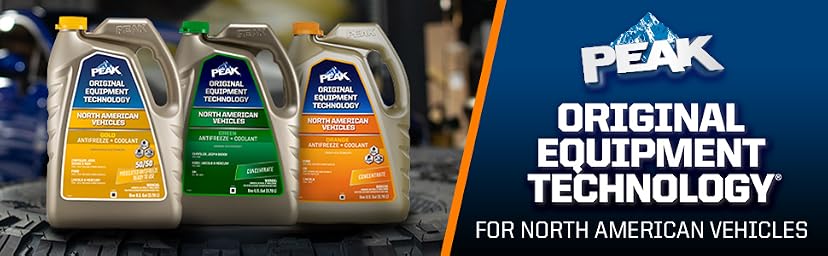
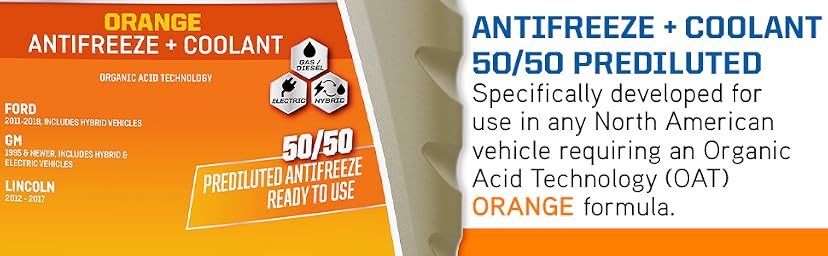
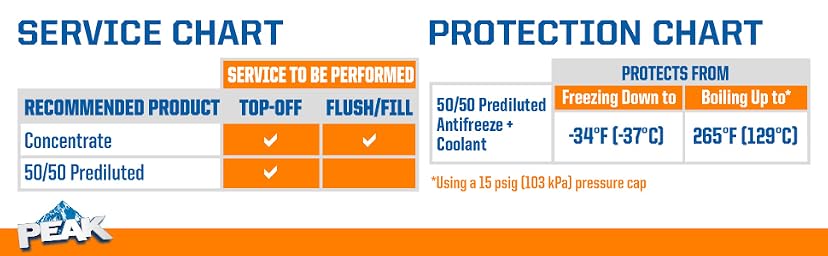
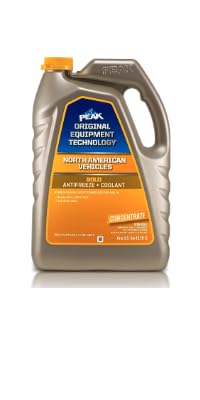
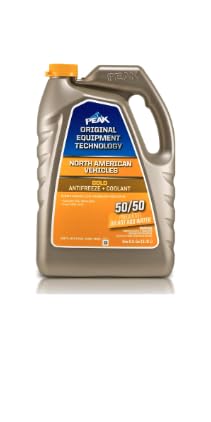
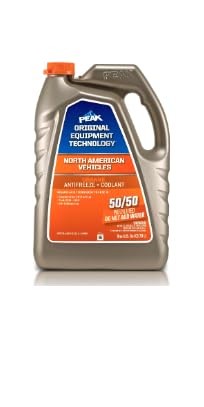
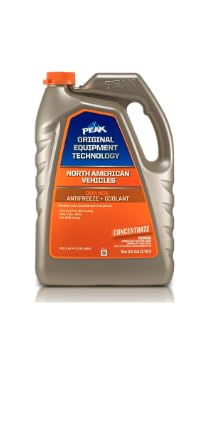
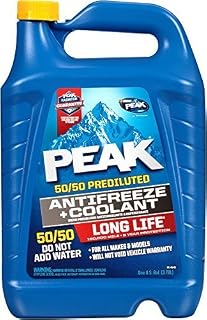
PEAK OET Orange is an OAT (organic acid technology) antifreeze for North American vehicles requiring orange extended-life coolant · covering most 2013+ Chrysler/Jeep/Dodge/Ram, 1995+ GM, and 2011-2018 Ford applications per the manufacturer's TDS. The OAT inhibitor package is phosphate-free, silicate-free, boron-free, and nitrite-free; the manufacturer claims a 400,000-mile or 15-year service life when used for a complete flush and fill. Pre-diluted 50/50 with deionized water · ready to use without measuring; a concentrate sibling (B08PC7XZKY) is available for those who prefer to mix. Ethylene glycol base; ingestion hazard covered in the Safety section. Denatonium benzoate bittering agent present at 30-50 ppm.
The right buy for Ford, Chrysler/Jeep/Dodge/Ram, and GM owners whose vehicles specify orange OAT coolant · it's a high-value pre-diluted option for routine top-offs and full flushes without hunting for OEM-branded fluid, and it's broadly trusted by owners. Skip it if your vehicle specifies a different inhibitor system (European Si-OAT, Asian blue/pink OAT, or green HOAT) · the wrong inhibitor package can cause corrosion damage over time. Also skip if you need a propylene glycol formula for pet- or child-safety reasons. People who handle coolant repeatedly and have reproductive health considerations should note the H361 (suspected reproductive toxicant, Cat 2) classification from the OAT inhibitor ingredients in SDS §2.
Signal word: WARNING. H302 (harmful if swallowed, Cat 4) and H361 (suspected reproductive toxicant, Cat 2, from OAT inhibitor salts) are classified in SDS §2; H373 (may cause kidney damage through prolonged/repeated exposure) also applies at mixture level. Ethylene glycol carries a California Proposition 65 developmental toxicity warning; the Prop 65 and H361 deductions are additive per SDS classification. Denatonium benzoate (30-50 ppm) deters accidental ingestion but does not change the H302 classification. SDS §8 specifies chemical-resistant gloves where skin contact is possible and eye/face protection for splash risk; no inhalation H-codes are present and no respiratory protection is required for ambient-temperature pour-fill work. Collect spent coolant for recycling at auto parts stores (AutoZone, O'Reilly, Advance Auto) · do not drain to ground or storm sewer. Environment score is 4/10 due to the ethylene glycol hard ceiling; glycol in stormwater runoff is regulated and must be recycled.
Per the TDS (12-27-23), PEAK OET Orange is designed for Chrysler, Jeep, Dodge, and Ram vehicles from 2013 and newer; Ford vehicles from 2011-2018; GM vehicles from 1995 and newer; and Lincoln vehicles from 2012-2017. It meets several named OEM spec codes including ASTM D3306, D4985, GMW3420, FCA/Chrysler MS-7170/MS-9769/MS-12106, and Ford WSS-M97B44-D/D2. However, Old World Industries (the manufacturer) includes an explicit disclaimer: 'This product has not been tested nor approved by Ford Motor Company, Fiat Chrysler Automobiles and General Motors LLC.' These are compatibility claims based on spec compliance, not formal OEM endorsements.
PEAK OET Orange uses OAT (organic acid technology) chemistry that is chemically equivalent to the DEX-COOL inhibitor system used in GM vehicles · same orange color, same phosphate-free/silicate-free OAT formula. The TDS states it meets GMW3420 (GM's coolant specification) for 1995 and newer GM vehicles. However, GM DEXCOOL is a registered trademark of GM LLC, and Old World Industries states the product has not been formally tested or approved by GM. In practice, the OAT chemistry is interchangeable with DEX-COOL for most GM applications, but owners who need formal OEM documentation should purchase the factory-branded fluid.
Yes. The product listing specifically discloses: 'This item contains a bittering agent called Denatonium Benzoate.' SDS §3 confirms denatonium benzoate at 30-50 ppm. Denatonium benzoate is one of the most bitter substances known, added as a deterrent to incidental ingestion by pets and children. It does not change the H302 toxicity classification · ethylene glycol is still harmful if swallowed · but it meaningfully reduces the risk of voluntary consumption due to the product's otherwise mild smell.
H361 ('suspected of damaging fertility or the unborn child, Cat 2') appears in SDS §2 at the mixture level and is driven by two OAT corrosion inhibitor ingredients: potassium 2-ethylhexanoate and sodium 2-ethylhexanoate (both listed at 0-5% in SDS §3). This is a real SDS classification · not boilerplate. The H361 does not come from ethylene glycol itself. For handlers with reproductive health concerns, gloves during drain work and avoiding skin contact with concentrate are the relevant precautions derived from SDS §8.
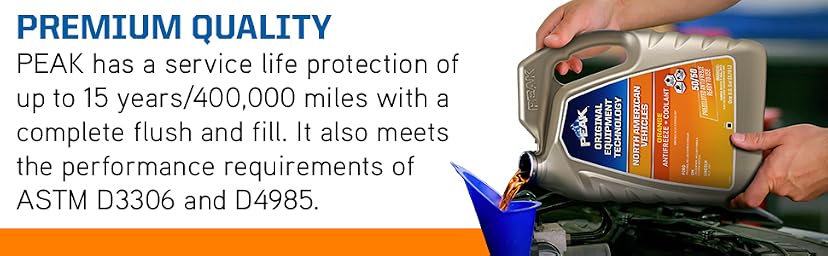
PEAK guarantees 400,000 miles or 15 years when installed as a complete flush and fill (not top-off use). This claim reflects the OAT inhibitor chemistry, which degrades more slowly than silicate-based (IAT) formulas. That said, independent used-coolant analysis (VOA) data specifically corroborating the 400,000-mile figure is not publicly available in community sources (BITOG, etc.) as of May 2026. BITOG community guidance for OAT coolants generally supports 5-year / 150,000-mile intervals with confidence; the 15-year/400k claim is on the aggressive end. Test inhibitor reserve and pH at 5-year intervals.
No. Ethylene glycol coolant · used or fresh · must be collected and brought to a recycling program. Most auto parts stores (AutoZone, O'Reilly Auto Parts, Advance Auto Parts) accept used coolant at no charge. Drain or ground disposal is prohibited under the Clean Water Act in most US jurisdictions and poses documented harm to aquatic ecosystems. The sweet smell of ethylene glycol also attracts pets and wildlife, increasing the ingestion risk if spilled.
The listing for PEAK OET Extended Life Orange 50/50 Prediluted Antifreeze/Coolant carries a California Prop 65 warning. PEAK OET Extended Life Orange 50/50 Prediluted Antifreeze/Coolant is a working automotive fluid rather than a passive part, so the warning points at the formulation itself. The manufacturer's Safety Data Sheet is the primary source for what is in it: the hazard classification and the PPE tiers on this page are translated from that sheet, and the full SDS is linked from the safety panel. California requires the warning whenever exposure to any of roughly 900 listed substances is possible. It does not name which substance applies to a given product, and it states no dose or risk level, so it is not on its own a measure of how hazardous this fluid is in normal use.
Marketing copy from PEAK, via Amazon. Not editorial.
Weekly pick
One product, one safety verdict, every week. No spam.
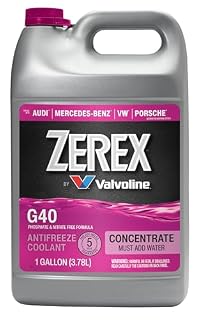
Zerex
G-40 Concentrate Antifreeze/Coolant
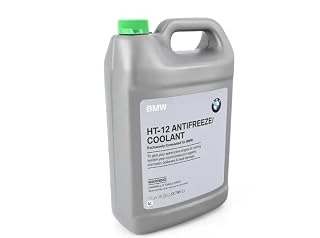
BMW
HT-12 Antifreeze/Coolant Concentrate, Green Si-OAT
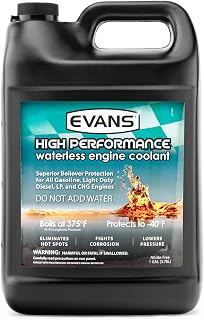
Evans Cooling Systems
Evans High Performance Waterless Engine Coolant
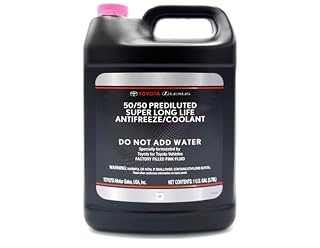
Toyota
Genuine Super Long Life Coolant SLLC2 (Pink), 50/50 Pre-Diluted, 1 Gallon
As an Amazon Associate I earn from qualifying purchases. Full disclosure

Community
0 postsShare how you use this product
Drop a quick comment or post a full review with photos and a star rating.
Sign in to postNew here? Create a free account.