CarCareTruth Score
Mediocre, but it's tough on the environment.
Opens Amazon in a new tab. No account needed to look.
Saved to your guest loadout. Sign up to also save to your Cabinet (consumables) or Kit (tools you own).
As an Amazon Associate I earn from qualifying purchases. Full disclosure
Prices may varyThe manufacturer's Safety Data Sheet classifies this product with one or more GHS Category 1 health hazards — the most severe tier. The hazard statements in quotes below are the verbatim GHS language from the SDS, as required by OSHA's Hazard Communication Standard. The line under each statement translates the GHS classification into plain language.
GHS Category 2 acute dermal toxicity — classified as toxic in contact with skin.
GHS Category 1 eye damage — classified as causing irreversible eye damage on contact.
GHS Category 2 acute inhalation toxicity — classified as toxic if inhaled.
If inhaled, on skin or splashed in eyes:
Call Poison Control immediately at 1-800-222-1222 (US, 24/7, free) and have the product container with you. Poison Control's standing guidance is to not induce vomiting after chemical exposure; they will direct first-aid steps based on the specific product.
About this product's hazards. This product's Safety Data Sheet uses signal word DANGER.Read the manufacturer's SDS and follow all safety instructions before use. CarCareTruth ratings translate the manufacturer's safety sheet. They do not replace the SDS or substitute for a hazard assessment specific to your task.
Health score is for adult use as intended, per the manufacturer's SDS. It does not model child ingestion, accidental spill cleanup, or off-label use. See the safety panel below for full hazard classification, and /disclaimer for the full editorial scope.
GHS hazard codes are quoted from the manufacturer’s Safety Data Sheet. PPE tiers below translate those codes and the listed ingredient chemistry; they are not CarCareTruth recommendations.
Show details for all categories ▾Hide details ▴
Especially relevant: splash risk
Translated from the manufacturer’s Safety Data Sheet, Section 2
H318 (serious eye damage Cat 1) in SDS §2 mixture classification. The pour step from concentrate into a fuel tank creates splash risk warranting eye protection.
U.S. regulatory standard
29 CFR 1910.133(a)(1); 1910.151(c)
“The employer shall ensure that each affected employee uses appropriate eye or face protection when exposed to eye or face hazards from… liquid chemicals, acids or caustic liquids…”
ANSI Z87.1 (chemical splash protection — incorporated via §1910.6)
OSHA standards apply to workplaces. Cited here as the U.S. reference threshold for the underlying hazard class.
CarCareTruth publishes the cited sources verbatim and does not advise what action a user should take. Consult the full SDS before use.
Only when: handling concentrate · prolonged use
Translated from the manufacturer’s Safety Data Sheet, Section 2
H315 (skin irritation Cat 2) in SDS §2. H311 (acute dermal toxicity Cat 3) also present. SDS §8 specifies nitrile or butyl gloves for the concentrate pour step. H311 is not H314 (corrosion) · skin tier per rubric is situational based on H315.
U.S. regulatory standard
29 CFR 1910.138(a); 1910.132(d)
“appropriate hand protection when employees' hands are exposed to hazards such as those from skin absorption of harmful substances.”
OSHA standards apply to workplaces. Cited here as the U.S. reference threshold for the underlying hazard class.
CarCareTruth publishes the cited sources verbatim and does not advise what action a user should take. Consult the full SDS before use.
Especially relevant: in enclosed space · prolonged use
Translated from the manufacturer’s Safety Data Sheet, Section 2
H331 (toxic if inhaled Cat 3) in SDS §2 mixture classification · more severe than simple irritation. SDS §8 and H331 together confirm respiratory protection is appropriate for any prolonged handling or enclosed-space use.
U.S. regulatory standard
29 CFR 1910.134(a)(1)–(2)
“When effective engineering controls are not feasible… appropriate respirators shall be used.”
OSHA standards apply to workplaces. Cited here as the U.S. reference threshold for the underlying hazard class.
CarCareTruth publishes the cited sources verbatim and does not advise what action a user should take. Consult the full SDS before use.
The published Safety Data Sheet for this product does not specify ventilation protection for consumer use.
Workplace context
29 CFR 1910.134(a); 1910.1000
“the primary objective shall be to prevent atmospheric contamination [via] accepted engineering control measures (for example, enclosure or confinement of the operation, general and local ventilation, and substitution with less toxic materials).”
Triggered by GHS H335 on the SDS.
OSHA standards apply to workplaces. Cited here as the U.S. reference threshold for the underlying hazard class.
PPE tiers translate the manufacturer’s SDS and U.S. regulatory standards. Not professional safety advice. How we report safety.
Scope of these PPE tiers. The tiers on this page translate the product's Safety Data Sheet where one is published, plus its ingredient chemistry, into a comparable rating. They describe a formulation, not a situation: a tier is not a safety determination for any specific user, task, quantity, or environment. The manufacturer's label and use instructions govern how the product is handled. Where the product is used at work, the employer's PPE program and hazard assessment under 29 CFR 1910.132 decide what protection is selected, not this page.
No warranties. CarCareTruth makes no warranties, express or implied, and expressly disclaims the implied warranties of merchantability and fitness for a particular purpose.
This product ranks #6 of 6 in Fuel Stabilizer.Three above it ↓
Last reviewed August 1, 2026
TL;DR owners confirm K-100 revives stale fuel after a single off-season · the marine-community use case it was built for. The manufacturer claims 2-year stabilization; community evidence supports single-season protection only. The SDS carries a health-driven DANGER signal word from H331 (toxic if inhaled Cat 3), H318 (serious eye damage), and H370 (organ toxicity), with Prop 65 confirmed for methanol; eye protection and respiratory protection are appropriate for the pour step.
K-100 is a solvent-carrier fuel treatment formulated around 2-butoxyethanol as a phase-separation inhibitor · the chemistry specifically targets the ethanol-blend water absorption problem in E10 and E15 pump gas. A corrosion inhibitor active (cyclic secondary amine, per SDS §3) protects metal fuel system components during extended storage. The manufacturer claims 2-year stabilization; the modest owner reviews base confirms single-season efficacy · marine owners describe reviving a boat engine after sitting all winter on a full tank. Multi-season independent corroboration is thin. Treatment economy is poor: the label directions call for the full 32 oz bottle per tank fill, making it one of the least concentrated options in the category.
Best fit for boat owners and marine users storing gasoline-powered inboard or I/O engines for a winter season · K-100 has a genuine community history in that application and the ethanol co-solvent chemistry addresses the marine E10 problem directly. Also suitable for other seasonal small-engine storage (lawn mowers, generators, motorcycles) with single-season expectations. Skip it if you store fuel for less than a month or two, or if you want strong concentrate economy · the one-bottle-per-tank dose makes it expensive relative to more concentrated alternatives.
These are the GHS classifications from the SDS. The PPE tiers below are translated from these codes and the underlying ingredient chemistry · not from generic SDS Section 8 boilerplate. The SDS assigns DANGER with H331 (toxic if inhaled Cat 3), H318 (serious eye damage Cat 1), H311 (acute dermal toxicity Cat 3), H370 (organ toxicity Cat 1 · visual organ and CNS), and H335 (respiratory irritation). Eye protection is required at the pour step (H318); respiratory protection is recommended for prolonged handling or enclosed spaces (H331). SDS §8 specifies nitrile or butyl gloves and outdoor or well-ventilated conditions. The product is highly flammable (flash point 25.5°C/78°F · H225); keep away from heat, sparks, and open flames. Prop 65 warning is confirmed in SDS §15 for methanol (reproductive toxin). Environmental fate is combustion/exhaust; dispose of unused concentrate through a fuel or chemical recycling program.
K-100 Marine Grade Fuel Treatment addresses three storage problems specific to modern ethanol-blended pump gas: it uses 2-butoxyethanol as a phase-separation inhibitor to prevent water absorption by ethanol, includes a corrosion inhibitor active (per SDS §3) to protect metal fuel system components, and acts as a stabilizer to slow fuel oxidation and gum/varnish buildup during extended storage.
The manufacturer claims stabilization up to 2 years. The owner reviews base is still modest, but owners confirm the product revives stale fuel after a single off-season · owners describe an I/O boat engine that ran perfectly after sitting all winter on a full tank treated with K-100. Multi-season independent corroboration (beyond label restatement) is thin at this ASIN.
The DANGER signal word is driven by health-tier GHS codes in the SDS: H331 (toxic if inhaled Cat 3), H318 (serious eye damage Cat 1), H370 (causes damage to organs · visual organ and CNS, single exposure), and H311 (acute dermal toxicity Cat 3). The formula also carries H225 (highly flammable, flash point 25.5°C/78°F). SDS §8 specifies outdoor or well-ventilated conditions and nitrile or butyl gloves.
Yes · addressing ethanol chemistry is the core brand purpose. The formula includes 2-butoxyethanol (20-40% per SDS §3), a documented ethanol co-solvent that inhibits phase separation. owners confirm use in boats and marine engines running E10 pump gas.
The listing for K-100 All-In-One Marine Grade Gasoline Fuel Treatment with Enhanced Stabilizers carries a California Prop 65 warning. K-100 All-In-One Marine Grade Gasoline Fuel Treatment with Enhanced Stabilizers is a working automotive fluid rather than a passive part, so the warning points at the formulation itself. The manufacturer's Safety Data Sheet is the primary source for what is in it: the hazard classification and the PPE tiers on this page are translated from that sheet, and the full SDS is linked from the safety panel. California requires the warning whenever exposure to any of roughly 900 listed substances is possible. It does not name which substance applies to a given product, and it states no dose or risk level, so it is not on its own a measure of how hazardous this fluid is in normal use.
Weekly pick
One product, one safety verdict, every week. No spam.
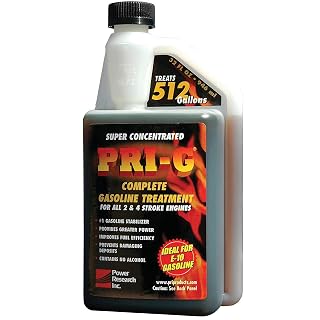
PRI-G
Complete Gasoline Treatment
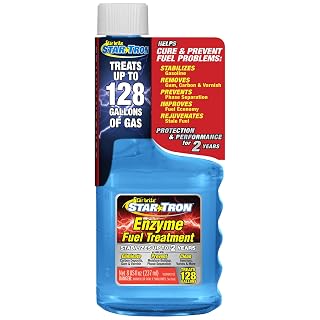
Star brite
Star Tron Enzyme Fuel Treatment
Yamaha
Yamalube Outboard Fuel Stabilizer & Conditioner Plus
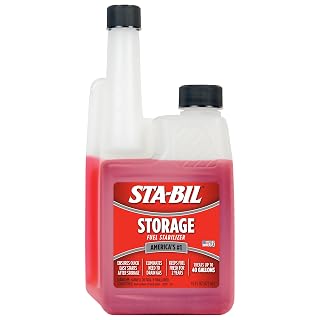
Gold Eagle Co.
STA-BIL Storage Fuel Stabilizer
As an Amazon Associate I earn from qualifying purchases. Full disclosure

Community
0 postsShare how you use this product
Drop a quick comment or post a full review with photos and a star rating.
Sign in to postNew here? Create a free account.