CarCareTruth Score
Decent.
Saved to your guest loadout. Sign up to also save to your Cabinet (consumables) or Kit (tools you own).
As an Amazon Associate I earn from qualifying purchases. Full disclosure
The manufacturer's Safety Data Sheet classifies this product with one or more GHS Category 1 health hazards — the most severe tier. The hazard statements in quotes below are the verbatim GHS language from the SDS, as required by OSHA's Hazard Communication Standard. The line under each statement translates the GHS classification into plain language.
GHS Category 1 aspiration toxicity — thin, oily liquids can slip into the lungs if swallowed, causing chemical pneumonia.
If swallowed:
The aspiration hazard (H304) is about the liquid being swallowed and reaching the airway, not about breathing fumes during normal use.
Call Poison Control immediately at 1-800-222-1222 (US, 24/7, free) and have the product container with you. Poison Control's standing guidance is to not induce vomiting after chemical exposure; they will direct first-aid steps based on the specific product.
About this product's hazards. This product's Safety Data Sheet uses signal word DANGER.Read the manufacturer's SDS and follow all safety instructions before use. CarCareTruth ratings translate the manufacturer's safety sheet. They do not replace the SDS or substitute for a hazard assessment specific to your task.
Health score is for adult use as intended, per the manufacturer's SDS. It does not model child ingestion, accidental spill cleanup, or off-label use. See the safety panel below for full hazard classification, and /disclaimer for the full editorial scope.
GHS hazard codes are quoted from the manufacturer’s Safety Data Sheet. PPE tiers below translate those codes and the listed ingredient chemistry; they are not CarCareTruth recommendations.
Show details for all categories ▾Hide details ▴
Translated from the manufacturer’s Safety Data Sheet, Section 8
SDS Section 8 calls for eye protection during use. Section 11 toxicology reports the aerosol may cause minor eye irritation on contact, and Section 2 carries no eye-damage GHS code (no H318, H319), so safety glasses address the documented irritation risk rather than a corrosive-level hazard.
CarCareTruth publishes the cited sources verbatim and does not advise what action a user should take. Consult the full SDS before use.
Translated from the manufacturer’s Safety Data Sheet, Section 8
SDS Section 8 calls for gloves and protective clothing. Section 11 toxicology reports the aerosol may cause slight skin irritation on contact, and Section 2 carries no skin-corrosion GHS code (no H314, H315), so gloves address the documented irritation risk from the petroleum distillate carrier rather than a corrosive hazard.
CarCareTruth publishes the cited sources verbatim and does not advise what action a user should take. Consult the full SDS before use.
Beyond SDS: translated from the ingredient chemistry
No inhalation H-codes (H330, H331, H335) at SDS §2 mixture level · the DANGER signal word is driven by H304 (aspiration hazard, ingestion pathway) and H222 (flammable aerosol), not by inhalation toxicity or respiratory irritation. The aerosol form factor with overhead underbody application in a semi-enclosed space places respiratory protection in the recommended tier per SDS §8 guidance; override from the default required tier: no inhalation H-codes at mixture level confirmed in SDS §2.
U.S. regulatory standard
29 CFR 1910.1200(f); 1910.132(d)
“The employer shall assess the workplace to determine if hazards are present, or are likely to be present, which necessitate the use of personal protective equipment.”
OSHA standards apply to workplaces. Cited here as the U.S. reference threshold for the underlying hazard class.
CarCareTruth publishes the cited sources verbatim and does not advise what action a user should take. Consult the full SDS before use.
No PPE specified in published sources for ventilation. Absence does not imply “not needed” — consult the full Safety Data Sheet.
PPE tiers translate the manufacturer’s SDS and U.S. regulatory standards. Not professional safety advice. How we report safety.
Scope of these PPE tiers. The tiers on this page translate the product's Safety Data Sheet where one is published, plus its ingredient chemistry, into a comparable rating. They describe a formulation, not a situation: a tier is not a safety determination for any specific user, task, quantity, or environment. The manufacturer's label and use instructions govern how the product is handled. Where the product is used at work, the employer's PPE program and hazard assessment under 29 CFR 1910.132 decide what protection is selected, not this page.
No warranties. CarCareTruth makes no warranties, express or implied, and expressly disclaims the implied warranties of merchantability and fitness for a particular purpose.
Last reviewed June 12, 2026
TL;DR Penetrating, non-drying corrosion protection that creeps into frame seams and welds · community-confirmed season-to-season performance in BITOG salt-belt threads with annual reapplication. The DANGER signal word means SDS §8 specifies a half-face respirator for overhead underbody aerosol use.
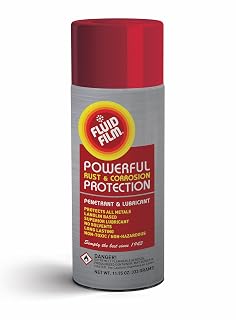
Fluid Film Black uses a petroleum distillate carrier with a sulfonated corrosion inhibitor (the brand's lanolin-based active) · a non-drying formula that penetrates seams and crevices rather than forming a hard film. The aerosol with the included extension wand reaches frame rails, door interiors, and underbody cavities. Hygroscopic chemistry blocks direct water-metal contact, which is how it holds up against road brine. BITOG threads and northern-tier owners confirm season-to-season protection; annual reapplication is the established expectation for salt-belt underbody use. No cure time needed before storage.
Right for salt-belt drivers treating frame rails, door interiors, and body seams before winter. Skip it on a vehicle with active rust perforation · a rust converter is the correct first step. Avoid aerosol application in a sealed garage: flash point −104°C means flammable vapors accumulate near ignition sources.
DANGER is driven by H304 (aspiration hazard) and H222 (extremely flammable aerosol). SDS §2 carries no inhalation H-codes (H330, H331, H335) and no skin or eye hazard classifications at the mixture level. SDS §8 specifies respiratory protection for aerosol use overhead in a semi-enclosed space. No Prop 65 warning per SDS §15. SDS §12 states the product is not harmful to aquatic organisms; CARB 310 compliant. The dominant petroleum distillate carrier (40-80%) has no SDS biodegradability data.
Community evidence from BITOG and northern-tier owners documents effective season-to-season corrosion protection with annual reapplication. The manufacturer's guidance also specifies annual reapplication for underbody use in salt-belt environments · outdoor exposure reduces protection faster than indoor or sheltered storage. Indoor equipment protection lasts longer (roughly 12 months or more in dry conditions). Fluid Film is a non-drying formula that creeps and self-heals into seams, which is a different performance profile from rubberized hard-set coatings that aim for 3-5 years per application.
The brand's marketing describes this as lanolin-based, and that framing reflects the product's positioning. SDS §3 lists Aristonate C-5000 (CAS 93820-57-6) as the active corrosion inhibitor · Aristonate C-5000 is a sulfonated petroleum derivative that may be a wool-wax (lanolin) sulfonate. The SDS does not list lanolin by name (CAS 8006-54-0). The dominant carrier (40-80%) is hydrotreated heavy paraffinic petroleum distillate. The manufacturer's 'no solvents' claim refers to absence of fast-evaporating VOC solvents · the petroleum distillate base is a lubricant oil, not a volatile solvent.
SDS §8 specifies respiratory protection for aerosol application. The SDS §2 mixture classification carries no inhalation H-codes (no H335 respiratory irritation, no H330 or H331 inhalation toxicity) · the DANGER signal word is from H304 aspiration hazard and H222 flammability, not from inhalation toxicity. For overhead underbody application in a semi-enclosed garage, a half-face respirator with organic vapor cartridges addresses the aerosol mist exposure scenario described in SDS §8.
Yes · this is a key advantage of the penetrating non-drying formula. It creeps into seams and around existing surface rust, absorbs moisture, and forms a hygroscopic barrier that denies water-metal contact. It is not a rust converter and does not chemically neutralize iron oxide, but it can slow and stabilize rust progression by excluding moisture. For severely perforated or structurally compromised metal, a rust converter or encapsulator followed by mechanical repair is the correct first step.
SDS §12 states the product is 'not considered harmful to aquatic organisms or to cause long-term adverse effects in the environment.' No aquatic toxicity H-codes (H400/H410/H411/H412) appear in the mixture classification. The product is CARB 310 compliant (VOC < 20% by weight). The dominant petroleum distillate carrier (CAS 64742-54-7, 40-80%) has no SDS biodegradability data · persistence in the environment is uncharacterized. The product cures on the vehicle and does not rinse to drains, which limits the direct aquatic exposure pathway.
Marketing copy from Fluid Film, via Amazon. Not editorial.
Weekly pick
One product, one safety verdict, every week. No spam.
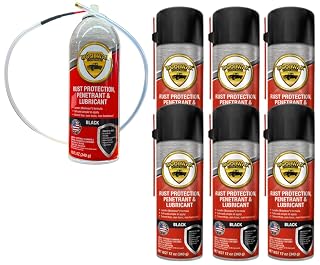
Woolwax
Black Aerosol Undercoating Spray (12 oz, 6-pack)
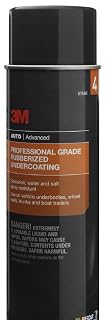
3M
Professional Grade Rubberized Undercoating (16 oz, Pack of 12)
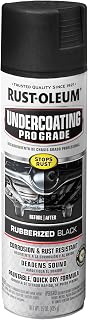
Rust-Oleum
248656 Professional Grade Rubberized Undercoating Spray (15 oz)
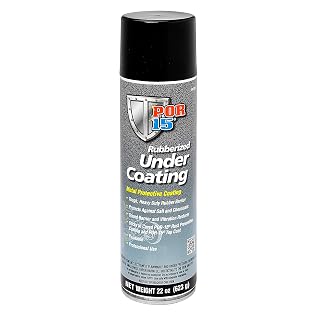
POR-15
Rubberized Undercoating
As an Amazon Associate I earn from qualifying purchases. Full disclosure

Community
0 postsShare how you use this product
Drop a quick comment or post a full review with photos and a star rating.
Sign in to postNew here? Create a free account.