CarCareTruth Score
Decent, but wear gloves and ventilate.
Opens Amazon in a new tab. No account needed to look.
Saved to your guest loadout. Sign up to also save to your Cabinet (consumables) or Kit (tools you own).
As an Amazon Associate I earn from qualifying purchases. Full disclosure
Prices may varyThe manufacturer's Safety Data Sheet classifies this product with one or more GHS Category 1 health hazards — the most severe tier. The hazard statements in quotes below are the verbatim GHS language from the SDS, as required by OSHA's Hazard Communication Standard. The line under each statement translates the GHS classification into plain language.
GHS Category 1 eye damage — classified as causing irreversible eye damage on contact.
If splashed in eyes:
Call Poison Control immediately at 1-800-222-1222 (US, 24/7, free) and have the product container with you. Poison Control's standing guidance is to not induce vomiting after chemical exposure; they will direct first-aid steps based on the specific product.
About this product's hazards. This product's Safety Data Sheet uses signal word DANGER.Read the manufacturer's SDS and follow all safety instructions before use. CarCareTruth ratings translate the manufacturer's safety sheet. They do not replace the SDS or substitute for a hazard assessment specific to your task.
Health score is for adult use as intended, per the manufacturer's SDS. It does not model child ingestion, accidental spill cleanup, or off-label use. See the safety panel below for full hazard classification, and /disclaimer for the full editorial scope.
GHS hazard codes are quoted from the manufacturer’s Safety Data Sheet. PPE tiers below translate those codes and the listed ingredient chemistry; they are not CarCareTruth recommendations.
Show details for all categories ▾Hide details ▴
Translated from the manufacturer’s Safety Data Sheet, Section 2
H318 (serious eye damage Cat 1) in SDS Section 2. GHS05 corrosive pictogram present for the eye-damage classification. Serious and potentially irreversible eye damage is the confirmed hazard classification. Upward spray application into wheel arches increases mist-to-face pathway. Safety goggles or splash glasses required by the H318 classification.
U.S. regulatory standard
29 CFR 1910.133(a)(1); 1910.151(c)
“The employer shall ensure that each affected employee uses appropriate eye or face protection when exposed to eye or face hazards from… liquid chemicals, acids or caustic liquids…”
ANSI Z87.1 (chemical splash protection — incorporated via §1910.6)
OSHA standards apply to workplaces. Cited here as the U.S. reference threshold for the underlying hazard class.
CarCareTruth publishes the cited sources verbatim and does not advise what action a user should take. Consult the full SDS before use.
Especially relevant: prolonged use
Translated from the manufacturer’s Safety Data Sheet, Section 2
H315 (skin irritation Cat 2) is classified at the SDS Section 2 mixture level. The SDS does not classify skin harm (H312) or skin corrosion (H314) at product level; SDS Section 11 confirms no additional skin-harm code. A real mixture-level skin H-code moves nitrile gloves to recommended for normal handling, not just for prolonged or repeated contact.
U.S. regulatory standard
29 CFR 1910.138(a)
“appropriate hand protection when employees' hands are exposed to hazards such as those from… chemicals which produce an adverse effect on the skin or eyes…”
OSHA standards apply to workplaces. Cited here as the U.S. reference threshold for the underlying hazard class.
CarCareTruth publishes the cited sources verbatim and does not advise what action a user should take. Consult the full SDS before use.
Only when: in enclosed space
Translated from the manufacturer’s Safety Data Sheet, Section 8
No inhalation H-codes at product level. SDS Section 11 confirms not classified as hazardous through inhalation (H332, H335, H331 are absent at product level). SDS Section 8 notes respiratory protection is necessary if a mist forms or occupational exposure limits are exceeded. The sulfur odor during dwell is a sensory indicator of thioglycolate volatiles. Apply outdoors or with adequate airflow.
CarCareTruth publishes the cited sources verbatim and does not advise what action a user should take. Consult the full SDS before use.
No PPE specified in published sources for ventilation. Absence does not imply “not needed” — consult the full Safety Data Sheet.
PPE tiers translate the manufacturer’s SDS and U.S. regulatory standards. Not professional safety advice. How we report safety.
California Prop 65 warning
This product's Amazon listing carries a California Prop 65 warning. The manufacturer's Safety Data Sheet (§15) does not list a Prop 65 substance for this product — we show the warning for transparency and flag the discrepancy rather than silently picking a side.
Scope of these PPE tiers. The tiers on this page translate the product's Safety Data Sheet where one is published, plus its ingredient chemistry, into a comparable rating. They describe a formulation, not a situation: a tier is not a safety determination for any specific user, task, quantity, or environment. The manufacturer's label and use instructions govern how the product is handled. Where the product is used at work, the employer's PPE program and hazard assessment under 29 CFR 1910.132 decide what protection is selected, not this page.
No warranties. CarCareTruth makes no warranties, express or implied, and expressly disclaims the implied warranties of merchantability and fitness for a particular purpose.
This product ranks #9 of 12 in Iron Remover.Three above it ↓
Last reviewed August 2, 2026
TL;DR DeCon Pro turns a vivid purple on brake-dusted paint and wheels and dissolves iron in a single application at the labeled dwell time; community evidence confirms both the color-change reaction and the removal performance. **DANGER signal word** on the SDS (H318 serious eye damage, H315 skin irritation): safety glasses are required by the H318 classification, and nitrile gloves are recommended for normal handling of the thioglycolate active. Confirmed pH 7.28 (neutral) from SDS; coating-safe by community consensus.
Spray onto cool paint panels, wheels, or glass, watch the product shift from clear to deep purple as the thioglycolate active pulls iron oxide out of the surface. The more contaminated the panel, the more vivid the reaction. Dwell 3-5 minutes (longer for heavy contamination), then pressure-rinse. A strong community evidence base across r/AutoDetailing and Detailing World confirms single-application removal on standard brake-dust and moderate rail dust loads on both paint and wheels. The dual-purpose positioning is supported by the chemistry: monoethanolamine thioglycolate reacts with iron regardless of substrate. The sulfur odor during dwell is present and notable by community consensus; use outdoors. Quality score 7.3/10, a solid mid-tier performance without the enthusiast-tier coating-ecosystem documentation of competitors like CarPro IronX.
The right pick for owners who want a single product covering both paint iron decontamination and brake-dust wheel cleaning at a competitive price, especially those already in the Chemical Guys ecosystem. It's a reliable choice before polishing, claying, or laying a maintenance coat on ceramic-coated paint or PPF. Skip it if odor control is a priority: Adam's Iron Remover's orange-scented reformulation is the strongest scent-mask in the pH-neutral category. Skip it if you're maintaining a specialized ceramic coating system that specifies a brand-approved iron remover; CarPro IronX has the deeper ecosystem documentation there.
The SDS (SPI215, rev. 2024-12-05) carries a DANGER signal word, driven by H318 (serious eye damage Cat 1) from the pH co-buffer thioglycolate active at 10-25%. The GHS05 corrosive pictogram on the label reflects this eye-damage classification; it is the eye hazard code, not a skin-corrosion indicator. Safety glasses or goggles are required by H318 when handling. H315 (skin irritation Cat 2) is the skin code; the SDS does not carry H312 (skin harm) or H314 (skin corrosion) at product level, but a real mixture-level irritant code still moves nitrile gloves to recommended for normal handling, not just for prolonged contact. The SDS Section 11 explicitly confirms the product is not classified as hazardous through inhalation (no H332, H335, or H331 at product level); the sulfur odor during dwell is a comfort consideration and a ventilation signal, not an inhalation hazard classification. Flash point 69C (157F); combustible liquid Cat 4, non-flammable under normal ambient use conditions. On environment: the formula contains 4-nonylphenol ethoxylate, a surfactant that degrades to 4-nonylphenol, a known endocrine disruptor; environment score 5/10 reflects the drain-destined rinse pathway, confirmed non-biodegradable NPE surfactant, and ingredient-level aquatic toxicity. Rinse to a sanitary drain, not a storm drain.
The SDS discloses a pH of 7.28, which is within the neutral range typically safe for ceramic coatings and PPF. Community evidence on r/AutoDetailing and Detailing World broadly supports the coating-safe claim for standard dwell times (3-5 minutes). For polished aluminum or anodized wheels, spot-test a hidden area first.
The purple color is iron-thioglycolate, the reaction product of the monoethanolamine thioglycolate active with iron oxide on the surface. The reaction is selective for ferrous iron, so the purple intensity reflects actual iron contamination level. Areas that don't turn purple have little to no bonded iron.
The SDS (SPI215, rev. 2024-12-05, Section 15) explicitly states California Proposition 65 is Not Applicable for this product; neither cancer nor reproductive harm listings apply. Amazon's platform sometimes displays a Prop 65 label on DeCon Pro listings, but this is a known false positive not supported by the SDS or ingredient cross-check.
The chemistry works on both; monoethanolamine thioglycolate reacts with iron oxide regardless of substrate. Community evidence confirms effective iron removal on painted surfaces, glass, and aluminum wheels in a single product. For vehicles with very heavy industrial fallout or rail dust on paint, a dedicated iron remover with higher active concentration may be needed.
Both use pH-neutral thioglycolate chemistry with similar active ingredient classes. CarPro IronX has deeper documentation within CarPro's coating maintenance ecosystem; DeCon Pro is positioned more broadly as a combined iron remover and wheel cleaner. Independent side-by-side community tests show comparable performance on brake dust, with some owners noting CarPro slightly ahead on heavy paint contamination and DeCon Pro competitive on wheel cleaning efficiency.
The SDS classifies H315 (skin irritation Cat 2) at the mixture level, which is a genuine chemistry signal rather than boilerplate. Nitrile gloves are recommended for normal handling, not just for prolonged or repeated contact, since the SDS does not carry a stronger skin-harm or corrosion code (H312 or H314) at the product level. Gloves are the practical choice any time you are spraying and dwelling the product on multiple panels.
Marketing copy from Chemical Guys, via Amazon. Not editorial.
Guide
Detailing Chemicals That Damage Paint, Trim, or Your Lungs
Most paint, trim, and respiratory damage from car-care products traces to a short list of chemistries (fluoride wheel acids, strong solvents, high-pH degreasers, isocyanate sprays, methylene chloride). This guide names the H-codes, the failure modes, and the catalog pages that show which products carry them.
Guide
Detailing PPE: When You Actually Need Gloves or a Respirator
Most weekend car care needs zero PPE. A small list of chemistries (fluoride wheel acids, isocyanate spray, strong solvent aerosols) genuinely does need gloves, goggles, or a respirator. This guide names the H-codes that trigger each, and points to safer picks by category.
Weekly pick
One product, one safety verdict, every week. No spam.


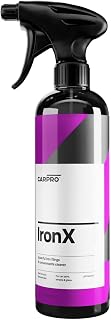
CarPro
IronX Iron Remover (500ml)
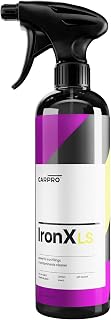
CarPro
IronX Iron Remover (Lemon Scent, 500ml)
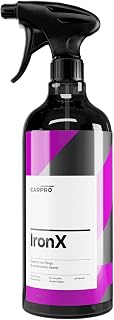
CarPro
IronX Iron Remover Cherry Scent (1 Liter)
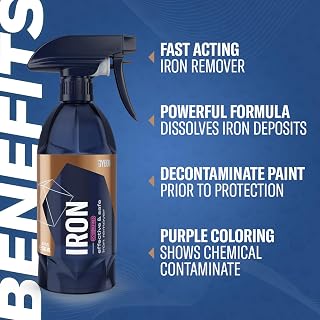
Gyeon
Q²M Iron Redefined
As an Amazon Associate I earn from qualifying purchases. Full disclosure

Community
0 postsShare how you use this product
Drop a quick comment or post a full review with photos and a star rating.
Sign in to postNew here? Create a free account.