CarCareTruth Score
Decent.
Opens Amazon in a new tab. No account needed to look.
Saved to your guest loadout. Sign up to also save to your Cabinet (consumables) or Kit (tools you own).
As an Amazon Associate I earn from qualifying purchases. Full disclosure
Prices may varyHealth score is for adult use as intended, per the manufacturer's SDS. It does not model child ingestion, accidental spill cleanup, or off-label use. See the safety panel below for full hazard classification, and /disclaimer for the full editorial scope.
GHS hazard codes are quoted from the manufacturer’s Safety Data Sheet. PPE tiers below translate those codes and the listed ingredient chemistry; they are not CarCareTruth recommendations.
Show details for all categories ▾Hide details ▴
Only when: when spraying
Translated from the manufacturer’s Safety Data Sheet, Section 8
H319 (eye irritation) and H318 (serious eye damage) are both absent from the proxy distributor SDS §2. SDS §8 directs safety glasses / chemical goggles if splashing is possible. Without a confirmed eye-irritation H-code, the tier is situational · eye protection applies when pump spray may reach the face (upward wheel-arch application, wind conditions).
CarCareTruth publishes the cited sources verbatim and does not advise what action a user should take. Consult the full SDS before use.
Translated from the manufacturer’s Safety Data Sheet, Section 8
H317 (Skin Sens. 1) confirmed in SDS §2 · ammonium mercaptoacetate is the sensitizing agent per SDS §11. H317 (skin sensitizer Cat 1) in SDS §2 · protective gloves recommended by the sensitization hazard classification. H312 (harmful in contact with skin) is absent from the proxy distributor SDS; its absence is flagged as a likely underclassification. SDS §8 directs nitrile gloves (0.35 mm, breakthrough ≥8 h) based on sensitization risk.
U.S. regulatory standard
29 CFR 1910.138(a); 1910.132(d)
“appropriate hand protection when employees' hands are exposed to hazards such as those from skin absorption of harmful substances.”
OSHA standards apply to workplaces. Cited here as the U.S. reference threshold for the underlying hazard class.
CarCareTruth publishes the cited sources verbatim and does not advise what action a user should take. Consult the full SDS before use.
Only when: in enclosed space · when spraying
Translated from the manufacturer’s Safety Data Sheet, Section 8
H332 (harmful if inhaled) is absent from the proxy distributor SDS §2. SDS §8 states breathing protection is not required under normal conditions with correct use, with a named trigger: insufficient ventilation combined with aerosol formation. The sulfur odor during dwell is a sensory indicator of thioglycolate volatile exposure · SDS §8's named ventilation trigger applies in enclosed spaces or when spray generates significant mist.
CarCareTruth publishes the cited sources verbatim and does not advise what action a user should take. Consult the full SDS before use.
No PPE specified in published sources for ventilation. Absence does not imply “not needed” — consult the full Safety Data Sheet.
PPE tiers translate the manufacturer’s SDS and U.S. regulatory standards. Not professional safety advice. How we report safety.
Scope of these PPE tiers. The tiers on this page translate the product's Safety Data Sheet where one is published, plus its ingredient chemistry, into a comparable rating. They describe a formulation, not a situation: a tier is not a safety determination for any specific user, task, quantity, or environment. The manufacturer's label and use instructions govern how the product is handled. Where the product is used at work, the employer's PPE program and hazard assessment under 29 CFR 1910.132 decide what protection is selected, not this page.
No warranties. CarCareTruth makes no warranties, express or implied, and expressly disclaims the implied warranties of merchantability and fitness for a particular purpose.
This product ranks #3 of 12 in Iron Remover.
Last reviewed June 14, 2026
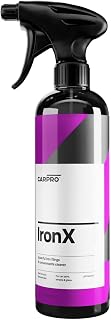
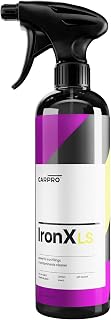
TL;DR CarPro IronX Cherry Scent turns a vivid purple within minutes on brake-dusted paint and wheels · the community reference for color-change iron removal with cherry fragrance to cut the sulfur smell. Safety data is from a proxy SDS (unfragranced formula); H317 skin sensitizer classification means gloves are required by the sensitization hazard classification when handling this product.
Spray onto cool wheels and painted panels, watch the surface go deep purple over three to five minutes, then pressure-rinse thoroughly. Community evidence across r/AutoDetailing, Detailing World, and independent YouTube comparisons confirms single-application iron dissolution on typical commuter contamination. The cherry fragrance reduces the sulfur odor that makes the unfragranced original difficult in enclosed areas. pH 7.5 formula is coating-safe; flash-drying on warm panels in direct sun is the main risk · work panel-by-panel in hot weather.
Right for enthusiasts on ceramic-coated or PPF-wrapped vehicles who want reduced odor for indoor or garage use. Buyers with light brake-dust accumulation on standard wheels may find a less expensive mid-market product sufficient.
Safety data is sourced from a proxy SDS (unfragranced formula, distributor source) · the cherry-scented formula's SDS has not been confirmed; PPE tiers should be treated as provisional. H317 (skin sensitizer Cat 1) in the proxy SDS means protective gloves are recommended by that hazard classification. The formula is drain-destined and the active chemistry has documented aquatic toxicity · direct runoff to storm drains or soil should be avoided.
ASIN B07XPGFKLC is the cherry-scented variant. The product listing specifications list 'Scent: Cherry,' and the feature bullets explicitly state 'Cherry Scented.' The SDS currently on file covers the unfragranced formula (sourced from a Canadian distributor) · a manufacturer-direct cherry-scented SDS has not been located. PPE tiers and safety data should be treated as provisional until the correct SDS is confirmed.
No · the iron-removal chemistry is identical. The active ingredient (ammonium mercaptoacetate at 10-30% per the proxy SDS) and pH-neutral formula (SDS-confirmed pH 7.5) are shared across all IronX variants. The cherry fragrance masks the characteristic sulfur odor without altering the color-change reaction or decontamination performance.
The brand markets IronX as pH-neutral (SDS-confirmed pH 7.5 for the unfragranced formula) and safe for ceramic coatings, sealants, and waxes within reasonable dwell windows (3-5 minutes maximum). Community evidence on r/AutoDetailing and Detailing World broadly supports the coating-safe claim across multiple coating brands and IronX variants.
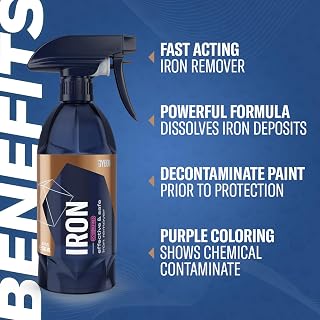
The purple color is the iron-thioglycolate reaction product · the active ingredient chelates iron oxide particles on the surface and the resulting complex is purple. The intensity scales with iron contamination load: vivid purple means heavy contamination, faint pink means light. When freshly applied product no longer turns purple on a panel, the accessible iron has been removed and the surface is ready to rinse.
CarPro recommends 3-5 minutes maximum. Do not let it dry on the surface · flash-drying on warm panels in direct sun locks unreacted product onto paint and requires aggressive rinsing. Apply panel-by-panel in summer or on warm vehicles, and keep the surface visually wet during the dwell window.
Marketing copy from CarPro, via Amazon. Not editorial.
Guide
Clay Bar vs Clay Mitt vs Nanoskin Pad: Real Differences
Clay bar wins for one-car home use and the most tactile feedback, though it is the least forgiving if you drop it. The more forgiving clay mitt wins for weekly maintenance and multi-car households. Nanoskin pad on a DA wins for trucks, vans, and shop volume. All three lift the same contamination when you match grade to paint and flood the panel with lubricant.
Guide
How Often to Actually Wash Your Car (by Climate)
Every two weeks is wrong for most people. Salt-belt cars need a full wash plus undercarriage rinse every 7 to 14 days through the salt season. Coastal cars run 2 to 3 weeks year-round. Desert cars stretch to 3 to 4 weeks but need waterless or rinseless methods in between.
Weekly pick
One product, one safety verdict, every week. No spam.

Gyeon
Q²M Iron Redefined
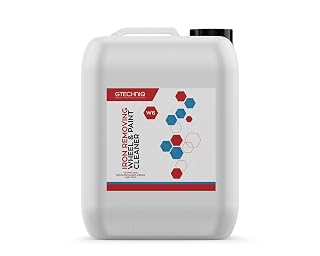
Gtechniq
W6 Iron and General Fallout Remover
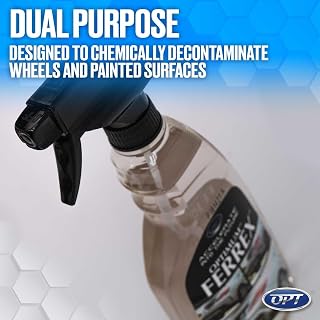
Optimum
FerreX Iron Remover
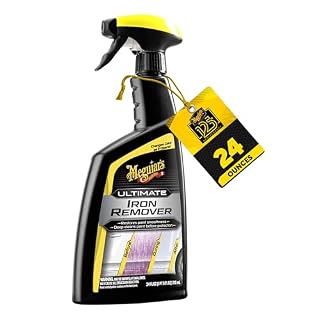
Meguiar's
Ultimate Iron Remover (24 oz)
As an Amazon Associate I earn from qualifying purchases. Full disclosure

Community
0 postsShare how you use this product
Drop a quick comment or post a full review with photos and a star rating.
Sign in to postNew here? Create a free account.