CarCareTruth Score
Mediocre, but wear gloves and ventilate.
Saved to your guest loadout. Sign up to also save to your Cabinet (consumables) or Kit (tools you own).
As an Amazon Associate I earn from qualifying purchases. Full disclosure
Health score is for adult use as intended, per the manufacturer's SDS. It does not model child ingestion, accidental spill cleanup, or off-label use. See the safety panel below for full hazard classification, and /disclaimer for the full editorial scope.
GHS hazard codes are quoted from the manufacturer’s Safety Data Sheet. PPE tiers below translate those codes and the listed ingredient chemistry; they are not CarCareTruth recommendations.
Show details for all categories ▾Hide details ▴
Only when: when spraying
Beyond SDS: translated from the ingredient chemistry
H319 (Eye Irritation Cat 2A) classified from MSDS hazard profile. User is outside the vehicle during the treatment cycle; primary eye exposure pathway is during initial pouch placement/water addition and during early-stage re-entry ventilation before the cabin is fully aired. MSDS §8 requires safety glasses or goggles for handling.
U.S. regulatory standard
29 CFR 1910.133(a)(1)
“The employer shall ensure that each affected employee uses appropriate eye or face protection when exposed to eye or face hazards from… liquid chemicals…”
ANSI Z87.1 (incorporated via §1910.6)
OSHA standards apply to workplaces. Cited here as the U.S. reference threshold for the underlying hazard class.
CarCareTruth publishes the cited sources verbatim and does not advise what action a user should take. Consult the full SDS before use.
Only when: sensitive individuals
Beyond SDS: translated from the ingredient chemistry
H315 (Skin Irritation Cat 2) classified from MSDS hazard profile. Sodium chlorite granules and the activated solution can irritate skin on direct contact. Normal consumer use (placing the pouch + adding water then exiting) involves brief skin contact with the dry pouch and minimal contact with the activated solution.
U.S. regulatory standard
29 CFR 1910.138(a)
“appropriate hand protection when employees' hands are exposed to hazards such as those from… chemicals which produce an adverse effect on the skin or eyes…”
OSHA standards apply to workplaces. Cited here as the U.S. reference threshold for the underlying hazard class.
CarCareTruth publishes the cited sources verbatim and does not advise what action a user should take. Consult the full SDS before use.
Especially relevant: in enclosed space
Beyond SDS: translated from the ingredient chemistry
aerosol_fogger form factor · categorical W5 rule: all total-release foggers receive lungs:required regardless of H-code profile. The Auto Shocker releases an oxidizing gas that fills the entire sealed cabin during the treatment cycle (2-24 hours). The gas is a respiratory irritant at elevated concentrations (ACGIH TWA 0.1 ppm; the sealed-cabin concentration during the treatment cycle exceeds this threshold). H335 (respiratory irritant) and the aerosol_fogger categorical rule both independently trigger required.
CarCareTruth publishes the cited sources verbatim and does not advise what action a user should take. Consult the full SDS before use.
The published Safety Data Sheet for this product does not specify ventilation protection for consumer use.
Workplace context
29 CFR 1910.134(a); 1910.1000
“the primary objective shall be to prevent atmospheric contamination [via] accepted engineering control measures (for example, enclosure or confinement of the operation, general and local ventilation, and substitution with less toxic materials).”
Triggered by GHS H335 on the SDS.
OSHA standards apply to workplaces. Cited here as the U.S. reference threshold for the underlying hazard class.
PPE tiers translate the manufacturer’s SDS and U.S. regulatory standards. Not professional safety advice. How we report safety.
Scope of these PPE tiers. The tiers on this page translate the product's Safety Data Sheet where one is published, plus its ingredient chemistry, into a comparable rating. They describe a formulation, not a situation: a tier is not a safety determination for any specific user, task, quantity, or environment. The manufacturer's label and use instructions govern how the product is handled. Where the product is used at work, the employer's PPE program and hazard assessment under 29 CFR 1910.132 decide what protection is selected, not this page.
No warranties. CarCareTruth makes no warranties, express or implied, and expressly disclaims the implied warranties of merchantability and fitness for a particular purpose.
Last reviewed June 9, 2026
TL;DR Genuine antimicrobial mechanism: the oxidizing gas kills odor-causing bacteria at the source, not fragrance masking. Health score 1.57 reflects real enclosed-space inhalation risk plus a Prop 65 warning on the product listing; the sealed cabin must be vacated for 2-24 hours, then aired 30 minutes before re-entry. Wear safety goggles when placing the pouch. Owners confirm strong results on cigarette smoke and mildew; deeply embedded pet urine in carpet padding is a documented weak point.
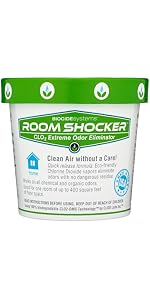
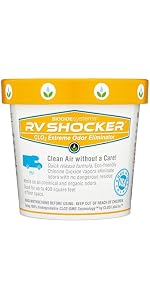
Single-use total-release fogger: add water to the activator granule pouch, place it on a hard surface inside the sealed vehicle, and exit. Over 2-24 hours the reaction generates an oxidizing gas that fills the entire cabin and permanently destroys odor molecules. Owner feedback is split: strong results on cigarette smoke, mildew, and food odors; failures on deeply saturated sources (urine soaked into carpet padding). Known failure mode: the pouch can pop during activation and spray solution that bleaches fabric. Place the canister in a cup holder, not on carpet.
Best for serious embedded odors · inherited smoker cars, mildew from water leaks, fuel spills · where fragrance-based foggers have already failed. Skip it if you cannot vacate the vehicle for the full protocol, or if the odor source is deeply saturated carpet padding; an enzyme spray applied directly to the wet area works better for that.
WARNING signal word (H335 respiratory irritant, H319 eye irritant, H315 skin irritant); health score 1.57 reflects enclosed-space inhalation exposure during the fog cycle plus an Amazon-listing Prop 65 warning that the pre-GHS MSDS does not clear. Do not re-enter before the 30-minute ventilation; wear safety goggles when placing the pouch. The formula degrades to salt water: no PFAS, no VOC load, confirmed biodegradable; environment score 8.0.
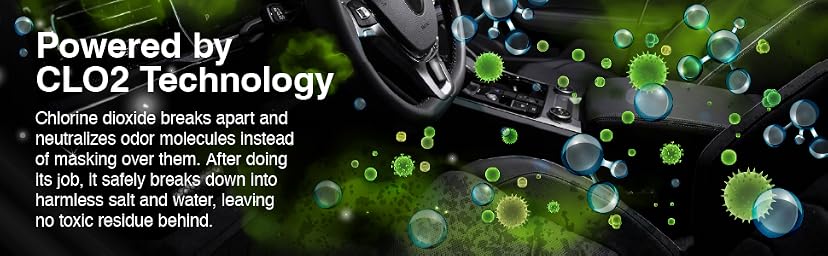
It eliminates them through oxidation. The active ingredient generates an oxidizing gas that reacts with and destroys odor-producing molecules rather than covering them with fragrance. Owner feedback, which is mixed overall, confirms this pattern: on cigarette smoke and mildew, the underlying odor does not return after treatment because the chemical compounds causing the smell have been oxidized. This is different from fragrance-based foggers, which wear off as the scent fades.
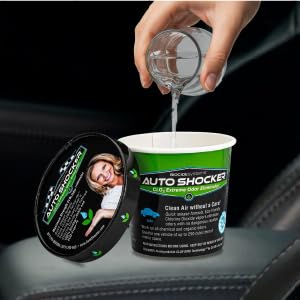
Activate the pouch by adding one full cup of cold water, then immediately exit and seal all doors and windows. Leave the vehicle sealed for 2-24 hours · 2 hours for light odors, up to 24 for heavy cigarette smoke or mildew. After the treatment cycle, open all doors and windows and ventilate for 30 minutes. Before entering, run the fan on recirculate mode for 15 minutes. Do not re-enter before the 30-minute airing is complete.
The Auto Shocker works best on smoke (cigarette, cannabis, BBQ), mildew and musty AC odors, food and grease odors, and gasoline or chemical off-gassing. It struggles on deeply saturated biological sources · dog or cat urine that has fully soaked into carpet padding or foam · because the gas reaches the surface but cannot penetrate deeply into wet substrate. For those cases, an enzyme spray applied directly to the saturated area and allowed to dwell before using the fogger as a finishing step gives better results.
Yes, and it is worth taking seriously. The sodium chlorite solution can bleach fabric, carpet, and upholstery on direct contact. The most common cause is the pouch clumping during activation and popping, spraying liquid across the interior. Multiple owner reviews document bleached carpet and upholstery from this failure mode. To minimize the risk: place the canister in a cup holder or on a hard flat surface (not directly on carpet), do not replace the lid during treatment, and follow the instructions to the letter. If the pouch pops, clean up the liquid immediately with large amounts of water before it dries.
The oxidizing gas has a characteristic chlorine-like odor (often described as 'swimming pool'). After ventilation, this residual smell typically dissipates within 1-3 days of normal driving with windows open. It is not a sign of product failure · it is residual off-gassing from treated surfaces. Owners consistently describe the chlorine smell as a temporary and acceptable trade-off for eliminating the underlying odor.
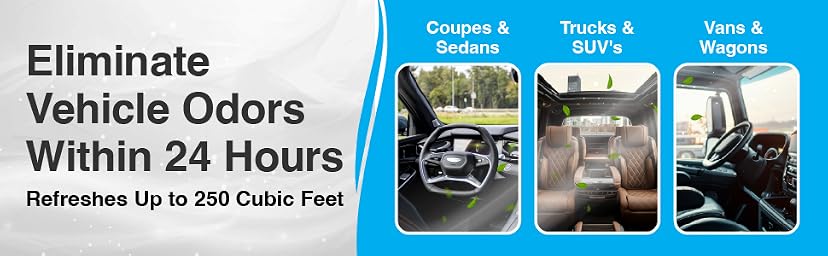
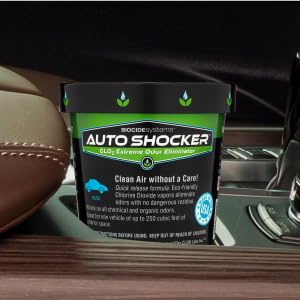
Marketing copy from Biocide Systems, via Amazon. Not editorial.
Weekly pick
One product, one safety verdict, every week. No spam.

Moso Natural
Air Purifying Bag 200g (Bamboo Charcoal Odor Absorber)
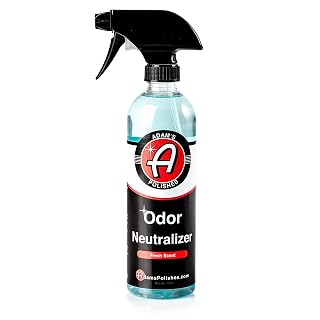
Adam's Polishes
Odor Neutralizer
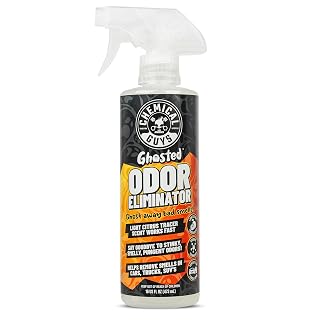
Chemical Guys
Ghosted Complete Interior Vehicle Odor Eliminator
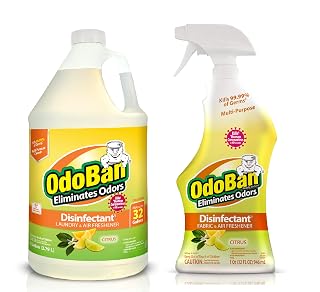
OdoBan
Ready-to-Use Disinfectant and Odor Eliminator (Citrus, 32 oz)
As an Amazon Associate I earn from qualifying purchases. Full disclosure

Community
0 postsShare how you use this product
Drop a quick comment or post a full review with photos and a star rating.
Sign in to postNew here? Create a free account.