CarCareTruth Score
Decent.
Opens Amazon in a new tab. No account needed to look.
Saved to your guest loadout. Sign up to also save to your Cabinet (consumables) or Kit (tools you own).
As an Amazon Associate I earn from qualifying purchases. Full disclosure
Prices may varyThis product ranks #3 of 4 in Paint Thickness Gauge.
Last reviewed June 14, 2026
TL;DR Dual-substrate coating thickness gauge with three-way Fe/NFe/Zn auto-detection (steel, aluminum, and galvanized), a ruby measuring tip, and a hard EVA carrying case included. Manufacturer-stated ±(3 percent plus 1 µm) accuracy is not independently corroborated and no calibration foils are included for multi-point self-verification, which limits accuracy confidence to on-device zero calibration only. Owner reception has been solid since it hit the market in 2019, though the review base is still modest. The ruby probe at this price tier is the differentiated spec; the missing foil kit is the structural gap.
The VVV-Group CM-206X is a consumer-tier coating thickness gauge with three-way automatic substrate recognition (Fe steel, NFe aluminum, Zn galvanized) confirmed from manufacturer feature bullets and the on-screen substrate icon visible in product imagery. Range is 0 to 1500 µm with 0.1 µm resolution. The measuring probe uses a ruby tip per the manufacturer claim, which reduces surface wear during repeated panel-to-panel measurements. A backlit color-segment LCD shows the current reading plus the running mean and the AUTO mode indicator. Throughput is up to 120 measurements per minute. Operating range is -13°F to 131°F. Power is 2 AAA alkaline cells; a silicone protective sleeve and a hard EVA zippered carrying case are included. No calibration foils ship with the unit, only on-device zero calibration, and no USB or wireless data export is documented.
Right pick for an owner, dealership inspector, or mobile appraiser who needs three-way substrate auto-detection (Fe, NFe, Zn) on modern mixed-panel vehicles plus the ruby probe for resistance to repeated-measurement wear, and who can carry the gauge in the included hard EVA case during field work. Skip it if multi-point foil-based calibration verification is required for the workflow, since the CM-206X ships with no foils and supports only on-device zero calibration. Skip it also if on-device batch memory or PC data export is needed for documentation, since the gauge does not store readings or transfer them; the ERAY gauge in this category offers both for a comparable price tier.
No chemical exposure pathway. Paint thickness gauges are handheld measurement instruments with no operating emission, no consumable, and no chemistry, so the health score reflects the tool baseline of 9.5. Power is 2 AAA alkaline batteries, replaceable, with disposal via Call2Recycle or retail drop-off. The included hard EVA carrying case and silicone protective sleeve extend the housing's useful life by reducing impact damage during field carry. No manufacturer calibration-service or take-back program is documented; the device itself is standard e-waste at end of life.
Fe refers to ferrous substrates (steel body panels), NFe refers to non-ferrous substrates (aluminum, copper, brass), and Zn refers to galvanized steel (zinc-coated). The CM-206X auto-detects which substrate type is under the probe and switches measurement modes accordingly; the substrate icon is displayed on the LCD with each reading so the user knows which mode produced the number. The Zn mode is an extension beyond the standard dual-Fe/NFe spec and is useful for galvanized truck body panels and some structural members.
Not per the Amazon feature bullets. The CM-206X supports on-device zero calibration but does not ship with the multi-point foil set that competing prosumer gauges include for verification across the full thickness range. This is a structural weakness for workflows that require periodic self-verification beyond a zero check; users who need foil-based verification can buy a third-party calibration foil set separately.
The probe tip is made of ruby (corundum, aluminum oxide) per the manufacturer claim. Ruby is exceptionally hard, so the tip resists wear from repeated contact with painted panels over the gauge's life. This is a real differentiator at the consumer-storefront price tier where most probes use harder steel or carbide tips that wear faster on glossy panels.
Yes. The NFe mode covers non-ferrous panels including aluminum, and the auto-detect identifies the substrate without manual switching. The substrate icon on the LCD confirms which mode produced the reading. Independent F-150 or Audi-panel community bench tests have not been located in current sources, so the auto-detect behavior on aluminum is treated as a strong manufacturer claim rather than as an independently verified outcome.
The ERAY gauge has a more complete on-device feature set: 320-reading memory across four groups, on-screen mean / min / max statistics, user-settable alarm limits, and USB data export with PC software. The VVV-Group CM-206X has a ruby probe, three-way Fe/NFe/Zn auto-detect, and a hard EVA carrying case included. The ERAY has the broader owner base and slightly stronger community reception, while the CM-206X's review base is still more modest. Pick the ERAY for data export and statistics; pick the CM-206X for the ruby probe and the included hard case.
Marketing copy from VVV-Group, via Amazon. Not editorial.
Weekly pick
One product, one safety verdict, every week. No spam.


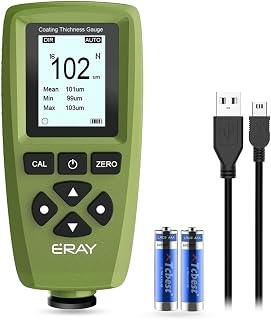
ERAY
Paint Thickness Gauge with Backlit LCD and USB Export
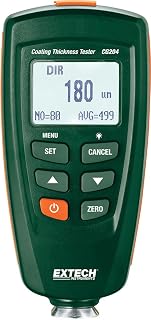
Extech Instruments
CG204 Coating Thickness Tester
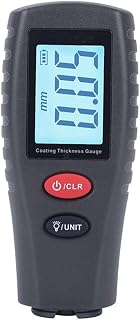
Reenwee
YNB-100 Paint Thickness Gauge
As an Amazon Associate I earn from qualifying purchases. Full disclosure

Community
0 postsShare how you use this product
Drop a quick comment or post a full review with photos and a star rating.
Sign in to postNew here? Create a free account.