CarCareTruth Score
Decent.
Saved to your guest loadout. Sign up to also save to your Cabinet (consumables) or Kit (tools you own).
As an Amazon Associate I earn from qualifying purchases. Full disclosure
About this product's hazards. This product's Safety Data Sheet uses signal word DANGER.Read the manufacturer's SDS and follow all safety instructions before use. CarCareTruth ratings translate the manufacturer's safety sheet. They do not replace the SDS or substitute for a hazard assessment specific to your task.
Health score is for adult use as intended, per the manufacturer's SDS. It does not model child ingestion, accidental spill cleanup, or off-label use. See the safety panel below for full hazard classification, and /disclaimer for the full editorial scope.
GHS hazard codes are quoted from the manufacturer’s Safety Data Sheet. PPE tiers below translate those codes and the listed ingredient chemistry; they are not CarCareTruth recommendations.
Show details for all categories ▾Hide details ▴
Especially relevant: splash risk
Beyond SDS: translated from the ingredient chemistry
SDS §9 discloses pH approximately 12 (from 2018 SDS; current SDS states 'not determined' but disodium metasilicate as pH adjuster is consistent with pH 12-<13). The W19 validator rule enforces eyes: required when disclosed pH ≥ 12 · the alkalinity pathway justifies this tier independently of the SDS §2 mixture-level H-code classification, which does not carry H319.
CarCareTruth publishes the cited sources verbatim and does not advise what action a user should take. Consult the full SDS before use.
Especially relevant: prolonged use
Beyond SDS: translated from the ingredient chemistry
SDS §9 pH approximately 12. W19 enforces skin: required at pH ≥ 12 regardless of mixture-level H-codes. SDS §2 does not classify H315 or H314 at mixture level, but the alkaline pH (~12) from disodium metasilicate creates a skin irritation pathway on repeated or prolonged contact. The tier reflects pH chemistry, not SDS §2 classification.
U.S. regulatory standard
29 CFR 1910.132(d); 1910.138(a)
“appropriate hand protection when employees' hands are exposed to hazards such as those from… chemical burns.”
OSHA standards apply to workplaces. Cited here as the U.S. reference threshold for the underlying hazard class.
CarCareTruth publishes the cited sources verbatim and does not advise what action a user should take. Consult the full SDS before use.
Only when: in enclosed space
Beyond SDS: translated from the ingredient chemistry
SDS §2 carries no respiratory H-codes (no H335 or H336) at mixture level. Aerosol format in a closed car cabin concentrates spray particles in ~3 m³ more than open-air use. No chemistry-driven inhalation hazard is present, but the aerosol delivery system in an enclosed space is the situational trigger.
CarCareTruth publishes the cited sources verbatim and does not advise what action a user should take. Consult the full SDS before use.
No PPE specified in published sources for ventilation. Absence does not imply “not needed” — consult the full Safety Data Sheet.
PPE tiers translate the manufacturer’s SDS and U.S. regulatory standards. Not professional safety advice. How we report safety.
Scope of these PPE tiers. The tiers on this page translate the product's Safety Data Sheet where one is published, plus its ingredient chemistry, into a comparable rating. They describe a formulation, not a situation: a tier is not a safety determination for any specific user, task, quantity, or environment. The manufacturer's label and use instructions govern how the product is handled. Where the product is used at work, the employer's PPE program and hazard assessment under 29 CFR 1910.132 decide what protection is selected, not this page.
No warranties. CarCareTruth makes no warranties, express or implied, and expressly disclaims the implied warranties of merchantability and fitness for a particular purpose.
Last reviewed May 25, 2026
TL;DR Aerosol foam cleaner for car fabric, carpet, vinyl, and plastic trim · requires prompt wiping to avoid tide marks. DANGER signal word is from flammable aerosol chemistry (physical hazard only; no health H-codes at mixture level). pH approximately 12 carries a compatibility concern for soft-touch rubberized panels.
Tuff Stuff dispenses as thick expanding foam that clings to surfaces during a 30-40 second dwell before wiping. The foam format limits liquid penetration compared to pump-spray mist · useful for fabric-backed surfaces and overhead applications. On standard hard plastic trim it handles light fingerprints adequately; heavy dressing residue may need a second pass. Prompt wiping is required · the label explicitly warns that dried foam leaves spotting on car finish. The alkaline silicate chemistry (pH ~12) drives cleaning power but limits use on soft-touch rubberized panels without a prior spot test.
Best for owners cleaning fabric seats, floor mats, and carpet where the aerosol foam format limits moisture penetration. Also effective on vinyl and standard hard plastic trim. Products formulated at neutral pH are better suited for repeated cleaning of soft-touch panels · the pH ~12 alkalinity carries a repeated-use compatibility concern for those surfaces. Not a UV protectant or dressing.
DANGER is driven by physical hazard codes only · H222/H229 (Flammable Aerosol Cat 1, pressurized container) and H290 (Corrosive to Metals). No health H-codes are classified at the mixture level in SDS §2 (rev 2026-03-16). Prop 65 warning for trace ethylene glycol monomethyl ether, 1,4-dioxane, and sodium nitrite. Keep away from heat and flame. pH ~12 places eyes and skin PPE in the required tier (W19 rule). 2-Butoxyethanol is an aquatic toxicant; SDS §13 instructs against drain disposal.
The SDS chemistry shows pH approximately 12 from disodium metasilicate. Products with pH in the neutral-to-slightly-alkaline range avoid the alkalinity concern for soft-touch panels; pH 12 falls into the high-alkaline bracket where soft-touch coatings can be affected with repeated use. No widespread community documentation of permanent damage exists, but the label does not explicitly confirm soft-touch safety. Spot-testing on a hidden panel is the documented industry recommendation for alkaline cleaners on soft-touch trim.
The DANGER signal word is driven by physical hazard classifications · specifically Flammable Aerosol Cat 1 (H222) and pressurized container (H229). These are fire and explosion hazards related to the isobutane propellant. The current SDS (rev 2026-03-16) does not classify any health-tier H-codes at the mixture level. Keep away from heat, sparks, and open flame.
The California Proposition 65 warning on the product listing covers substances identified in SDS §15: ethylene glycol monomethyl ether (trace impurity, listed for developmental and male reproductive harm) and 1,4-dioxane (trace impurity from ethoxylated surfactant manufacturing, listed as a carcinogen). Sodium nitrite (<1%, intentional preservative/corrosion inhibitor) is also Prop 65 listed for carcinogenicity. None of these are primary cleaning actives.
The aerosol foam format is frequently cited in detailing communities as a safer format for headliner cleaning compared to pump-spray liquids · foam deposits significantly less liquid than spray mist and is less likely to saturate the headliner backing board. The label instructs spraying 'liberally,' but the foam self-limits liquid penetration. No widespread headliner delamination complaints are documented in community reviews. Standard guidance: apply foam, let dwell 30-40 seconds, blot with a damp cloth · avoid saturating.
The label explicitly warns that dried foam can leave spotting · specifically noting to wipe overspray from glass before it dries and to use powdered cleanser to remove dried-on residue from glass. On dark upholstery or plastic, tide marks are possible if excess foam is allowed to dry in place. Wiping promptly with a dry cloth after the 30-40 second dwell period is the documented technique to avoid residue.
Marketing copy from Tuff Stuff, via Amazon. Not editorial.
Weekly pick
One product, one safety verdict, every week. No spam.

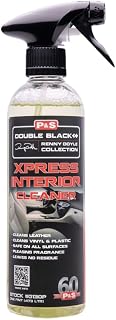
P&S Detail Products
Xpress Interior Cleaner
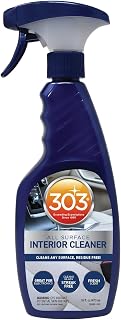
303 Products
Interior Cleaner
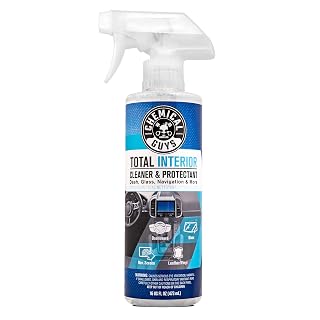
Chemical Guys
Total Interior Cleaner & Protectant
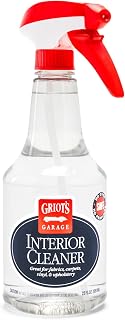
Griot's Garage
Interior Cleaner
As an Amazon Associate I earn from qualifying purchases. Full disclosure

Community
0 postsShare how you use this product
Drop a quick comment or post a full review with photos and a star rating.
Sign in to postNew here? Create a free account.