CarCareTruth Score
Decent, but wear gloves and ventilate.
Opens Amazon in a new tab. No account needed to look.
Saved to your guest loadout. Sign up to also save to your Cabinet (consumables) or Kit (tools you own).
As an Amazon Associate I earn from qualifying purchases. Full disclosure
Prices may varyThe manufacturer's Safety Data Sheet classifies this product with one or more GHS Category 1 health hazards — the most severe tier. The hazard statements in quotes below are the verbatim GHS language from the SDS, as required by OSHA's Hazard Communication Standard. The line under each statement translates the GHS classification into plain language.
GHS Category 2 acute oral toxicity — classified as toxic if swallowed.
GHS Category 2 acute dermal toxicity — classified as toxic in contact with skin.
GHS Category 2 acute inhalation toxicity — classified as toxic if inhaled.
If swallowed, inhaled or on skin:
Call Poison Control immediately at 1-800-222-1222 (US, 24/7, free) and have the product container with you. Poison Control's standing guidance is to not induce vomiting after chemical exposure; they will direct first-aid steps based on the specific product.
About this product's hazards. This product's Safety Data Sheet uses signal word DANGER.Read the manufacturer's SDS and follow all safety instructions before use. CarCareTruth ratings translate the manufacturer's safety sheet. They do not replace the SDS or substitute for a hazard assessment specific to your task.
Health score is for adult use as intended, per the manufacturer's SDS. It does not model child ingestion, accidental spill cleanup, or off-label use. See the safety panel below for full hazard classification, and /disclaimer for the full editorial scope.
GHS hazard codes are quoted from the manufacturer’s Safety Data Sheet. PPE tiers below translate those codes and the listed ingredient chemistry; they are not CarCareTruth recommendations.
Show details for all categories ▾Hide details ▴
Translated from the manufacturer’s Safety Data Sheet, Section 2
H370 STOT SE Cat 1 targets the CNS and optic nerve as a systemic toxicity route; SDS §8 specifies eye protection. GHS08 health-hazard pictogram is present. Required given H370 targets eyes directly.
U.S. regulatory standard
29 CFR 1910.133(a)(1)
“The employer shall ensure that each affected employee uses appropriate eye or face protection when exposed to eye or face hazards from… liquid chemicals…”
ANSI Z87.1 (incorporated via §1910.6)
OSHA standards apply to workplaces. Cited here as the U.S. reference threshold for the underlying hazard class.
CarCareTruth publishes the cited sources verbatim and does not advise what action a user should take. Consult the full SDS before use.
Translated from the manufacturer’s Safety Data Sheet, Section 2
H311 classifies this product as acutely toxic by dermal contact (Cat 3); methanol absorbs through skin causing systemic poisoning. SDS §8 specifies protective gloves. Required given the H311 dermal toxicity classification.
U.S. regulatory standard
29 CFR 1910.132(d); 1910.138(a)
“appropriate hand protection when employees' hands are exposed to hazards such as those from skin absorption of harmful substances.”
OSHA standards apply to workplaces. Cited here as the U.S. reference threshold for the underlying hazard class.
CarCareTruth publishes the cited sources verbatim and does not advise what action a user should take. Consult the full SDS before use.
Translated from the manufacturer’s Safety Data Sheet, Section 2
H331 classifies this product as acutely toxic by inhalation (Cat 3). SDS §8 specifies respiratory protection in confined or poorly ventilated spaces. Required given the H331 inhalation toxicity classification.
U.S. regulatory standard
29 CFR 1910.134(a)(1)–(2)
“When effective engineering controls are not feasible… appropriate respirators shall be used.”
OSHA standards apply to workplaces. Cited here as the U.S. reference threshold for the underlying hazard class.
CarCareTruth publishes the cited sources verbatim and does not advise what action a user should take. Consult the full SDS before use.
No PPE specified in published sources for ventilation. Absence does not imply “not needed” — consult the full Safety Data Sheet.
PPE tiers translate the manufacturer’s SDS and U.S. regulatory standards. Not professional safety advice. How we report safety.
Scope of these PPE tiers. The tiers on this page translate the product's Safety Data Sheet where one is published, plus its ingredient chemistry, into a comparable rating. They describe a formulation, not a situation: a tier is not a safety determination for any specific user, task, quantity, or environment. The manufacturer's label and use instructions govern how the product is handled. Where the product is used at work, the employer's PPE program and hazard assessment under 29 CFR 1910.132 decide what protection is selected, not this page.
No warranties. CarCareTruth makes no warranties, express or implied, and expressly disclaims the implied warranties of merchantability and fitness for a particular purpose.
This product ranks #6 of 9 in Deicer / Frost Spray.Three above it ↓
Last reviewed August 2, 2026
TL;DR Methanol-based aerosol deicer; health score 1.2/10 reflects genuine acute toxicity, not an error. SDS Section 2 finds it toxic if swallowed, inhaled, or skin-absorbed, with CNS and eye organ damage, so goggles, gloves, and a respirator are required. Label claims -25°F; cold-climate verification is limited.
Community cold-climate verification is limited: reviews confirm reliable ice clearing, but few buyers report sub-zero test conditions, so the label's -25°F claim (chemically plausible since methanol does not freeze until -144°F) is not independently confirmed at that extreme. This is a methanol-based aerosol formula rather than the more common isopropyl-alcohol deicer, and methanol carries real acute-toxicity hazards IPA formulas do not. Surface safety is solid: no chloride content, and owners report no paint, seal, or trim damage. The 11 oz can is smaller than the 16-22 oz category standard and also thaws frozen locks.
Right for buyers who need a very-low freeze-point formula and will use the required PPE every time: goggles, gloves, and a respirator. Not a casual glove-box spray. Buyers wanting a lower-hazard aerosol deicer should choose an IPA-based formula instead.
SDS Section 2 assigns DANGER from real health hazards: toxic if swallowed (H301), skin contact (H311), inhalation (H331), and organ damage to the CNS and optic nerve (H370). Section 15 confirms Prop 65 for methanol and 2-methoxyethanol. H311 and H370 push all three PPE categories to required. Environment scores 6/10: high VOC is offset by SDS Section 12.3's confirmed biodegradability.
Yes. This is a methanol-based aerosol formula, not a salt- or chloride-based deicer, so it carries no corrosion risk for paint or metal. The manufacturer states it is safe for painted finishes and harmless to painted rubber components, and owners have not reported paint, trim, or seal damage. Independent multi-season forum confirmation is still limited.
Most consumer deicers use isopropyl alcohol and score in the 7 to 9 range on health. Penray 5216 is methanol-based instead, and SDS Section 2 classifies methanol as acutely toxic if swallowed, inhaled, or absorbed through skin, with organ damage to the CNS and optic nerve. That genuine acute-toxicity profile, not a chemistry error, drives the 1.2/10 score.
SDS Section 8 specifies eye protection, protective gloves, and respiratory protection in confined or poorly ventilated spaces. Because methanol absorbs through skin and its vapor is toxic if inhaled, all three PPE categories translate to required: safety goggles, nitrile gloves, and an organic-vapor respirator, not the situational protection typical of IPA-based deicers.
The chemistry supports it: methanol does not freeze until about -144°F, so the formula cannot lock up at any realistic outdoor temperature. However, no independent cold-climate community reports specifying sub-zero test conditions were found among owner reviews, so the -25°F label claim is chemically plausible but not independently confirmed at that extreme.
Yes. The product is positioned for both windshield de-icing and frozen door lock applications. Spraying into a lock cylinder briefly concentrates methanol vapor in a small enclosed gap, which is part of why the lungs PPE tier stays elevated; a single brief application is the intended use case, not sustained multi-lock sessions without ventilation.
Marketing copy from Penray, via Amazon. Not editorial.
Weekly pick
One product, one safety verdict, every week. No spam.


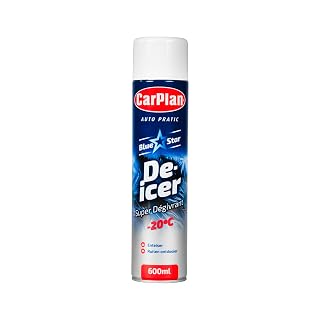
CarPlan
Blue Star De-Icer Spray
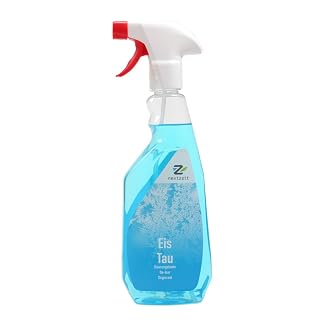
nextzett
Eistau De-Icer Spray
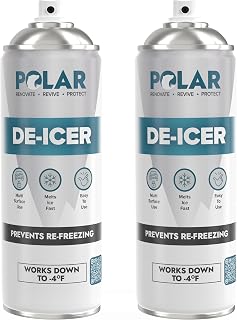
Polar Specialist Coatings
Polar De-Icer Spray
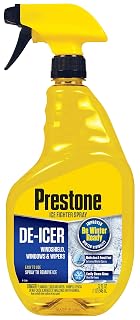
Prestone
AS247 Trigger Spray Windshield De-Icer
As an Amazon Associate I earn from qualifying purchases. Full disclosure

Community
0 postsShare how you use this product
Drop a quick comment or post a full review with photos and a star rating.
Sign in to postNew here? Create a free account.