CarCareTruth Score
Decent, but it's tough on the environment.
Saved to your guest loadout. Sign up to also save to your Cabinet (consumables) or Kit (tools you own).
As an Amazon Associate I earn from qualifying purchases. Full disclosure
Health score is for adult use as intended, per the manufacturer's SDS. It does not model child ingestion, accidental spill cleanup, or off-label use. See the safety panel below for full hazard classification, and /disclaimer for the full editorial scope.
GHS hazard codes are quoted from the manufacturer’s Safety Data Sheet. PPE tiers below translate those codes and the listed ingredient chemistry; they are not CarCareTruth recommendations.
Show details for all categories ▾Hide details ▴
Only when: splash risk
Translated from the manufacturer’s Safety Data Sheet, Section 8
SDS §8 calls for safety glasses with side shields, or chemical goggles. SDS §2 carries no eye-hazard GHS code, and SDS §11 states the liquid is 'not thought to be an irritant' with 'no adverse effect observed' in registered eye-irritation data, though direct splash contact can still cause transient discomfort (tearing, redness, described in the SDS as windburn-like). Safety glasses cover a routine pour into an oil fill port; goggles matter more if pouring from a larger container or decanting.
CarCareTruth publishes the cited sources verbatim and does not advise what action a user should take. Consult the full SDS before use.
Translated from the manufacturer’s Safety Data Sheet, Section 8
SDS §8 calls for chemical-resistant gloves (PVC), an apron, and barrier cream. SDS §11 reports the paraffinic carrier can degrease skin on repeated contact, producing non-allergic contact dermatitis, and specifically warns against exposing open cuts or broken skin to the product, even though it is not classified as an irritant under EC criteria. Gloves are the practical safeguard for handling the can and pouring.
CarCareTruth publishes the cited sources verbatim and does not advise what action a user should take. Consult the full SDS before use.
Only when: in enclosed space
Translated from the manufacturer’s Safety Data Sheet, Section 2
H336 (STOT-SE Cat 3 · narcotic effects) in SDS §2. Brief above-waist pour from a small 300 mL can into an engine oil fill port has minimal vapor exposure. In a closed garage without ventilation, vapor accumulation from the petroleum carrier is plausible at the engine bay temperature. SDS §7 requires storage and use in a well-ventilated area (P271, P261).
CarCareTruth publishes the cited sources verbatim and does not advise what action a user should take. Consult the full SDS before use.
The published Safety Data Sheet for this product does not specify ventilation protection for consumer use.
Workplace context
29 CFR 1910.134(a); 1910.1000
“the primary objective shall be to prevent atmospheric contamination [via] accepted engineering control measures (for example, enclosure or confinement of the operation, general and local ventilation…).”
Triggered by GHS H336 on the SDS.
OSHA standards apply to workplaces. Cited here as the U.S. reference threshold for the underlying hazard class.
PPE tiers translate the manufacturer’s SDS and U.S. regulatory standards. Not professional safety advice. How we report safety.
Scope of these PPE tiers. The tiers on this page translate the product's Safety Data Sheet where one is published, plus its ingredient chemistry, into a comparable rating. They describe a formulation, not a situation: a tier is not a safety determination for any specific user, task, quantity, or environment. The manufacturer's label and use instructions govern how the product is handled. Where the product is used at work, the employer's PPE program and hazard assessment under 29 CFR 1910.132 decide what protection is selected, not this page.
No warranties. CarCareTruth makes no warranties, express or implied, and expressly disclaims the implied warranties of merchantability and fitness for a particular purpose.
Last reviewed July 8, 2026
TL;DR Molybdenum disulfide (MoS2) is among the best-studied solid friction modifiers in tribology literature · the mechanism is real, peer-reviewed, and substantially different from PTFE ('Teflon') or 'nano' additive categories that have weaker evidence. For this specific Liqui Moly product, no independent ASTM D4172 Four-Ball test or UOA wear-metal analysis data has been published, so community evidence (multiple BITOG threads with consistent positive sentiment) is the best available corroboration. Explicitly compatible with catalytic converters and DPF/GPF particulate filters · the compatibility question ZDDP buyers have to wrestle with does not apply here.
Liqui Moly MoS2 Anti-Friction Engine Treatment suspends molybdenum disulfide (MoS2) solid lubricant particles in a heavy paraffinic petroleum carrier. MoS2 is a layered crystalline material: under shear, its molecular layers slide against each other, depositing a low-friction boundary film on metal surfaces that persists even when the oil film temporarily thins (cold starts, high-load conditions). This mechanism is well-documented in tribology peer review; the chemistry class scores significantly better in the evidence hierarchy than PTFE or undisclosed "nano" formulations. The Liqui Moly product is marketed for all 4-stroke gasoline and diesel engines, with or without turbochargers, and the label confirms compatibility with catalytic converters and DPF/GPF particulate filters · making it one of the few oil additives positioned for modern vehicles without the phosphorus caveat that applies to ZDDP products. Community data on BITOG shows consistent positive reports of reduced engine noise and smoother operation, though no used-oil analysis comparing wear metals before and after has been published for this specific product.
Best for owners of modern 4-stroke gasoline or diesel engines who want a supplemental friction modifier and have confirmed their base oil doesn't already include a robust organomolybdenum additive package. Also appropriate for high-mileage or older engines where reducing friction at cold-start is a priority. Skip it if your vehicle's OEM oil specification already includes a moly-based friction modifier (many European-spec and Japanese OEM oils do) · you are unlikely to see additional benefit from a duplicate chemistry. The strongest use case is engines that run on mineral or conventional oil without factory moly content.
The SDS (WHMIS 2015 / OSHA HazCom 2012 compatible, Revision 2019-11-01) classifies this product with a WARNING signal word and a single H-code: H336 (STOT-SE Cat 3 · may cause drowsiness or dizziness from the petroleum carrier vapors). There are no skin-irritation (H315), eye-irritation (H319), or aspiration-hazard (H304) classifications at the mixture level · the SDS §11 toxicology data confirms no adverse skin or eye effects for this product. During the pour, working outdoors or with the garage door open addresses the H336 vapor concern; a closed garage with engine heat increases vapor concentration and is the relevant trigger scenario. The SDS classifies no aquatic toxicity at mixture level (fish LC50 >100 mg/L). As with all petroleum-based fluids mixed into engine oil, used oil goes to a collection facility · not down a drain or storm sewer. Most automotive retailers and municipal hazardous waste programs accept used oil at no charge.
Yes · Liqui Moly explicitly states on the product label that the MoS2 Anti-Friction Engine Treatment is 'Safe for use with catalytic converters and particulate filters (GPF/DPF).' MoS2 (molybdenum disulfide) is a solid-film friction modifier, not a ZDDP (zinc/phosphorus) additive. ZDDP products are the ones known to poison catalytic converters through phosphorus deposition. MoS2 does not introduce zinc or phosphorus, so the catalytic converter compatibility concern that applies to high-ZDDP additives does not apply here.
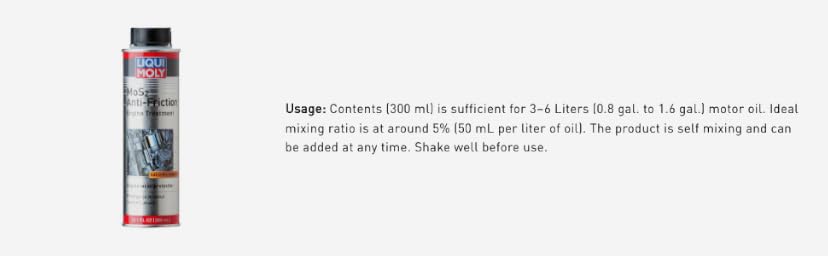
The label states 300 mL (one full can) is sufficient for 3-6 liters (0.8-1.6 gallons) of motor oil. For a standard 4-5 quart passenger-car fill, one 300 mL can is the correct dose · this works out to roughly 5-10% of total oil volume, which is within the range where tribology research on MoS2 additives shows meaningful film formation without disrupting base oil viscosity. Add at each oil change.
Molybdenum disulfide (MoS2) is a layered solid lubricant with a crystal structure that allows molecular layers to slide against each other under shear force · this is the same mechanism that makes graphite slippery. In engine oil, suspended MoS2 particles can deposit on metal surfaces and form a low-friction boundary layer that stays in place even when the oil film momentarily breaks down (cold starts, high-load conditions). The chemistry is well-studied in tribology literature; it differs from PTFE ('Teflon') additives, which have a much weaker evidence base.
The label positions this product for all 4-stroke gasoline and diesel engines with or without turbochargers, and explicitly confirms catalytic converter compatibility. Unlike high-ZDDP additives that are specifically aimed at flat-tappet classic engines, the MoS2 product is compatible with modern engines. That said, modern engine oils formulated to current API SP/GF-6 specifications already contain friction modifiers (often organomolybdenum compounds); the incremental benefit of this additive in a modern engine is debated in the community.
Marketing copy from Liqui Moly, via Amazon. Not editorial.
Weekly pick
One product, one safety verdict, every week. No spam.


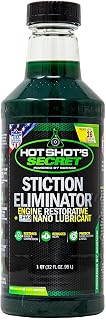
Hot Shot's Secret
Original Stiction Eliminator
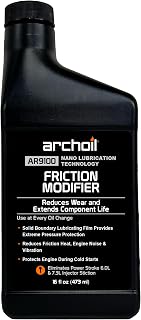
Archoil
AR9100 Oil Treatment
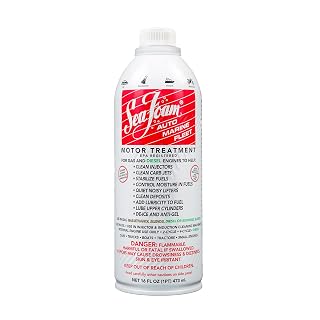
Sea Foam
Motor Treatment
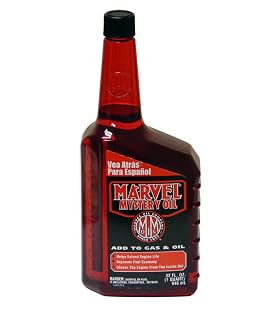
Marvel
Mystery Oil Original Motor Treatment
As an Amazon Associate I earn from qualifying purchases. Full disclosure

Community
0 postsShare how you use this product
Drop a quick comment or post a full review with photos and a star rating.
Sign in to postNew here? Create a free account.