
Best Chrome Polish of 2026: 10 Scored, Ranked by What They Actually Cut
We score every chrome polish we can verify, for performance and ingredient safety. These are the 8 best of 10 in our catalog.
CarCareTruth scored 10 metal polishes for 2026, and Simichrome All Metal Polish ranks first: a German-made concentrated paste with a fine abrasive that pulls a mirror off pitted chrome faster than anything else here. It is also the only polish here classified as a suspected carcinogen, and it carries a Prop 65 warning and 253 g/L of VOC, so if you want that finish without those numbers, Autosol Metal Polish scores within 0.05 of it and its safety sheet carries no signal word, no hazard classification and no Prop 65 warning at all. Mothers California Gold Chrome Polish is the liquid pick and the only one here that leaves a polymer barrier behind instead of bare metal. For bare aluminum rather than plating, Mothers Mag and Aluminum Polish is the decades-old flagship and takes a machine. Eagle One Nevr-Dull is cotton wadding in a tin, which is the wrong tool for a wheel and the right one for a grille. One warning worth carrying into the aisle: Blue Magic 400 is marketed 'Non-abrasive' twice on its own listing, and its own safety data sheet discloses activated aluminium oxide at 10 to 30 percent.
Affiliate disclosure: CarCareTruth is reader-supported. As an Amazon Associate I earn from qualifying purchases. We may also earn commissions from other retailers linked on this page, at no extra cost to you. Affiliate revenue never influences our scores or rankings. Full disclosure
Best of Chrome Polish
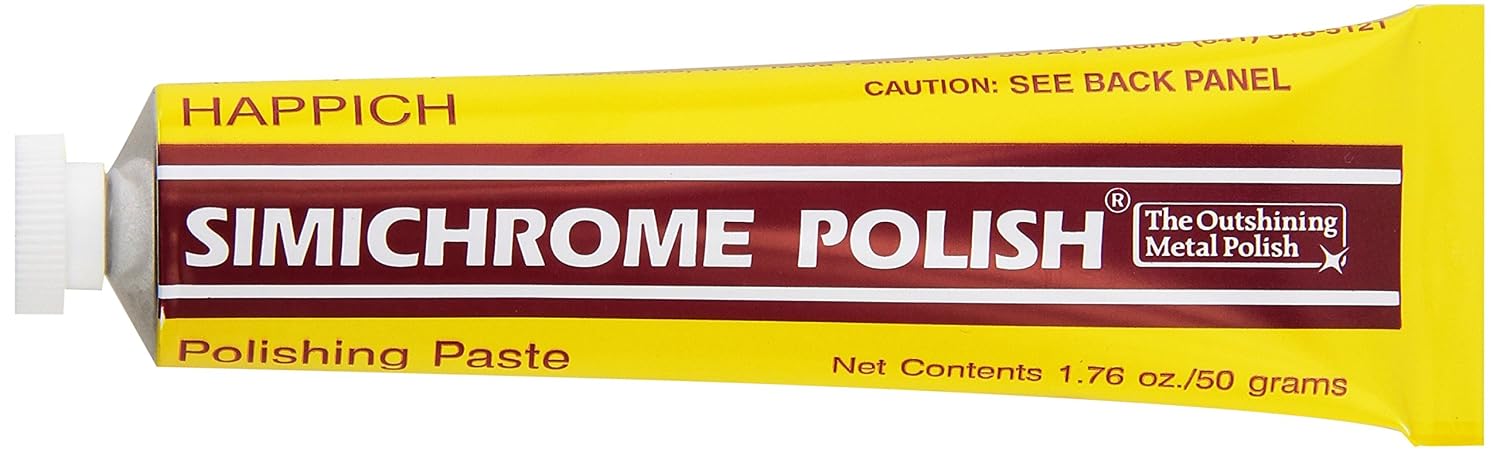
Simichrome All Metal Polish Tube
The Full Ranking
| Rank | Product | CCTCCT Score | HealthHealth & Safety | Price tier | Buy |
|---|---|---|---|---|---|
1 | All Metal Polish TubeSimichromeBest Overall Prop 65 | 7.5/10 | 6.0/10 | Check Price | |
2 | Metal PolishAutosolBest Without the Hazard Sheet | 7.4/10 | 8.5/10 | Check Price | |
3 | Heavy Metal Polish Restorer and ProtectantChemical Guys Prop 65 | 6.5/10 | 4.6/10 | Check Price | |
4 | 3D Metal Polish · Heavy Duty Car Metal Polish for All Metals3D Car Care Biodegradable | 6.5/10 | 5.0/10 | Check Price | |
5 | Mag & Aluminum PolishMothersBest for Bare Aluminum | 6.3/10 | 5.0/10 | Check Price | |
6 | 400 Metal Polish CreamBlue Magic | 6.0/10 | 4.0/10 | Check Price | |
7 | Metal PolishMeguiar's Prop 65 | 5.9/10 | 5.5/10 | Check Price | |
8 | Nevr-Dull All Metal Wadding PolishEagle OneBest for Grilles and Tight Trim | 5.3/10 | 5.0/10 | Check Price |
Why each pick earned its spot
Best Overall: Simichrome All Metal Polish Tube
Simichrome is the polish that shows up in motorcycle and hot-rod circles when someone posts pitted chrome and asks what will save it. It is a German-made concentrated paste, a fine abrasive in a petroleum-distillate carrier with an ammonia-based cleaner, and owners who have used both describe a pea-sized amount on a microfiber cutting noticeably faster than the milder creams here. It ranks first on our card and it is the top pick in the category. What you are trading for that speed is the safety sheet: a WARNING signal word, an H351 suspected-carcinogen classification, a Prop 65 warning driven by a diethanolamine amide, and 253 g/L of VOC. Worth being exact about what that does and does not mean. Four products on this page carry DANGER, the more severe of the two GHS signal words, and Simichrome carries the lesser WARNING. But it is the only one of the ten classified as a suspected carcinogen, and that is the line most people will care about. Use it outdoors or with the garage door open, wear nitrile, and if that classification bothers you, the next pick scores within 0.05 without it.
Best Without the Hazard Sheet: Autosol Metal Polish
Autosol scores 7.43 against Simichrome's 7.48, a gap small enough that no one buffing a bumper will feel it, and it gets there with a safety sheet that carries no signal word, no mixture-level hazard classification, and no Prop 65 warning. It earns a health score of 8.5 where Simichrome earns 6. Owners reach for it on chrome, brass, copper and polished alloy, and describe it as an easy pull to a mirror by hand. Worth being precise about the evidence there: that reputation rests on a large and consistent owner base rather than on forum threads with before-and-after photos, which is why its finish score stops short of the top of our scale. Where this one costs you is the carrier: a C10 to C13 hydrocarbon base still means gloves and a ventilated space, and it is a paste, so it wants hand pressure and a clean towel rather than a machine. For most people asking which chrome polish to buy, this is the one we would actually hand them.
Best for Bare Aluminum: Mothers Mag & Aluminum Polish
Chrome plating and bare aluminum are different jobs and want different products, and this is the one built for the second. Mothers' decades-old flagship uses an aluminum-oxide abrasive in a petroleum-distillate carrier, and it is explicitly for uncoated, unplated metal: aluminum wheels, stainless, brass, magnesium, bronze, copper, nickel. It is also the pick here most at home on a machine, which is the difference between an afternoon and a whole weekend on a set of polished wheels. Two things to watch: its safety sheet carries a DANGER signal word and is the one pick here that puts eye and skin protection at required rather than optional, so safety glasses and gloves are not a suggestion on this one. And the word 'uncoated' up there is doing real work. On a clear-coated wheel this is the wrong product and will haze the coating rather than brighten anything under it.
Best for Grilles and Tight Trim: Eagle One Nevr-Dull All Metal Wadding Polish
Nevr-Dull is not a liquid or a paste. It is a tin of cotton wadding pre-soaked in solvent and polish, and you tear off a piece and work it with your fingers. That format is the right answer for the things a towel cannot reach: grille slats, badge lettering, spoke wheels, exhaust tips, the ribbed bits of vintage trim. It has been sold in the same tin for decades and old-car people are loyal to it for exactly this reason. This is also the lowest-scoring pick on the page and the reasons are not small: a DANGER signal word from the solvent, the worst environmental score in the category at 1 out of 10, and cut mild enough that heavy pitting is beyond it. Buy it as the detail-work companion to one of the pastes above, not as your only polish.
Full ranked catalog — including picks 11+, out-of-stock options, and the ones we couldn’t crown.
How we rank
Every chrome polishin our catalog runs through the same scoring rubric: measured effectiveness, ingredient-safety data translated from each product’s SDS, and environmental impact. We don’t take placement fees, and affiliate links never move a product up the list.
Metal polish shopping goes wrong in one specific way: people buy the most aggressive product they can find and use it on the thinnest metal on the car. Chrome is a plating a few microns thick over steel or plastic, and once you cut through it, no product on this page brings it back. Bare aluminum is the opposite problem, a soft metal that oxidizes into a grey film and genuinely needs an abrasive with some bite to come back. So the first question is not which polish is best, it is which metal you are working on, because the answer changes the product. Anything sold for uncoated aluminum wheels is more aggressive than chrome plating needs, and anything mild enough to be safe on plating will feel useless against real aluminum oxidation.
The second thing worth knowing before you shop is that in this category, cut and safety pull against each other harder than in most. The polish that ranks first here is also the only one of the ten classified as a suspected carcinogen and it carries a Prop 65 warning, while the product scoring 0.05 behind it has no signal word, no hazard classification and no Prop 65 warning at all. That is not a small difference in a closed garage, and it is worth settling before you are standing in the aisle rather than after you have opened the wrong tin indoors. These are solvent-carried products across the board, so gloves and open air are the baseline regardless of which one you pick, and one goes further than that: Mothers Mag and Aluminum Polish is the only pick here whose own safety sheet puts eye and skin protection at required rather than recommended. A proper microfiber also matters more here than in most categories, because you are moving loosened oxide around and a loaded towel puts it straight back onto the metal.
Read the label for the word "uncoated" and take it literally. Most factory wheels made this century are clear-coated, and polish on a coated wheel hazes the clear instead of brightening the metal underneath, which is a repair rather than a mistake you can buff out. If water beads on the wheel and it looks like painted metal, it is coated, and what it wants is a wheel cleaner and protection rather than an abrasive. And polish is subtractive, so the way to keep chrome bright is not to polish it more often but to protect it afterward, either with a polish that leaves a polymer barrier or with a wax or sealant over the freshly cleaned metal. Salt season is where chrome is actually lost.
How we score: CCT grades each metal polish on cut and finish quality, on the honesty of its labeling against its own published chemistry, and on health translated directly from its safety data sheet rather than from marketing copy. Scores move when the evidence moves, and four products on this page had their environment scores corrected in August 2026 after we found a formula error in our own category rubric.
Related guides
Frequently Asked Questions
What is the difference between chrome polish and metal polish?
In practice, almost nothing, and that is why every product on this page is sold as a metal polish rather than a chrome-specific one. Chrome is a thin plating over another metal, so what a polish is really doing is removing oxidation and light contamination from a plated surface, which is the same job it does on brass or aluminum. What actually differs between products is cut, meaning how aggressive the abrasive is, and whether anything is left behind afterward. The distinction worth shopping on is not the word on the label, it is whether the product is rated for plated surfaces or for bare uncoated metal, because an aluminum polish aimed at raw wheels is more aggressive than thin chrome plating needs.
Will chrome polish damage the plating?
It can, and this is the real risk in the category rather than a theoretical one. Chrome plating is measured in microns, and an aggressive aluminum-grade abrasive worked hard in one spot can cut through it, at which point no polish brings it back. Two habits prevent it: start with the mildest product that will do the job and only escalate if it will not, and keep the pressure light and the passes moving rather than grinding one pit. If the chrome is already flaking or showing rust bleeding through from underneath, polish is the wrong tool entirely, because the plating has failed and what is left needs re-plating, not buffing.
Can you use chrome polish on clear-coated wheels?
No, and this catches people every year. Rinse the wheel and watch the water: if it sits in beads instead of sheeting off, that is clear coat, and abrading it just clouds the finish the coating was there to protect. A polished-alloy wheel that is genuinely bare feels slightly different too, warmer and less glassy, and it will leave grey on a white towel where a coated wheel leaves nothing. Mothers Mag and Aluminum Polish prints 'uncoated, unplated' on the label for exactly this reason, and the same caution applies to the other aggressive pastes here. On a coated wheel the right products are a wheel cleaner and a sealant, and the polish stays in the drawer for the rare set that is actually raw metal.
Is non-abrasive chrome polish real?
Some of it is, and some of it is a label claim the safety sheet does not support. Flitz genuinely classifies as not hazardous under GHS and is rated safe on painted surfaces, glass and plastics, which is consistent with a very mild formula. Blue Magic 400, by contrast, is marketed as 'Non-abrasive' twice on its own product listing, while the manufacturer's own safety data sheet discloses activated aluminium oxide at 10 to 30 percent by weight, and the listing's own specification table separately names aluminum oxide as its grit material. Aluminium oxide is an abrasive. The product may still be mild in use, but the claim as printed is not supported by the document the manufacturer publishes about it.
Should you use two different polishes, a coarse one then a fine one?
On genuinely oxidized metal, yes, and this is the step most first-timers skip. The trade approach is the same two-stage logic as paint correction: a product with real cut to remove the oxide layer, then a finer polish to bring up the mirror, because the abrasive that removes heavy tarnish leaves its own fine haze behind. On this page that means something like Mothers Mag and Aluminum or 3D Metal Polish for the first pass on bare aluminum, then Simichrome or Autosol to finish. Two caveats. On chrome plating, skip the coarse stage entirely and start fine, because the plating is microns thick and the cut stage is where people go through it. And if one fine polish is bringing the finish up on its own, you are done, since every pass removes material you do not get back.
Why does the towel turn black when polishing chrome or aluminum?
Because it is working. The black on the cloth is oxidized metal lifting off the surface along with spent abrasive, and on bare aluminum it can be dramatic enough that people stop mid-job thinking they have damaged something. You have not. What matters is what you do with that loaded towel: keep folding to a clean face, and swap to a fresh one when a panel stops coming up bright, because a saturated cloth stops cutting and starts dragging the oxide you just removed back across the metal. It also means the towels you use for metal are done for paintwork, so keep them separate. On plated chrome you should see far less of it, and if a chrome piece is producing heavy black residue pass after pass, that is worth a second look, because you may be into the layer under the plating rather than cleaning the plating itself.
Do you need a machine to polish chrome?
Not for most jobs. Chrome trim, bumpers and exhaust tips are hand work, and a machine on a curved bumper mostly buys you the chance to burn through an edge. Where a machine earns its place is large flat runs of bare polished aluminum, which is why Mothers Mag and Aluminum Polish is the pick here that is happiest on one: a set of polished alloy wheels or a truck's aluminum tank is a lot of surface area to cover by hand. If you do go to a machine, keep the speed low, keep it moving, and stay off the edges where the metal is thinnest.
How often should you polish chrome?
As rarely as the finish lets you get away with, because every polish removes a little material and chrome plating is not a renewable resource. Once or twice a season is plenty for a driven car, and the way to stretch that is to protect the metal after polishing rather than polishing more often. Mothers California Gold is the pick here that does both in one step by leaving polymers behind, and a wax or sealant over freshly polished metal does the same job. Winter is the exception worth watching: road salt attacks bare and plated metal fast, so a wash and a fresh coat of protection before and after salt season saves far more chrome than aggressive polishing ever will.
What is the safest chrome polish to use?
On our scoring, Flitz and Autosol tie for the best health score in the category at 8.5, and Autosol is the one currently in stock. Both carry no mixture-level hazard classification and no Prop 65 warning. At the other end it depends which risk you are asking about. Simichrome is the only one of the ten classified as a suspected carcinogen, but its signal word is the lesser WARNING, while 3D Metal Polish, Mothers Mag and Aluminum, Blue Magic 400 and Eagle One Nevr-Dull all carry the more severe DANGER. On raw count of hazard classifications the worst is Eagle One Nevr-Dull, whose sheet lists seven against Simichrome's one, and Mothers Mag and Aluminum is the only product here that puts eye and skin protection at required rather than recommended. Meguiar's Metal Polish is a case worth knowing about: its safety sheet declares no hazard classification at all, but the manufacturer publishes a separate ingredient-disclosure page that names beta-myrcene, which California lists as a carcinogen. Whichever you buy, these are solvent products, so gloves and moving air are the two habits that matter.
Why is Flitz not one of the picks when it scores highest?
Because you cannot currently buy it. Flitz Metal Polish Paste scores 7.75, the highest in this category, and pairs it with the joint-best health score at 8.5, so on the numbers alone it would lead this page. As of 14 August 2026 the listing reads as out of stock on two independent live checks, and a buying guide that leads with a product nobody can add to a cart is not much of a buying guide. It stays in the ranked list below for reference, and if it comes back into stock it will be a genuinely strong option, particularly because it is the one polish here rated safe on painted surfaces, glass and plastics rather than metal only.
#1 · All Metal Polish Tube
7.5/10 CCT