CarCareTruth Score
Decent, but wear gloves and ventilate.
Opens Amazon in a new tab. No account needed to look.
Saved to your guest loadout. Sign up to also save to your Cabinet (consumables) or Kit (tools you own).
As an Amazon Associate I earn from qualifying purchases. Full disclosure
Prices may varyHealth score is for adult use as intended, per the manufacturer's SDS. It does not model child ingestion, accidental spill cleanup, or off-label use. See the safety panel below for full hazard classification, and /disclaimer for the full editorial scope.
GHS hazard codes are quoted from the manufacturer’s Safety Data Sheet. PPE tiers below translate those codes and the listed ingredient chemistry; they are not CarCareTruth recommendations.
Show details for all categories ▾Hide details ▴
Translated from the manufacturer’s Safety Data Sheet, Section 2
SDS §8 directs safety glasses with side shields or tight-sealing goggles, and SDS §9 gives a strongly alkaline pH of 12.0-12.8. At that alkalinity, eye protection is warranted, especially for overhead engine-bay spray where mist reaches eye level.
CarCareTruth publishes the cited sources verbatim and does not advise what action a user should take. Consult the full SDS before use.
Translated from the manufacturer’s Safety Data Sheet, Section 2
SDS §8 directs protective natural-rubber, nitrile, neoprene, or PVC gloves for prolonged use. The pH-12.4 alkaline chemistry can irritate skin on extended contact during agitation, though it falls short of the caustic-corrosive threshold that would force gloves.
CarCareTruth publishes the cited sources verbatim and does not advise what action a user should take. Consult the full SDS before use.
Only when: in enclosed space
Beyond SDS: translated from the ingredient chemistry
There is no respiratory H-code at mixture level and the SDS discloses no VOC; the water-based formula has no inhalation pathway under normal use. SDS §8 states no protection is needed under normal conditions. The enclosed_space trigger captures engine-bay spray in a closed garage, where mist can accumulate.
CarCareTruth publishes the cited sources verbatim and does not advise what action a user should take. Consult the full SDS before use.
No PPE specified in published sources for ventilation. Absence does not imply “not needed” — consult the full Safety Data Sheet.
PPE tiers translate the manufacturer’s SDS and U.S. regulatory standards. Not professional safety advice. How we report safety.
Scope of these PPE tiers. The tiers on this page translate the product's Safety Data Sheet where one is published, plus its ingredient chemistry, into a comparable rating. They describe a formulation, not a situation: a tier is not a safety determination for any specific user, task, quantity, or environment. The manufacturer's label and use instructions govern how the product is handled. Where the product is used at work, the employer's PPE program and hazard assessment under 29 CFR 1910.132 decide what protection is selected, not this page.
No warranties. CarCareTruth makes no warranties, express or implied, and expressly disclaims the implied warranties of merchantability and fitness for a particular purpose.
This product ranks #8 of 10 in Engine Degreaser.Three above it ↓
Last reviewed July 6, 2026
TL;DR Spray Nine 26825 is a ready-to-use, water-based spray that doubles as a cleaner, degreaser, and EPA-registered disinfectant across engine bays, shop surfaces, and household grime. It handles road film, light-to-moderate grease, and stains with a spray-on, wipe-off routine rather than dissolving years of baked-on oil in one pass. There is no signal word on its SDS, but the chemistry is strongly alkaline (pH 12.4), so safety glasses are the right call and gloves are sensible on longer jobs. The listing also carries a California Proposition 65 warning the SDS does not clear.
This is a ready-to-use alkaline cleaner you spray straight from the bottle, not a concentrate. On an engine bay it lifts road film, light-to-moderate greasy buildup, and general grime with a short dwell and a wipe or rinse; it is better understood as a versatile all-surface cleaner than a solvent-strength stripper for heavily oil-caked bays. Being water-based with no petroleum solvents, it rinses cleanly with little residue. The real caveat is surface safety: at pH 12.4 it is strongly alkaline, so spot-test bare aluminum and finished engine covers before a long dwell. A genuine bonus is that it is an EPA-registered disinfectant, useful on shop and household surfaces too.
The right pick for someone who wants one grab-and-go spray for road film, light-to-moderate engine-bay grease, and general shop or household cleaning, with disinfecting thrown in and no mixing. Anyone facing years of baked-on, oil-caked buildup may want a heavier solvent-based degreaser; buyers who care about per-ounce value are better served by a dilutable concentrate, and anyone working on bare aluminum or delicate finishes should spot-test first given the alkaline pH.
The SDS carries no signal word and no hazard codes: the manufacturer classifies it as not hazardous under the 2012 OSHA Hazard Communication Standard. That is not the whole story, because SDS §9 reports a strongly alkaline pH of 12.0-12.8. At that alkalinity the liquid can irritate eyes and skin, so SDS §8 directs safety glasses (or goggles) and protective gloves for prolonged use; eye protection is sensible when spraying overhead into an engine bay where mist reaches face level. The SDS states no respiratory protection is required under normal conditions, and the chemistry agrees: water-based, non-flammable, no inhalation hazard code. Still, use it outdoors or in a well-ventilated garage. The listing carries a California Proposition 65 warning the SDS does not affirmatively clear, so the health score treats that signal at face value. Environmentally the SDS offers little to credit: no biodegradability data, and engine-bay rinse water still carries dissolved oil toward storm drains, so keep runoff away from them.
It is ready to use (RTU), not a concentrate. You spray it straight from the trigger bottle onto the surface, let it dwell briefly, agitate greasy areas, then wipe or rinse. Because there is no dilution step, a bottle does not stretch as far as a diluted concentrate, and there is no ratio to adjust for lighter or heavier soils. That convenience is the trade-off: less per-ounce value and less flexibility than a concentrate, but nothing to mix.
The SDS §3 is fully redacted, so the exact chemistry cannot be independently verified, but the manufacturer describes it as water-based with no petroleum solvents, which are the usual cause of rubber swelling. The main caution is the pH of 12.0-12.8: strongly alkaline cleaners can dull or etch bare aluminum and some finished surfaces on prolonged contact. Spot-test finished engine covers and polished aluminum in an inconspicuous area first, and avoid long dwell on warm surfaces.
The two statements answer different questions. The SDS §2 classification is that the product is not considered hazardous under the 2012 OSHA Hazard Communication Standard, which is a workplace hazard rule. The product listing carries a separate California Proposition 65 warning, and the SDS §15 asserts the product contains a Prop 65 chemical but leaves the substance name blank. Because the listing shows the warning and the SDS does not affirmatively clear it, the health score treats the signal at face value rather than assuming it away.
Yes. It is an EPA-registered disinfectant (Pesticide Registration No. 6659-3), so beyond cutting grease and road film it is labeled to kill listed viruses and bacteria on hard surfaces. For the disinfecting claim to hold, the surface generally needs to stay visibly wet for the full contact time on the label, which is longer than a quick spray-and-wipe. For plain engine-bay degreasing you do not need to meet that dwell; the disinfectant capability is a bonus for shop and household surfaces.
Marketing copy from Spray Nine, via Amazon. Not editorial.
Weekly pick
One product, one safety verdict, every week. No spam.
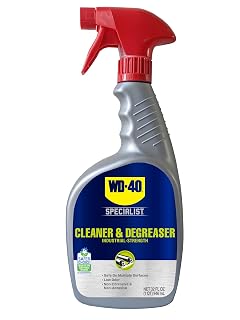
WD-40
Specialist Industrial-Strength Cleaner & Degreaser
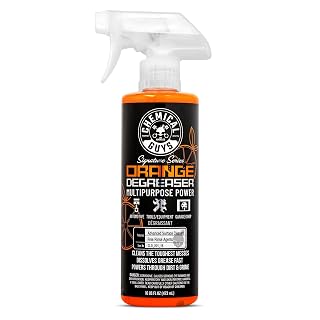
Chemical Guys
Signature Series Orange Degreaser
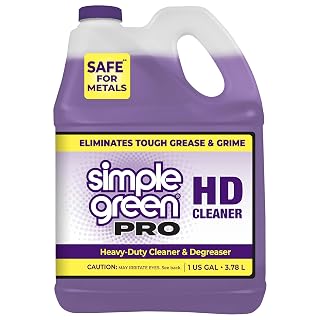
Simple Green
Pro HD Heavy-Duty Cleaner & Degreaser
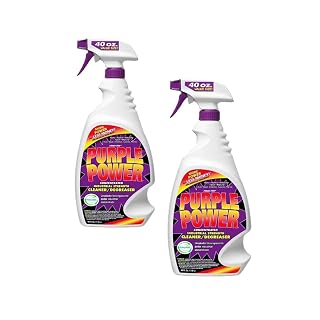
Purple Power
Industrial Strength Cleaner/Degreaser
As an Amazon Associate I earn from qualifying purchases. Full disclosure

Community
0 postsShare how you use this product
Drop a quick comment or post a full review with photos and a star rating.
Sign in to postNew here? Create a free account.