CarCareTruth Score
Decent, but it's tough on the environment.
Opens Amazon in a new tab. No account needed to look.
Saved to your guest loadout. Sign up to also save to your Cabinet (consumables) or Kit (tools you own).
As an Amazon Associate I earn from qualifying purchases. Full disclosure
Prices may varyThe manufacturer's Safety Data Sheet classifies this product with one or more GHS Category 1 health hazards — the most severe tier. The hazard statements in quotes below are the verbatim GHS language from the SDS, as required by OSHA's Hazard Communication Standard. The line under each statement translates the GHS classification into plain language.
GHS Category 1 aspiration toxicity — thin, oily liquids can slip into the lungs if swallowed, causing chemical pneumonia.
If swallowed:
The aspiration hazard (H304) is about the liquid being swallowed and reaching the airway, not about breathing fumes during normal use.
Call Poison Control immediately at 1-800-222-1222 (US, 24/7, free) and have the product container with you. Poison Control's standing guidance is to not induce vomiting after chemical exposure; they will direct first-aid steps based on the specific product.
About this product's hazards. This product's Safety Data Sheet uses signal word DANGER.Read the manufacturer's SDS and follow all safety instructions before use. CarCareTruth ratings translate the manufacturer's safety sheet. They do not replace the SDS or substitute for a hazard assessment specific to your task.
Health score is for adult use as intended, per the manufacturer's SDS. It does not model child ingestion, accidental spill cleanup, or off-label use. See the safety panel below for full hazard classification, and /disclaimer for the full editorial scope.
GHS hazard codes are quoted from the manufacturer’s Safety Data Sheet. PPE tiers below translate those codes and the listed ingredient chemistry; they are not CarCareTruth recommendations.
Show details for all categories ▾Hide details ▴
Only when: when spraying · in enclosed space
Translated from the manufacturer’s Safety Data Sheet, Section 8
SDS §8.2.2 lists Indirect Vented Goggles as the specified eye/face protection. SDS §11 states: 'Sprayed material may cause eye irritation.' No H319 eye irritation classification appears at the mixture level in SDS §2. Aerosol spray inside the vehicle cabin at face level creates a plausible eye contact pathway.
CarCareTruth publishes the cited sources verbatim and does not advise what action a user should take. Consult the full SDS before use.
Only when: prolonged use
Translated from the manufacturer’s Safety Data Sheet, Section 8
SDS §11 documents dermal defatting from prolonged or repeated exposure to the petroleum distillate carrier. No H315 (skin irritation) classification appears at the mixture level in SDS §2. The situational tier applies for extended application sessions.
CarCareTruth publishes the cited sources verbatim and does not advise what action a user should take. Consult the full SDS before use.
Translated from the manufacturer’s Safety Data Sheet, Section 8
SDS §2 (version 5.04, 2026-05-06) classifies H336 (STOT SE Cat 3 · may cause drowsiness or dizziness) and H370 (STOT SE Cat 1 · causes damage to organs, cardiovascular system). H336 is an inhalation pathway code applicable under the aerosol use scenario. H370 appears with a physician note in SDS §4: 'Exposure may increase myocardial irritability. Do not administer sympathomimetic drugs unless absolutely necessary.' SDS §7 contains a non-boilerplate enclosed-space restriction and specifies: 'Use only outdoors or in a well-ventilated area.'
U.S. regulatory standard
29 CFR 1910.134; 1910.138; 1910.1000
“the primary objective shall be to prevent atmospheric contamination… When effective engineering controls are not feasible… appropriate respirators shall be used.”
OSHA standards apply to workplaces. Cited here as the U.S. reference threshold for the underlying hazard class.
CarCareTruth publishes the cited sources verbatim and does not advise what action a user should take. Consult the full SDS before use.
The published Safety Data Sheet for this product does not specify ventilation protection for consumer use.
Workplace context
29 CFR 1910.134(a); 1910.1000
“the primary objective shall be to prevent atmospheric contamination [via] accepted engineering control measures (for example, enclosure or confinement of the operation, general and local ventilation…).”
Triggered by GHS H336 on the SDS.
OSHA standards apply to workplaces. Cited here as the U.S. reference threshold for the underlying hazard class.
PPE tiers translate the manufacturer’s SDS and U.S. regulatory standards. Not professional safety advice. How we report safety.
Scope of these PPE tiers. The tiers on this page translate the product's Safety Data Sheet where one is published, plus its ingredient chemistry, into a comparable rating. They describe a formulation, not a situation: a tier is not a safety determination for any specific user, task, quantity, or environment. The manufacturer's label and use instructions govern how the product is handled. Where the product is used at work, the employer's PPE program and hazard assessment under 29 CFR 1910.132 decide what protection is selected, not this page.
No warranties. CarCareTruth makes no warranties, express or implied, and expressly disclaims the implied warranties of merchantability and fitness for a particular purpose.
This product ranks #5 of 9 in Fabric Protectant.Three above it ↓
Last reviewed July 31, 2026
TL;DR Reliable aerosol fabric protection · the bead test holds on car fabric seats and carpet for 4-6 weeks on a daily driver, consistent with quarterly reapplication rather than the biannual claim on the label. Non-PFAS formula: the current formulation (SDS version 5.04, May 2026) contains no fluoropolymer or fluorotelomer ingredients. DANGER signal word: the SDS classifies organ damage (cardiovascular system) and aspiration hazard · apply with all vehicle doors fully open. California Prop 65 warning present.
Scotchgard Auto Fabric & Carpet Water Shield sprays a silicone-based protective barrier onto fabric seats, carpet, and floor mats in seconds · the aerosol format makes even coverage easy and the coating dries within 1-2 hours. The bead test is the central performance story: owners consistently document liquid beading and rolling off treated fabric on direct pours, with the protection window holding through normal vacuuming and light passenger contact for 4-6 weeks. Reapplication is the trade-off · the label says every cleaning or every six months, but the community consensus clusters around quarterly reapplication in normal daily-driver conditions. Stain resistance is strongest for common liquid spills (coffee, soda) when blotted promptly; muddy and particulate soiling requires faster action on treated fabric. Carpet protection holds slightly longer than seat fabric, where passenger contact is more abrasive.
A practical choice for daily drivers with standard woven fabric seats and OEM carpet who want quick, broadly available protection from spills and wet weather. The aerosol format is the right tool for car carpet and floor mats · complete, even coverage without soaking or over-application. Buyers who want to avoid PFAS chemistry will find the current silicone-based formula confirmed PFAS-free in SDS §3. Skip it for Alcantara, suede, or suede-effect synthetic upholstery · the solvent carrier is incompatible with delicate napped fabrics, and the aerosol format makes controlled application difficult. The DANGER signal word and enclosed-cabin inhalation risk also mean this is not the right product for anyone who cannot spray with doors fully open.
The SDS (3M Document Group 41-2291-7, version 5.04, 2026-05-06) carries a DANGER signal word. The primary health classifications are H370 (damage to organs · cardiovascular system, STOT SE Cat 1) from the aerosol propellant and H304 (aspiration hazard Cat 1) from the carrier · the SDS physician note in §4 warns against sympathomimetic drugs after exposure, indicating cardiac sensitization risk is a documented concern tied to aerosol propellant inhalation. H336 (drowsiness or dizziness, STOT SE Cat 3) also appears. If swallowed, do not induce vomiting · the aspiration hazard classification means forcing vomiting can cause product to enter the airway; seek immediate medical attention. California Prop 65 warning is present; the basis is benzene trace in the petroleum distillate carrier (SDS §13 RCRA D018 classification). The 5.0/10 health score is set by the H304 aspiration-hazard ceiling, which floors the score at 5.0 regardless of the DANGER signal word, H336, high VOC, and Prop 65 deductions stacked underneath it. The current formula contains no PFAS · SDS §3 lists no fluoropolymer or fluorotelomer ingredients. VOC is high (~714 g/L from the carrier and aerosol propellant) and no aquatic toxicity H-codes appear in SDS §2, placing environment at Notable Concerns primarily due to the high VOC content.
No. The current formulation (3M SDS Document Group 41-2291-7, version 5.04, dated May 2026) lists hydrotreated light petroleum distillates (60-70%), liquefied petroleum gas propellant (20-30%), a proprietary silicone mixture, a proprietary resin, and a proprietary crosslinker · no fluoropolymer or fluorotelomer ingredients appear in Section 3. 3M announced the elimination of PFAS from Scotchgard products and completed the transition. If you're working from an older bottle with an older SDS, chemistry may differ.
The California Proposition 65 warning on the current formula is associated with the hydrotreated light petroleum distillate carrier (CAS 64742-47-8). Petroleum-derived hydrocarbon solvents can contain trace benzene, which is a listed Prop 65 carcinogen. The SDS designates this product as EPA RCRA D018 (benzene) for waste disposal purposes, consistent with the Prop 65 flag. The warning does not indicate PFAS content.
The manufacturer label states reapplication every cleaning or every six months. Independent owners typically report noticeable bead-test degradation at 4-6 weeks on a daily driver with regular vacuuming, which is roughly consistent with quarterly reapplication (not biannual). Heavy use, passenger contact, and frequent vacuuming accelerate depletion. The protection window on car carpet, which sees less direct contact, tends to hold slightly longer than on seat fabric.
No. Scotchgard Auto Fabric & Carpet Water Shield is not recommended for Alcantara, suede, or suede-effect synthetic fabrics. The aerosol solvent carrier can affect the delicate nap structure and finish of napped fabrics. Manufacturer guidance and detailing community experience both flag compatibility concerns with these materials. Use a product specifically formulated for Alcantara or suede · typically a water-based formula applied with a brush applicator rather than an aerosol spray.
The SDS carries a DANGER signal word and specifies: 'Do not use in a confined area with minimal air exchange.' The SDS also includes a physician note about cardiac sensitization risk from the aerosol propellant. Apply with all vehicle doors open and allow to dry before occupying the cabin. The SDS specifies use 'only outdoors or in a well-ventilated area.' If swallowed, do not induce vomiting · the aspiration hazard classification means forcing vomiting can cause product to enter the airway. Seek immediate medical attention.
Marketing copy from 3M, via Amazon. Not editorial.
Weekly pick
One product, one safety verdict, every week. No spam.
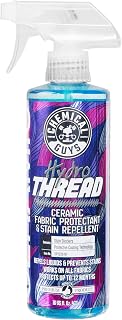
Chemical Guys
HydroThread Ceramic Fabric Protectant & Stain Repellent
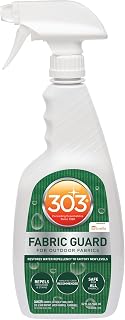
303 Products
303 Fabric Guard (32 oz)
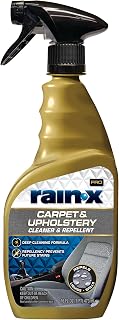
Rain-X
Pro Carpet & Upholstery Cleaner & Repellent
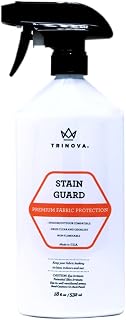
TriNova
Stain Guard Premium Fabric Protection
As an Amazon Associate I earn from qualifying purchases. Full disclosure

Community
0 postsShare how you use this product
Drop a quick comment or post a full review with photos and a star rating.
Sign in to postNew here? Create a free account.