CarCareTruth Score
Recommended.
Opens Amazon in a new tab. No account needed to look.
Saved to your guest loadout. Sign up to also save to your Cabinet (consumables) or Kit (tools you own).
As an Amazon Associate I earn from qualifying purchases. Full disclosure
Prices may varyHealth score is for adult use as intended, per the manufacturer's SDS. It does not model child ingestion, accidental spill cleanup, or off-label use. See the safety panel below for full hazard classification, and /disclaimer for the full editorial scope.
GHS hazard codes are quoted from the manufacturer’s Safety Data Sheet. PPE tiers below translate those codes and the listed ingredient chemistry; they are not CarCareTruth recommendations.
Show details for all categories ▾Hide details ▴
Only when: when spraying
Beyond SDS: translated from the ingredient chemistry
SDS §2 classifies H320 (causes eye irritation, Cat 2B). SDS §8 directs P280 'Wear safety glasses with side shields.' Pump-spray application at close range to the top surface creates plausible mist contact during agitation.
U.S. regulatory standard
29 CFR 1910.133(a)(1)
“appropriate eye or face protection when exposed to eye or face hazards from… liquid chemicals…”
ANSI Z87.1 (incorporated via §1910.6)
OSHA standards apply to workplaces. Cited here as the U.S. reference threshold for the underlying hazard class.
CarCareTruth publishes the cited sources verbatim and does not advise what action a user should take. Consult the full SDS before use.
Only when: prolonged use
Translated from the manufacturer’s Safety Data Sheet, Section 2
SDS §2 classifies H316 (causes mild skin irritation, Cat 3). SDS §11 notes repeated or prolonged exposure may cause skin irritation and dermatitis from degreasing. Brief brush-agitation contact in a 15·30 minute session is low-risk; extended or frequent hand contact is the trigger.
U.S. regulatory standard
29 CFR 1910.138(a)
“appropriate hand protection when employees' hands are exposed to hazards such as those from…”
OSHA standards apply to workplaces. Cited here as the U.S. reference threshold for the underlying hazard class.
CarCareTruth publishes the cited sources verbatim and does not advise what action a user should take. Consult the full SDS before use.
Only when: in enclosed space
Beyond SDS: translated from the ingredient chemistry
SDS §8 states 'No personal respiratory protective equipment normally required.' No H335, H331, H334, or H330 at mixture level. Water-based formula with no measurable VOC (USEPA 601/602/608) and no flash point to 212°F. Standard outdoor application poses no inhalation pathway concern; situational tier captures the rare enclosed-garage scenario.
CarCareTruth publishes the cited sources verbatim and does not advise what action a user should take. Consult the full SDS before use.
No PPE specified in published sources for ventilation. Absence does not imply “not needed” — consult the full Safety Data Sheet.
PPE tiers translate the manufacturer’s SDS and U.S. regulatory standards. Not professional safety advice. How we report safety.
This product ranks #4 of 6 in Convertible Top Cleaner.Three above it ↓
Last reviewed July 12, 2026
TL;DR Reliable on light-to-moderate mold and road grime on fabric canvas and vinyl with a soft brush and one application · heavy established mold typically needs a second pass. No color shift on black or tan canvas in multi-season owner data. Surfactant-based, no biocidal active; removes mold mechanically. Carries a mild-irritant warning for skin and eyes; the SDS doesn't classify it as hazardous.
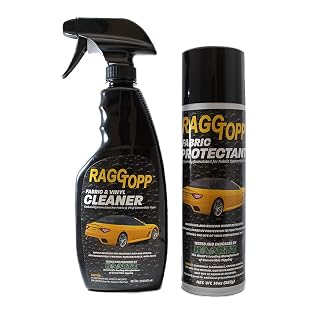
A water-based surfactant cleaner (pH 9.7·10.7) in a 16 oz pump bottle · the cleaner-only standalone from the Haartz-endorsed RaggTopp system. Spray onto a damp top, agitate with a soft-bristle brush, dwell briefly, then rinse with a garden hose. No EPA-registered biocidal active; it lifts soil mechanically via surfactant action. Reliable on routine grime and light-to-moderate mold across canvas and vinyl; deeply neglected tops with heavy mold may need a second pass or chlorinated pre-treatment. Community data confirms no color shift on fabric tops over repeated applications.
Best fit for convertible top owners doing routine maintenance cleaning who already own a separate protectant or want to restock the cleaner component individually. Paired with the RaggTopp Fabric Protectant, it becomes the full Haartz-endorsed system. Owners with heavy established mold should start with a chlorinated mildew remover first. Mohair and natural-fiber tops have less independent community data · confirm fabric-specific compatibility before committing.
WARNING comes from mild-irritant codes H316 (skin, Cat 3) and H320 (eye, Cat 2B); SDS Section 15 confirms not classified as hazardous under OSHA HCS. Section 8 recommends safety glasses for close-range spray work; no respirator required. Biodegradable per OECD 301B (SDS §12); the fathead-minnow 96-hr LC50 (316 mg/L) sits above the GHS aquatic-hazard classification cutoff, so no aquatic toxicity codes are assigned. No PFAS, no chlorinated bleach, no aquatic toxicity codes.
The formula is identical · this is the cleaner component sold by itself. The kit (ASIN B0017TTPE0) pairs this same 16 oz pump bottle with the RaggTopp Fabric Protectant aerosol. If you already own the protectant and just need to restock the cleaner, this standalone bottle is the right buy. If you are starting fresh with a dirty top and no protectant, the kit is the complete system.
It removes light-to-moderate mold and routine staining with a soft-bristle brush and a single application. The formula is a surfactant-based cleaner · it lifts soil and surface mold mechanically via cleaning chemistry. It does not contain an EPA-registered biocidal active (no quaternary ammonium compound, no benzalkonium chloride). Heavy or established black mold colonies typically need a second pass; if the mold has progressed too far, a chlorinated mildew remover applied first, then RaggTopp for maintenance, is the more effective sequence.
Owner reports across multiple seasons document no color shift or bleaching on black and tan canvas with normal use. The formula contains no chlorinated bleach and no aggressive solvents. SDS Section 3 shows the active components are non-ionic surfactants, a fatty-acid soap, an alkanolamine pH buffer, and a tetrasodium chelator · none of which carry bleaching chemistry. Mohair or specialty natural-fiber tops have less independent community documentation; check fabric-specific data before committing.
Coverage varies with top size, soil level, and how thoroughly the surface is pre-wetted. Owner reports indicate one bottle is sufficient for small-to-medium fabric tops under light-to-moderate soiling. Larger tops or heavily soiled tops may require most or all of a single bottle, leaving limited reserve for a second pass. Buying two bottles at once is a common workaround for large or neglected tops.
The WARNING signal word is driven by two Category 3 hazard codes: H320 (causes eye irritation) and H316 (causes mild skin irritation). Both sit one GHS category below the codes that would meaningfully escalate the safety profile (H319 and H315). SDS Section 15 confirms the product is 'not classified as a Hazardous Chemical under the OSHA Hazard Communication Standard' · the WARNING label reflects mild irritant statements, not a serious hazard classification.
Marketing copy from RaggTopp, via Amazon. Not editorial.
Weekly pick
One product, one safety verdict, every week. No spam.
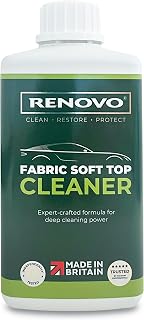
Renovo
Fabric Soft Top Cleaner
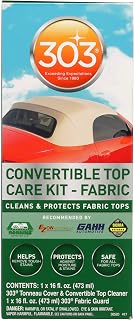
303 Products
303 Convertible Fabric Top Cleaning and Care Kit
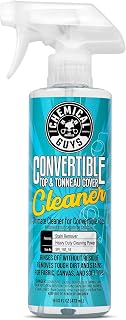
Chemical Guys
Convertible Top Cleaner
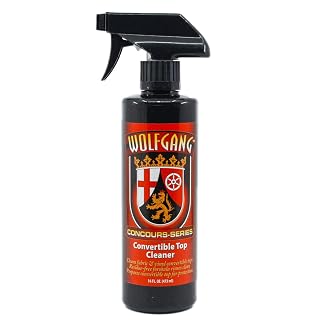
Wolfgang Concours-Series
Convertible Top Cleaner
As an Amazon Associate I earn from qualifying purchases. Full disclosure

Community
0 postsShare how you use this product
Drop a quick comment or post a full review with photos and a star rating.
Sign in to postNew here? Create a free account.