CarCareTruth Score
Decent.
Opens Amazon in a new tab. No account needed to look.
Saved to your guest loadout. Sign up to also save to your Cabinet (consumables) or Kit (tools you own).
As an Amazon Associate I earn from qualifying purchases. Full disclosure
Prices may varyHealth score is for adult use as intended, per the manufacturer's SDS. It does not model child ingestion, accidental spill cleanup, or off-label use. See the safety panel below for full hazard classification, and /disclaimer for the full editorial scope.
GHS hazard codes are quoted from the manufacturer’s Safety Data Sheet. PPE tiers below translate those codes and the listed ingredient chemistry; they are not CarCareTruth recommendations.
Show details for all categories ▾Hide details ▴
Only when: splash risk
Translated from the manufacturer’s Safety Data Sheet, Section 8
H319 (Eye Irritation Cat 2A) is listed in SDS §2. The foam-applicator wipe-on format does not routinely generate spray or splash at eye level, so the SDS §8 eye-protection guidance translates to situational use: on splash or direct contact during application.
U.S. regulatory standard
29 CFR 1910.133(a)(1)
“The employer shall ensure that each affected employee uses appropriate eye or face protection when exposed to eye or face hazards from… liquid chemicals…”
ANSI Z87.1 (incorporated via §1910.6)
OSHA standards apply to workplaces. Cited here as the U.S. reference threshold for the underlying hazard class.
CarCareTruth publishes the cited sources verbatim and does not advise what action a user should take. Consult the full SDS before use.
Only when: prolonged use
Translated from the manufacturer’s Safety Data Sheet, Section 8
H315 (Skin Irritation Cat 2) is listed in SDS §2. SDS §8 specifies chemical-resistant gloves tested to EN 374 for prolonged contact. Brief foam-applicator contact during normal home-detailer application does not meet the prolonged-contact threshold; gloves apply for extended or repeated direct contact.
U.S. regulatory standard
29 CFR 1910.138(a)
“appropriate hand protection when employees' hands are exposed to hazards such as those from… chemicals which produce an adverse effect on the skin or eyes…”
OSHA standards apply to workplaces. Cited here as the U.S. reference threshold for the underlying hazard class.
CarCareTruth publishes the cited sources verbatim and does not advise what action a user should take. Consult the full SDS before use.
No PPE specified in published sources for lungs. Absence does not imply “not needed” — consult the full Safety Data Sheet.
No PPE specified in published sources for ventilation. Absence does not imply “not needed” — consult the full Safety Data Sheet.
PPE tiers translate the manufacturer’s SDS and U.S. regulatory standards. Not professional safety advice. How we report safety.
This product ranks #5 of 11 in Trim Restorer.Three above it ↓
Last reviewed June 14, 2026
TL;DR A linseed-oil surface coating that darkens faded ABS plastic, polypropylene bumper trim, and rubber weatherstripping with a single wipe-on pass. Community durability runs 4-8 weeks on a daily driver; the manufacturer honestly labels this "temporary dye coloring." Tape adjacent painted panels before applying as a precaution. WARNING signal word (H315/H319: skin and eye irritation per SDS §2).
This is a surface-coating type trim restorer: the formula fills pores of faded plastic and rubber and darkens on oxidative cure, producing a matte-to-satin black finish. Pour a few drops on the included foam applicator, wipe on, and drive within an hour. The thick, non-runny formula is forgiving; over-application does not permanently damage trim, and one pass is sufficient for most surfaces. Community owners confirm genuine, visible darkening on moderately faded ABS and rubber in before/after photos. Severely chalky polypropylene responds less dramatically than rubber. The manufacturer's claim of "several months" per treatment exceeds what community owners consistently report on daily drivers: 4-8 weeks washed regularly. Community owners commonly tape adjacent painted panels as a precaution.
Drivers with moderately faded daily-driver trim who want quick, visible results with minimal technique will find this well-suited. The forgiving foam-applicator format and included applicator lower the barrier for a first-time user. Drivers with severely faded, chalky polypropylene trim who need 3+ months of sustained restoration should look at penetrating-polymer restorers: more technique-sensitive application, but meaningfully longer durability.
The SDS classifies this product WARNING: H315 (skin irritation Cat 2) and H319 (eye irritation Cat 2A). The foam-applicator format does not routinely generate spray or splash, so eye protection applies situationally on splash; gloves are specified by SDS §8 for prolonged or repeated contact. VOC is 0% by EPA and Cal ARB methods; no inhalation concern and CARB compliant. C.I. Solvent Black 29 has ingredient-level aquatic toxicity data in SDS §12; keep product and applicators away from storm drains. Used applicator cloths soaked in this product can self-ignite through oxidation of the linseed oil carrier; lay them flat in a ventilated area to dry or seal in a water-filled metal container before disposal.
The manufacturer's claim of 'several months' is aspirational. Community owners on daily drivers report 4-8 weeks of sustained darkening before noticeable fading begins, closer to 8-10 weeks on a vehicle parked in shade and washed gently. The linseed oil cures by oxidative polymerization rather than true polymer bonding, so UV exposure and repeated washing gradually break down the film.
Adam's markets this as 'no sling, no mess.' The linseed oil formula is thick and does not sling when applied by foam applicator to the trim surface. Owners commonly recommend taping adjacent painted panels as a precaution before applying. Any trim restorer product can transfer to adjacent paint if over-applied or wiped across the paint/trim boundary.
Surface coating with oxidative cure. The primary ingredient (boiled linseed oil with cobalt-manganese drier salts) fills the pores of faded plastic and rubber and darkens them as it oxidizes, but it does not bond to polypropylene at a molecular level the way dedicated penetrating polymer restorers do. Adam's marketing labels it a 'temporary dye coloring,' an accurate description of the mechanism.
SDS Section 15 (rev. 2024-11-22) explicitly states 'none of the ingredients are listed' under California Proposition 65. Adam's has a documented pattern of Amazon Prop 65 flags that do not reflect the actual SDS; the SDS is the authoritative source. CarCareTruth uses the SDS for this determination.
Per the SDS, intended use is 'black vinyl and trim restorer.' It works on ABS plastic, polypropylene bumper trim, rubber weatherstripping, and EPDM seals. Boiled linseed oil penetrates and darkens all of these porous surfaces. Results on severely chalky polypropylene are typically less dramatic than on rubber, where linseed oil absorption is more uniform.
Marketing copy from Adam's Polishes, via Amazon. Not editorial.
Weekly pick
One product, one safety verdict, every week. No spam.






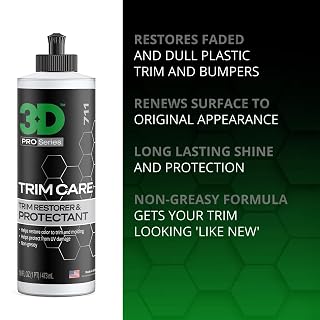
3D Car Care
Trim Care Restorer
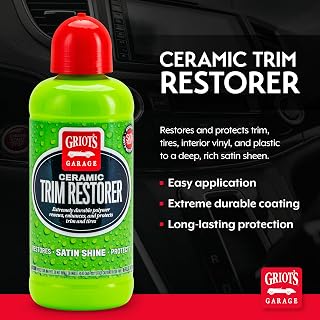
Griot's Garage
Ceramic Trim Restorer
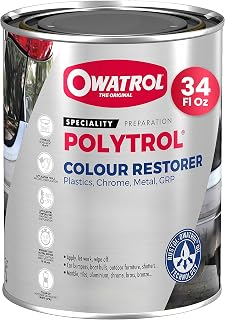
OWATROL
Polytrol Colour Restorer
Solution Finish
Black Trim Restorer
As an Amazon Associate I earn from qualifying purchases. Full disclosure

Community
0 postsShare how you use this product
Drop a quick comment or post a full review with photos and a star rating.
Sign in to postNew here? Create a free account.