
MDM Hydantoin
- Preservatives
- CAS 27636-82-4
- IUPAC: Mono(hydroxymethyl)-5,5-dimethylimidazolidine-2,4-dione
MDM Hydantoin (CAS 27636-82-4) appears in 8 of the 2,122 car-care products CarCareTruth tracks (as of August 2026). It is readily biodegradable.
MDM hydantoin is a formaldehyde-releasing preservative structurally related to DMDM hydantoin. It is not on California's Prop 65 list, though the formaldehyde it can release is listed separately. At the trace use concentrations typical in car-care products (≤0.001%), released formaldehyde is far below Prop 65 thresholds and the respiratory-sensitizer classification does not apply to the finished product.
MDM Hydantoin (mono-hydroxymethyl-5,5-dimethylimidazolidine-2,4-dione) is a formaldehyde-releasing preservative structurally related to DMDM Hydantoin. It appears in some interior detailer and cosmetic formulations as part of a dual-hydantoin preservative system at trace concentrations (typically ≤ 0.001%). Like DMDM Hydantoin, it releases small amounts of formaldehyde as its antimicrobial mechanism, but at use concentrations far below any regulatory threshold. Not on the Prop 65 list. Not an asthmagen at trace use concentrations.
Health & environment profile
- VOC
- no
- Prop 65 listed
- no
- Asthmagen
- no
- EPA Safer Choice
- no
- Aquatic toxicity
- no
- Biodegradable
- yes
- Bioaccumulative
- no
- Persistent
- no
- Ozone depleting
- no
- Microplastic
- no
- PFAS
- no
- Env. score
- 4/5
Common questions about MDM Hydantoin
- What is MDM Hydantoin used for in car care?
- Formaldehyde-releasing preservative co-agent; antimicrobial at trace concentrations
- Is MDM Hydantoin a VOC?
- No. MDM Hydantoin is not classified as a volatile organic compound (VOC).
- Is MDM Hydantoin on California's Proposition 65 list?
- No. MDM Hydantoin is not on California's Proposition 65 list.
- Is MDM Hydantoin biodegradable?
- Yes. MDM Hydantoin has a confirmed biodegradable profile.
8 products contain this
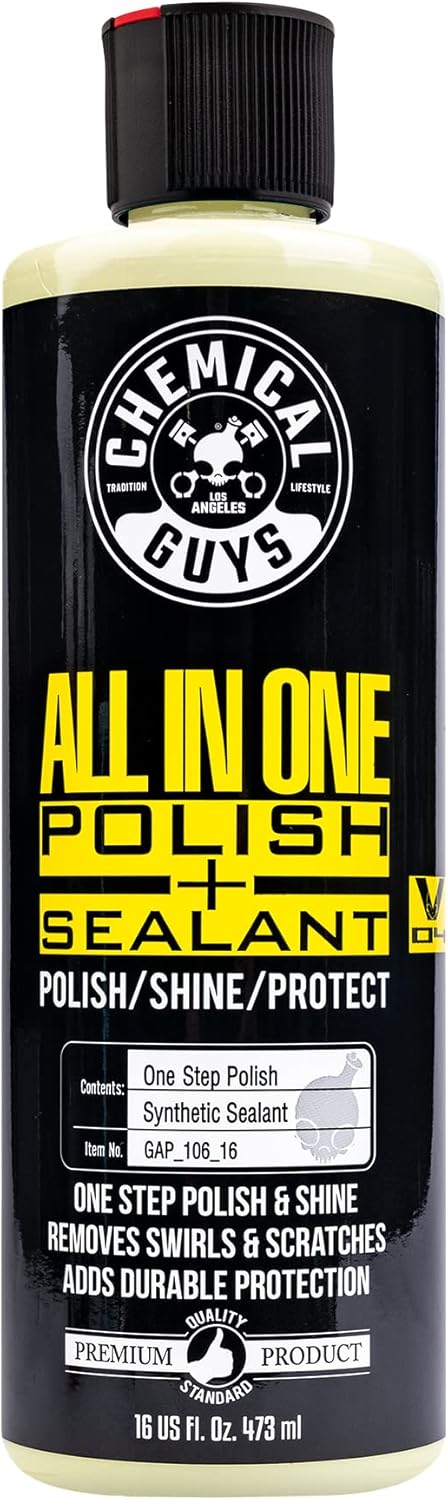 Chemical Guys V4 All-in-One Polish + Sealant
one-step-polish

 Chemical Guys Headlight Restore and Protect
headlight-restoration
 Chemical Guys InnerClean Interior Quick Detailer
interior-detailer

 Chemical Guys Leather Quick DetailerProp 65
leather-conditioner
 Chemical Guys V38 Optical Grade Final Polish
finishing-polish
 Chemical Guys Vintage Series Leather ConditionerProp 65
leather-conditioner
Related
Health and environment notes translate the manufacturer Safety Data Sheet, the GHS classification, and authoritative regulatory listings (California Prop 65, EPA). Not medical advice. They describe the ingredient itself; whether a hazard applies to a finished product depends on its concentration and how it's used.