CarCareTruth Score
Mediocre.
Opens Amazon in a new tab. No account needed to look.
Saved to your guest loadout. Sign up to also save to your Cabinet (consumables) or Kit (tools you own).
As an Amazon Associate I earn from qualifying purchases. Full disclosure
Prices may varyHealth score is for adult use as intended, per the manufacturer's SDS. It does not model child ingestion, accidental spill cleanup, or off-label use. See the safety panel below for full hazard classification, and /disclaimer for the full editorial scope.
GHS hazard codes are quoted from the manufacturer’s Safety Data Sheet. PPE tiers below translate those codes and the listed ingredient chemistry; they are not CarCareTruth recommendations.
Show details for all categories ▾Hide details ▴
Translated from the manufacturer’s Safety Data Sheet, Section 2
H319 (serious eye irritation Cat 2) at mixture level · splatter from the applicator pad is the realistic eye-contact pathway. SDS §8 specifies safety glasses to EN 166.
U.S. regulatory standard
29 CFR 1910.133(a)(1)
“The employer shall ensure that each affected employee uses appropriate eye or face protection when exposed to eye or face hazards from… liquid chemicals…”
ANSI Z87.1 (incorporated via §1910.6)
OSHA standards apply to workplaces. Cited here as the U.S. reference threshold for the underlying hazard class.
CarCareTruth publishes the cited sources verbatim and does not advise what action a user should take. Consult the full SDS before use.
Translated from the manufacturer’s Safety Data Sheet, Section 8
Tetrabutyl titanate hydrolyzes on skin contact releasing n-butanol · SDS §8 specifies nitrile rubber (NBR, ≥0.4 mm) or butyl rubber gloves. Trace toluene in §3 also carries 'Sk' skin-absorption notation in §8 occupational limits.
CarCareTruth publishes the cited sources verbatim and does not advise what action a user should take. Consult the full SDS before use.
Only when: in enclosed space · prolonged use
Translated from the manufacturer’s Safety Data Sheet, Section 8
Flash point 33°C and methanol/toluene §3 content put inhalation in play · SDS §8 specifies a Type A organic-vapor respirator 'in case of insufficient ventilation.' Open-garage or outdoor application meets the §8 ventilation standard; enclosed-space application or extended sessions cross into respirator territory.
CarCareTruth publishes the cited sources verbatim and does not advise what action a user should take. Consult the full SDS before use.
No PPE specified in published sources for ventilation. Absence does not imply “not needed” — consult the full Safety Data Sheet.
PPE tiers translate the manufacturer’s SDS and U.S. regulatory standards. Not professional safety advice. How we report safety.
Scope of these PPE tiers. The tiers on this page translate the product's Safety Data Sheet where one is published, plus its ingredient chemistry, into a comparable rating. They describe a formulation, not a situation: a tier is not a safety determination for any specific user, task, quantity, or environment. The manufacturer's label and use instructions govern how the product is handled. Where the product is used at work, the employer's PPE program and hazard assessment under 29 CFR 1910.132 decide what protection is selected, not this page.
No warranties. CarCareTruth makes no warranties, express or implied, and expressly disclaims the implied warranties of merchantability and fitness for a particular purpose.
This product ranks #6 of 6 in PPF / Vinyl Coating.Three above it ↓
Last reviewed May 30, 2026
TL;DR SONAX's PROFILINE PPF + Vinyl Ceramic Coating is a US debut with a thin owner track record and no independent installer follow-up on named PPF brands · the manufacturer compatibility claim is plausible but unverified. The SDS rates this WARNING · flammable liquid (flash point 33°C, outdoor or open-garage application), with H319 serious eye irritation. Toluene and methanol in §3 trigger California Prop 65 ingredient presence; no PFAS.
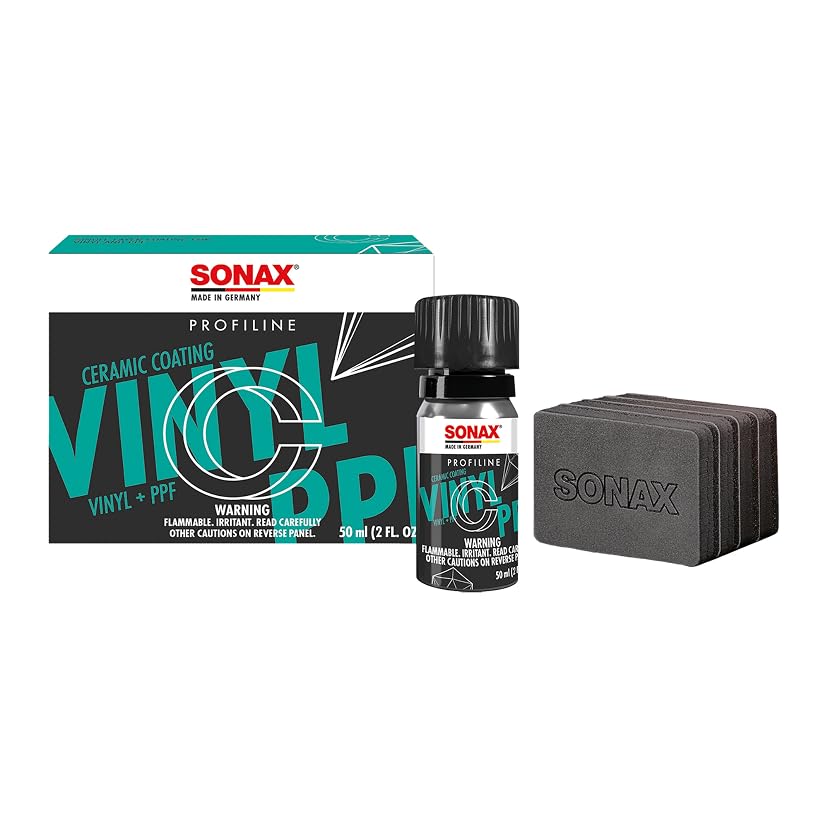
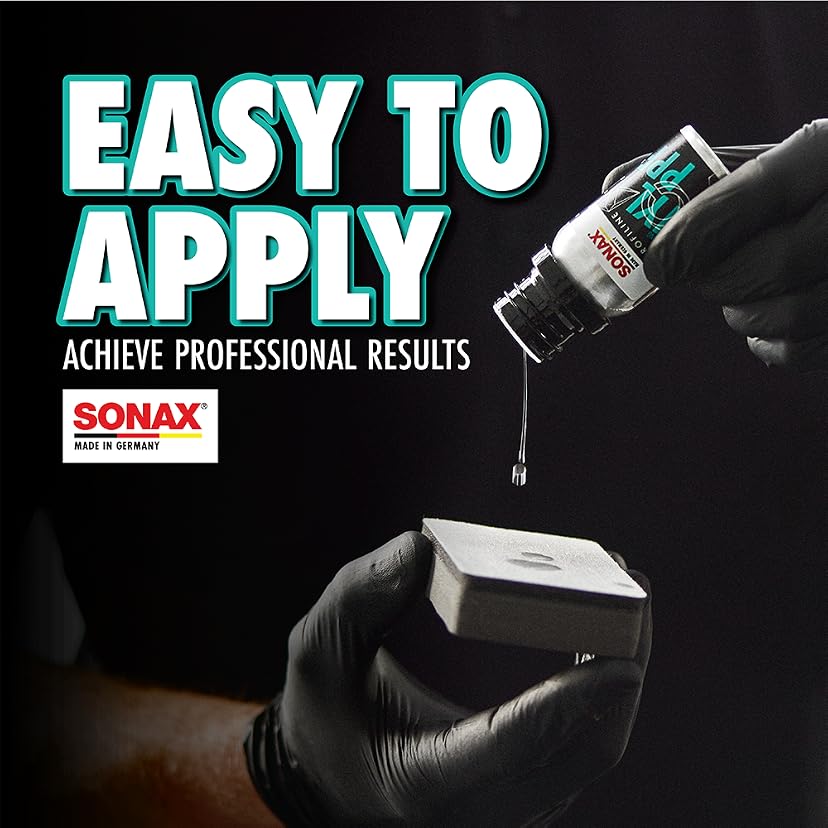
A solvent-based ceramic topcoat formulated by SONAX specifically for paint protection film and vinyl wraps · sold in a 50 mL bottle with two foam applicator blocks, sized for one full-vehicle treatment. The chemistry is an alkoxysilane network catalyzed by a trace titanate ester; cure happens by moisture-driven hydrolysis, with ethanol and a small amount of methanol released at the cured surface during flash-off. SONAX positions the product for both glossy and matte finishes with a stated 3-year durability claim. The 5-step application (prep, apply, spread, buff, cure) is consistent with PPF coating norms. What is missing is the community evidence base: this listing went live in May 2025 and the owner track record is still thin at the time of writing, with no independent installer threads naming XPEL, LLumar, SunTek, or Avery Dennison film brands surfaced. PPF-specific durability on actual film, not paint, cannot be confirmed without that data.
Best for owners who already trust SONAX's professional line and are willing to be the early-data point on PPF-specific use · apply to a small test section first to confirm compatibility with your specific film brand. Skip it if you need independent installer confirmation on XPEL, LLumar, or SunTek before coating expensive film; CarPro CQuartz Skin or GYEON Q² PPF have larger community data bases on named brands. Also skip if you cannot apply outdoors or in an open garage · flash point 33°C requires it.
WARNING signal word from SDS §2 · driven by H319 (serious eye irritation), H226 (flammable liquid Cat 3, flash point 33°C), and H412 (chronic aquatic Cat 3). SDS §8 specifies nitrile or butyl gloves and safety glasses; respiratory protection is conditional on inadequate ventilation, so outdoor or open-garage application meets the SDS standard. Toluene and methanol both appear in §3 at trace concentrations and are California Proposition 65·listed for developmental toxicity · ingredient presence is confirmed even where the bottle face does not display the warning. Environment score 3 is driven by the chronic aquatic mixture-level classification (H412), ingredient-level aquatic toxicity from tetrabutyl titanate and trace D4, D4's PBT/vPvB classification, and the solvent-based VOC footprint · the stay-on-car × 0.75 multiplier moderates these but does not offset them. No PFAS confirmed.
SONAX markets this as PROFILINE Ceramic Coating CC Vinyl + PPF · explicitly for paint protection film and vinyl wraps, with manufacturer-stated compatibility on glossy and matte finishes. The marketing language does not name specific PPF brands (XPEL, LLumar, SunTek, Avery Dennison), and independent installer follow-up at 12+ months on named film brands has not been located. This is a US-debut product (the product listing dated May 28, 2025), and the owner track record is still thin at the time of this writeup. Treat the manufacturer compatibility claim as plausible but unverified for any specific film brand · apply to a small test section before committing to a full vehicle.
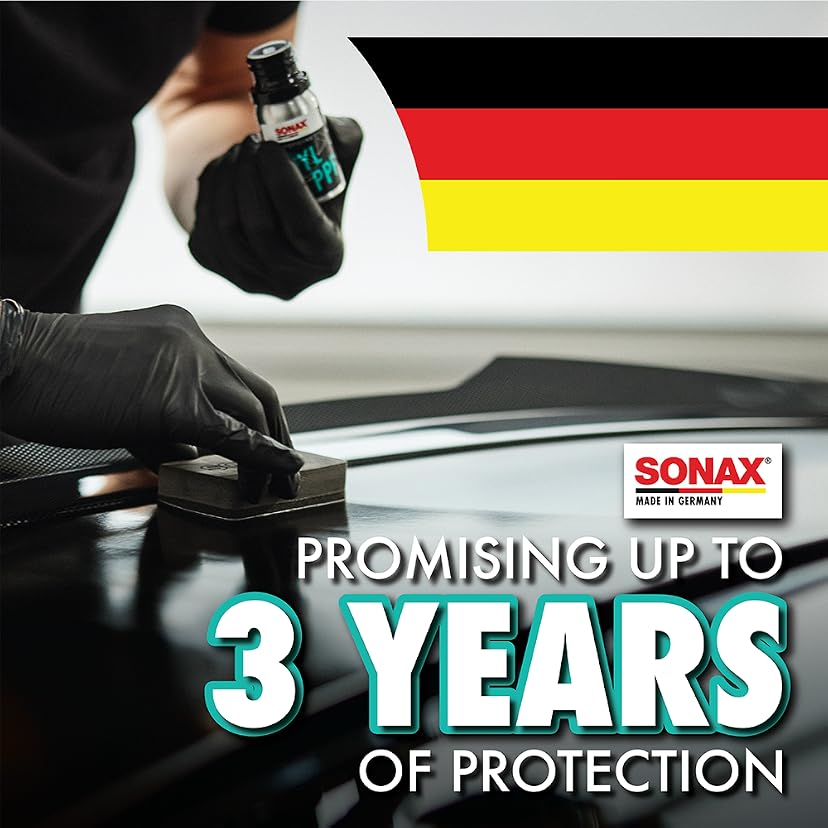
SONAX's A+ marketing on the listing claims up to 3 years of protection. PPF coatings as a category typically deliver 1-3 years on film, with the upper end requiring confirmation by independent installer follow-up that does not yet exist for this product. Paint-coating durability does not transfer to PPF · film flexes, heat-cycles, and self-heals differently than painted metal, so a coating that lasts 3 years on paint may degrade significantly earlier on PPF. The 3-year figure is a label claim, not a community-confirmed range, for this listing.
Three things drive the score down from the chemical baseline of 8.5: H319 serious eye irritation at mixture level (−0.8), the California Prop 65 ingredient presence (toluene and methanol are both Prop 65·listed for developmental toxicity · −1.5), and the high VOC estimate from the solvent-based carrier (flash point 33°C with reactive silanes that hydrolyze releasing methanol and ethanol · −1.0). The signal word is WARNING (not DANGER), and there are no Cat 1 health H-codes at mixture level, so the score lands in the Hazardous band rather than Serious Hazard.
The active coating chemistry is a triethoxysilane network · when the silane meets atmospheric moisture or substrate humidity, the ethoxy groups hydrolyze and the silane crosslinks into a glass-like cured layer. The hydrolysis releases ethanol (most of it) and a small amount of methanol as by-products. SDS §2.3 flags this because methanol is toxic by all routes and the warning is required even at small release quantities. In practice the release happens at the cured-coating surface in the open air; the realistic consumer-application exposure is the brief flash-off period during application, not chronic inhalation.
No. SDS §3 lists tetrabutyl titanate (titanate ester catalyst), toluene, methanol, and octamethylcyclotetrasiloxane (D4) as dangerous components · none of these is a per- or polyfluoroalkyl substance. The bulk silanes identified in §9 (triethoxy(methyl)silane, triethoxy(vinyl)silane) are also non-fluorinated. No fluorinated silane crosslinker or fluoropolymer additive is disclosed. The product is PFAS-free per the SDS.
Weekly pick
One product, one safety verdict, every week. No spam.


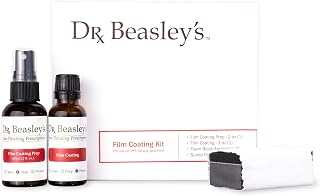
Dr. Beasley's
Film Coating Kit
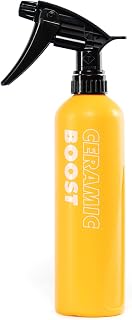
XPEL
Ceramic Boost Spray Coating
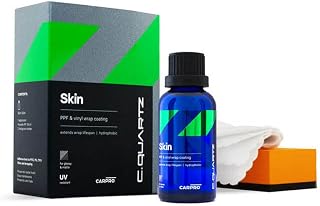
CarPro
CQUARTZ Skin PPF & Vinyl Nano-Coat
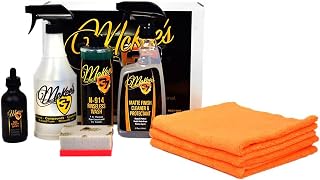
McKee's 37
Matte Finish Ceramic Coating Kit
As an Amazon Associate I earn from qualifying purchases. Full disclosure

Community
0 postsShare how you use this product
Drop a quick comment or post a full review with photos and a star rating.
Sign in to postNew here? Create a free account.