Priced as of May 24, 2026
4.5(187 ratings)Buy on AmazonSaved to your guest loadout. Sign up to also save to your Cabinet (consumables) or Kit (tools you own).
As an Amazon Associate and affiliate partner, CarCareTruth earns from qualifying purchases. Full disclosure
Prices may varyThe Podium · Top 3 in Jumper Cables
See the full ranking →This product ranks #3 of 6 in Jumper Cables.
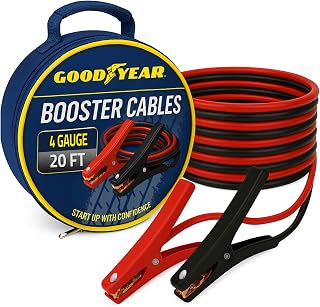
- Gold · #1GoodyearHeavy Duty 4 Gauge 20 FT Booster CablesCCT 6.5
- Silver · #2AUTOGEN2 Gauge 20 Feet Jumper Cables 800AMPCCT 6.5
- Bronze · #3You're hereRoad PowerHeavy Duty 4 Gauge 25 ft Jumper CablesCCT 6.4
CarCareTruth's Analysis
Last reviewed May 26, 2026
TL;DR Stated 4 AWG with CCA conductor confirmed by distributor disclosure — not misrepresented, but not pure copper. No independent gauge measurement found. T-Prene thermoplastic elastomer jacket is manufacturer-rated to −94°F and community-reported to stay flexible in winter (no named temperature). Polar-Glow clamps are top- and side-post compatible. Adequate for passenger-car and light-truck emergency use at 25 ft; the length-gauge combination is marginal for sustained heavy-diesel cranking. Passive cable — no inline reverse-polarity protection.
What it is and how it performs
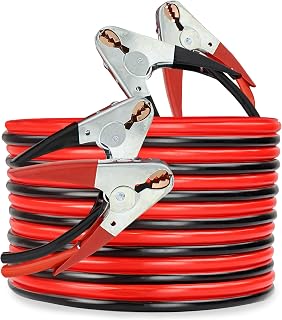
Road Power states 4 AWG on the 25 ft cable — CCA conductor confirmed by distributor disclosure (Empire Rigging lists model 86620104 explicitly as CCA) and corroborated by sibling-SKU distributor data; no independent gauge measurement exists. T-Prene thermoplastic elastomer jacket is manufacturer-rated to −94°F; one Canada reviewer confirms the cable stays pliable in winter, though no named temperature is cited. Polar-Glow ergonomic clamps are described as top- and side-post compatible, with copper contact surfaces per one verified reviewer; one 3-star reviewer reported a crimp failure requiring re-crimping. Passive cable — no inline reverse-polarity electronics. Length at 25 ft is marginally long for a 4 AWG CCA conductor when sustained heavy cranking loads are applied.
Who should buy this — and who should skip it
Right pick for a passenger-car or light-truck owner who needs a long-reach emergency cable and occasionally jumps in awkward parking situations — the 25 ft length handles nose-to-tail and side-by-side scenarios where 16–20 ft cables fall short, the T-Prene jacket holds up in cold-weather climates, and the UL Listing provides independent construction verification. Skip if the vehicle is a heavy-duty diesel or large commercial truck — the 4 AWG CCA conductor at 25 ft is marginally undersized for sustained 400 A cranking, and the "commercial-duty" label overstates the use case. Also skip if a dedicated storage bag matters — no bag is included.
Safety and environmental impact
Passive electrical conductor with T-Prene thermoplastic elastomer jacket — no chemical exposure pathway in normal use. Passive cable with no reverse-polarity indicator or inline protection electronics. CCA conductor recycles poorly — separating the copper coating from the aluminum core is not economically viable at most scrap facilities; insulation is not routinely recycled. The UL Listing covers construction safety; it does not certify sustained cranking current capacity at the stated gauge.
Frequently asked questions
Are Road Power 4 gauge jumper cables pure copper or CCA?▾
CCA (copper-clad aluminum). Distributor Empire Rigging explicitly lists model 86620104 as 'CCA Polar,' and sibling SKUs from the same Road Power family are uniformly disclosed as CCA by multiple B2B distributors. The Amazon listing says 'copper' without a qualifier — that language does not indicate pure copper. CCA has higher electrical resistance than solid copper at the same stated gauge.
What is T-Prene insulation?▾
T-Prene is Road Power's trademarked name for a thermoplastic elastomer (TPE) jacket compound. Multiple retailer descriptions cite a manufacturer cold-flex rating of −94°F (−70°C), which exceeds the performance of standard PVC insulation. One Canadian reviewer confirms the cable stays pliable in winter use, though no specific temperature is named in community evidence.
Are these UL Listed?▾
Yes — UL Listing is confirmed across multiple retailer product descriptions for this model. UL Listing verifies the product meets electrical safety construction standards. It does not independently confirm the stated AWG gauge.
Is 25 ft of 4 AWG adequate for heavy-duty diesel trucks?▾
Marginally. The brand markets these as 'commercial-duty' and community reviews confirm use on Utilimaster diesel delivery trucks, but 4 AWG at 25 ft produces more voltage drop under sustained high-amperage cranking than a shorter or heavier-gauge cable. A 2 AWG cable is more appropriate for regular heavy-diesel use.
Do these cables come with a storage bag?▾
No dedicated bag is included. The cables arrive in a cardboard box with a handle, which functions as initial storage. Multiple reviewers purchased a separate cable bag for trunk storage.
From the manufacturer
Marketing copy from Road Power, via Amazon. Not editorial.
- •Strong & Reliable Performance: The Southwire Road Power provides a commercial grade jumper cable with ergonomically designed clamps for safe, easy, and efficient jump starts
- •Ergonomically Designed Clamps: This car battery jumper cable features ergonomic handles for easy use when it matters most
- •A Tool for Any Situation: Whatever you're up against at home or at the jobsite, Southwire has a tool that will make your work more convenient and efficient
- •Tools You Can Trust: Southwire tools are made from high-quality materials and are built to last
- •Delivering Power Responsibly: Southwire is known for providing innovative products and services and delivering on our promises
Weekly pick
One product, one safety verdict, every week. No spam.

Manufacturer images


Manufacturer specifications
- Manufacturer
- Southwire
- Brand
- Road Power
- Model
- 86620104
- Item Weight
- 7.3 pounds
- Item model number
- 86620104
- Batteries
- 1 Unknown batteries required.
- Manufacturer Part Number
- 86620104
- ASIN
- B00002243X
- Customer Reviews
- 4.5 4.5 out of 5 stars (187) 4.5 out of 5 stars
- Best Sellers Rank
- #1,722,692 in Automotive (See Top 100 in Automotive) #702 in Automotive Battery Jumper Cables
- Date First Available
- November 9, 2004
More in Jumper Cables

Goodyear
Heavy Duty 4 Gauge 20 FT Booster Cables
CCT 6.5 · DecentHealth 9.5
AUTOGEN
2 Gauge 20 Feet Jumper Cables 800AMP
CCT 6.5 · DecentHealth 9.5
CARTMAN
4 Gauge 20 Feet Jumper Cables UL-Listed
CCT 6.3 · DecentHealth 9.5
Energizer
1-Gauge 800A Heavy Duty Jumper Cables 25 Feet
CCT 6.3 · DecentHealth 9.5
As an Amazon Associate and affiliate partner, CarCareTruth earns from qualifying purchases. Full disclosure
Community
0 postsShare how you use this product
Drop a quick comment or post a full review with photos and a star rating.
Sign in to postNew here? Create a free account.
Top Amazon review
↗External — Amazon's most-helpful review for context.
Excellent choice for Jumper Cables!!!
I absolutley love Amazon!!! For the price of a set of cheap Booster/Jumper Cables in a brick and morter store, you can buy extra long and heavy duty jumpers! First off, don't be the person that not only needs to ask a kind passer-by for a "jump" but also if they have jumper cables. It's MUCH easier to get a jump start if you have your own cables.Next lets talk about sizing. Having the longest cable possible is a major plus if your car is parked up against something like a pole or wall, or even parked on a one way street. The "booster car" (the car w/o a dead battery) can pull in close enough to use the cables without having to manuver into some akward position. Or better yet, you won't have to push your vehicle into a position to be jumped. If your diving a normal sized car they can even pull in behind you to jump you! Or if their vehicle is the shorter of the two, they could pull in front. Now how about gauge? For those who aren't electricians or engineers, as the number value of gauge decreases, the size and capacity of the cable increases. So for example 6-ga has about twice as much copper wire as 8-ga, and 4-ga is a about twice as much as 6-ga, so on and so on. That doesn't mean you double the capacity of wire with every two numbers though. 4-gauge may sound like a lot but it really isn't.The technical stuff. Don't worry if this doesn't make sense, you don't really need to know all of this, but I'm trying to make a point as to why to get the longest and heavist cables you can. I'm not an electrican but I've worked with it long enough to know a few general rules of thumb. First of the enemy of electricty is resistance. Resistance ultimately determines the load a particular wire can carry. Five things factor into resistance. Temperature, conductor, voltage, load, and distance. Temp we can't control, so we have to assume the worst (HOT)...or in other words need heavier cable. Conductor should be copper, or at least a high purity mix of copper...good there. Voltage...12VDC is a low voltage system...probably the biggest problem we face. Since is a low voltage system we have to contend with voltage drop as it travels over the wire. The higher the voltage, the longer it can run with acceptable levels of voltage drop over a particular gauge wire...so again since it's low voltage need heavier gauge wire. Load (Amperage)...it's a car starter so it takes A LOT of power. The voltage is a fixed number (more or less) so Amperage is determined by the size of the engine your trying to start. And you'd be surprised how high that can be. Even a small engine can be well over 300 Cranking Amps. That said even a "dead" battery will put out some power. As for distance...this cables selling point is also a draw back. 25' is LONG run for 12VDC. So like I said in the last line 4-ga isn't as much as you think. In fact, if you have an engine over 6-liters you should really consider 2-ga for this distance. So summing up in layman's terms...considering the hot temperatures outside, the fact that it's 12VDC and we need a long cable, and that we're trying to start a car engine (which takes a LOT of power) these are the ONLY cables I could reccomend for anyone driving a small car up to a light truck.Lets talk about how to properly start a car with a drained battery. Make sure the LAST connection make is the NEG clamp to the "dead" car on a frame ground (something metal and NOT MOVING or GOING TO MOVE in the engine compartment.) Don't attach it directly to the battery's NEG post. Next lightly rev the engine of the running vehicle for 3 to 5 minutes. This will put a bit of a surface charge on the dead battery. Then attempt to start the car. As soon as it starts remove the cables (starting with the NEG on the car being jumped.) If you ever have a dead battery for any reason...take it to an auto parts store as soon as possible and have it tested to make sure it still holds a proper charge. Most places do it for free. NEVER touch the clamps together once connected to a battery!!! Doing so could damage you vehicles electrical system, and/or cause fire, burns, explosion of the battery, damages to your cables...A couple of final thoughts. Protect your investment. I bought a cable bag that works really well to keep them from getting tangled with everything in my trunk. Also keep the twist ties that come with them which will keep them organized inside the cable bag. And once used, take them home and clean and dry them before storing them once again. The oils inside of engine compartments can be corrosive to rubber jackets and copper contacts. These cables are more than worth they weight in gold! They are inexpensive and top notch quality!