Priced as of May 16, 2026
4.6(8,653 ratings)Buy on AmazonSaved to your guest loadout. Sign up to also save to your Cabinet (consumables) or Kit (tools you own).
As an Amazon Associate and affiliate partner, CarCareTruth earns from qualifying purchases. Full disclosure
Prices may varyCarCareTruth's Analysis
Last reviewed May 16, 2026
TL;DR CE-only (no UL or ETL listing found); claims 4000A peak — label figure not independently verified. Community reception is broadly positive for starting passenger cars, SUVs, and trucks; cold-weather and diesel performance reports are mixed. LiPo battery with manufacturer-documented BMS; no documented thermal runaway incidents; no active CPSC recall as of 2026-05-16.
What it is and how it performs
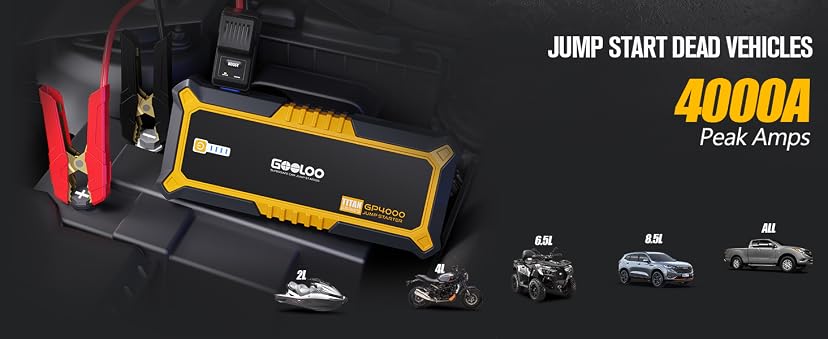
The GP4000 is a 12V lithium polymer jump starter that claims 4000A peak and coverage of all gas engines plus diesel up to 10.0L. The 4000A figure is a label claim — no confirmed independent bench measurement (Project Farm or equivalent) was found for this model at time of review; ultra-high-claim units in this range routinely test at a fraction of their labeled peak. The unit is CE-marked, a self-declared EU-export conformity marking. UL Product iQ and Intertek ETL searches found no third-party lab listing — a meaningful gap compared to UL-listed competitors.
Community evidence is broadly positive for the vehicle classes most buyers actually own: sedans, SUVs, and light trucks under normal and moderately cold conditions. One BobIsTheOilGuy forum thread described the GP4000 outperforming a competitor in cold-weather starts on smaller diesels. The BOOST button — intended for deeply discharged batteries — draws mixed reports, with some users reporting success and others failure on completely flat batteries.
Charge retention requires more attention than premium lithium starters: GOOLOO recommends a top-off every 2–3 months, shorter than the 3–6 month category median, consistent with LiPo self-discharge rates. Long-term (3+ year) ownership data in available community evidence is thin.
Who should buy — and who should skip it
The GP4000 fits budget-conscious drivers who start passenger cars, SUVs, or light trucks and are willing to stay on top of the 2–3 month charge interval. At ~$80 with 8,600+ Amazon ratings and a 4.6-star average, the community reception is strong for the price. Skip it if you need a confirmed third-party certification, rely on it for large diesel engines where the 4000A claim matters most, or want a set-and-forget trunk unit — the charge interval and absence of an IP rating make it less suitable for neglected storage.
Safety and environmental impact
The GP4000 is an electronics device with no SDS. It is CE-marked; no UL or ETL certification was found in third-party databases as of 2026-05-16. The battery is lithium polymer with a manufacturer-documented BMS covering overcharge, overcurrent, and thermal protection. No CPSC recall is active; no thermal runaway incidents are documented for this model. California Prop 65 warning does not apply per Amazon listing data. No Call2Recycle participation or manufacturer battery take-back program was documented — battery disposal follows standard lithium e-waste channels (municipal hazardous waste collection, e-waste drop-off sites).
Frequently asked questions
Does the GOOLOO GP4000 really deliver 4000A?▾
The 4000A figure is a label claim. No confirmed independent bench measurement (Project Farm or equivalent) was found for the GP4000 specifically at time of this review. Community reviews broadly confirm the unit starts passenger cars, SUVs, and trucks under normal and cold conditions, but the actual peak-amp output has not been independently verified. The cranking performance score is capped at 6.5 per the rubric rule for ultra-high-claim units without independent bench data.
Is the GOOLOO GP4000 UL-listed?▾
No. Searches of the UL Product iQ database (productiq.ul.com) and the Intertek ETL database found no listing for the GOOLOO GP4000 as of 2026-05-16. The unit is CE-marked — a self-declared conformity marking standard for EU-export products — but CE is not equivalent to UL or ETL third-party lab certification. The Amazon listing does not claim UL listing.
How often does the GP4000 need to be recharged in storage?▾
GOOLOO recommends a top-off charge every 2–3 months. This is shorter than the 3–6 month interval typical of lithium-ion jump starters in this class, consistent with LiPo battery self-discharge characteristics. If stored for extended periods without charging, capacity can degrade. Keep the unit partially or fully charged for best results in an emergency.
Is the GOOLOO GP4000 safe to store in a car trunk?▾
The unit carries CE marking and the manufacturer documents 10 built-in protections including overcharge, overcurrent, short circuit, and thermal protection. No CPSC recall is active as of 2026-05-16, and no documented thermal-runaway incidents were found for this model. No third-party UL or ETL certification has been confirmed — buyers who require a third-party lab-certified unit should consider UL-provisional or UL-confirmed alternatives.
From the manufacturer
Marketing copy from GOOLOO, via Amazon. Not editorial.
- •Powerful and Reliable Car Battery Jump Starter - The 4000 amp booster pack jump starter is capable of quickly jump-starting a dead car battery. Even if the battery voltage is extremely low, simply pressing the "BOOST" button will forcefully restart the car. The GOOLOO car battery charger jump starter can effectively start all gasoline engines and diesel engines up to 10.0L within mere seconds. This versatile device is compatible with 12v vehicles, motorcycles, pickup trucks, RVs, tractors, trucks, cargo vans, ATVs, snowmobiles, yachts, and various other vehicles
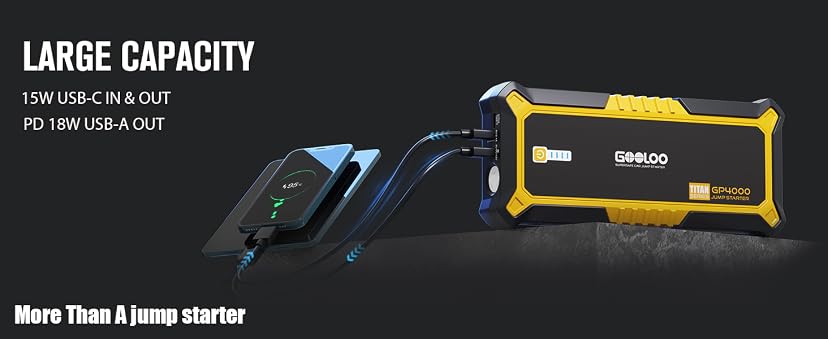
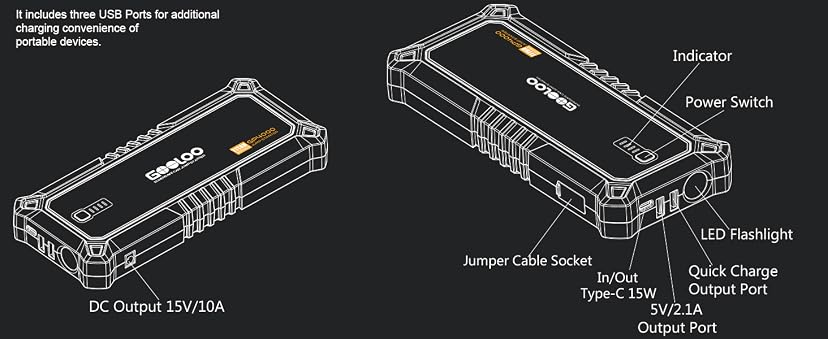
- •Massive Capacity Portable Charger - The GP4000 car battery charger jump starter boasts an immense capacity and offers dual USB charging output ports (one supporting fast charging) along with a USB Type-C charging port (5V/3A). This versatile power source enables you to charge other devices or recharge the jump starter itself. Its compact design ensures high portability, making it capable of efficiently charging various portable devices such as smartphones, tablets, cameras, GPS systems, and more
- •Emergency Life Saver - The GOOLOO GP4000 car jump starter provides quick vehicle jump-starting capabilities, ensuring that you're not stranded and exposed to potential dangers for an extended period of time. With a full charge, it can jump-start most vehicles over 60 times, offering reliable assistance in emergency situations
- •Safety & Quality Metal Clamps - The GOOLOO booster pack jump starter is equipped with 10 different types of built-in protection, alleviating concerns about misuse and sparks. Our primary objective was to ensure that users feel completely safe while using our product. The Smart Jumper Cables are designed with durable all-metal clamps to prevent damage that may occur from long-term usage
- •Rugged 12V Car Jump Starter - The sturdy construction of hardened plastic and rubber corners ensures that the jump starter can withstand drops without any issues. Additionally, it features a built-in flashlight to provide assistance during vehicle emergencies at night
- •Reliable in Extreme Cold Weather - The advanced smart chip used in the GP4000 jump pack ensures fast and dependable car startup even in extreme temperatures ranging from -4°F (-20°C) to 140°F (60°C)
- •IN THE BOX - GOOLOO Heavy-Duty Portable Car Battery Jump Starter GP4000, Smart Jumper Cable, USB to Type-C Cable, Cigarette Lighter Socket Adapter, EVA Storage Case, 18 Months Warranty and Lifetime Tech Support. (Wall charger is not included)
- •【TIPS】 If the jump starter has been idle for an extended period, it is advisable to charge it every 2-3 months to maintain its optimal condition
Weekly pick
One product, one safety verdict, every week. No spam.

Manufacturer videos
Manufacturer images


Manufacturer specifications
- Brand
- GOOLOO
- Battery Cell Composition
- Lithium Polymer
- Voltage
- 12 Volts
- Product Dimensions
- 3.92"D x 8.97"W x 1.49"H
- Vehicle Service Type
- ATV, Lawn Mower, Motorcycle, Passenger Car, RV, Snowmobile, Truck, UTV
- Battery Type
- Lithium Polymer
- Compatible with Vehicle Type
- ATV, Lawn Mower, Motorcycle, Passenger Car, RV, Snowmobile, Truck, UTV
- Battery Capacity
- 24000 Milliamp Hours
- Amperage
- 4000 Amps
- Peak Output Current
- 4000 Amps
- Automotive Fit Type
- Universal Fit
- Item Dimensions D x W x H
- 3.92"D x 8.97"W x 1.49"H
More in Jump Starter

NOCO
Boost HD GB70 Jump Starter
CCT 7.4 · RecommendedHealth 8.5
NOCO
Boost X GBX75 Jump Starter
CCT 7.1 · RecommendedHealth 8.5
Clore Automotive
Jump-N-Carry JNC660
CCT 6.8 · DecentHealth 8.5
NOCO
Boost Plus GB40
CCT 6.7 · DecentHealth 8.5
As an Amazon Associate and affiliate partner, CarCareTruth earns from qualifying purchases. Full disclosure
Community
0 postsShare how you use this product
Drop a quick comment or post a full review with photos and a star rating.
Sign in to postNew here? Create a free account.
Top Amazon review
↗External — Amazon's most-helpful review for context.
Reaaly works!! BELEIVE the mfgr'r's claims!!
This is a long, involved Review. So... be patient.I bought this Gooloo unit exactly 30 days ago. Today provided my first opportunity to test it out.Background: I'm a 74 yr old Disabled/Retired Senior; confined to a wheelchair. I live off of my monthly SS check; so, limited income/essentially no savings. I live alone, ~ 60 mi. S. of Abq., NM; and make one errand run into Abq., each month - ~ 140 mi. round trip, with the around-town errands included.I put less than 1500 miles on my car, per year. I inherited the car when my mother died in 2010. The car is a 2002 Pontiac Bonneville; so, closing up on 21/22 yrs old. The stock battery lasted 15 yrs, but I've had ongoing dead-battery issues, since. I've put in four NAPA-grade batteries in the last 7 yrs, or so; two, new (at ~ $200 a pop), and two under limited warranty replacement (~ $80 a pop).The battery lives under the rear seat, and, what with the nature of my handicaps... it's pretty much a quite considerable pain for me to replace one. Over the last 7 yrs, the car has suffered from some sort of unidentified, intermittent drain on the bat, that deads it out maybe six to eight times a year. I suspect something like a malfunctioning trunk light switch, but have never been able to nail down the exact issue (I rmv'd the trunk lamp/bulb, but still have the issue; so... go figure).Anymore, I ck the battery once or twice a week; but still run into the dead bat issue, all too often. Unfortunately, before I discover it so... the battery often sits dead for several days or more; sulfate'ing away, all the while; i.e., getting deader & deader each day, before I actually discover that it IS dead. If dead (sulfate'd) for too long (a week or two?)... the bat is unrecoverable; and then requires replacement.I have multiple, high quality bat chrgrs, but, if the bat's been sulfate'ing, it can take up to several hours, or more, to get it to accept enough charge to (barely) start the car. I have no garage, so the car lives on the street, out front; and it is not practical to use a Battery Tender/trickle charger on it (pwr cord/public sidewalk/safety issues).When I think the bat's getting marginal, I start the car, and run it for 15 minutes, to top off the bat.Background, complete.In reading the Amazon reviews (and some from other sites) I noticed a couple of reviewers lambasting the Gooloo unit(s) for having a small, actual AH (Amp Hour) rating. I had already been wondering how SUCH a small unit... could start a car; much less, the over 60 times per charge claimed for this unit (and, that, at ONLY 50% or greater retained charge [not supposed to use it to jump-start, at all, below 50% charge]).In the specs, this unit is rated at ~ 98 WH (Watt Hours). No actual AH (Amp Hour) Rating is provided. I've been in electronics all my career, so have the wherewithal to apply the appropriate math to the issue. 98 WH IS a tad under 8 AH; just as the negative reviewer(s) were/are claiming. It appears, however, that they were wanting to use the units to run some sort of meteorological/ecological instrumentation setups (?); and, sure enough, only 8 AH is hardly going to get that sort of job done!So... how does this all compute? A little more background is needed, here.Mfgr's commonly use a procedure called 'binning'; essentially, dividing the production line output into, essentially, Good, Better, Best ratings. Three-level binnings are common, though you can obviously go further; until reaching the level of full rejection/unacceptable performance/failure.I literally have dozens of Makita brand, battery operated tools; and have something like 37 batteries for same, in two sizes (AH Ratings). Most are fairly old, the oldest being in excess of 15 yrs. I used to pull all the bats every six or eight months, and run them all through my chargers. However, I found, over the years, that they (unless the bat/unit had been recently/heavily drained) typically achieved full charge in under five minutes; occasionally, as long as 30 mins. Commonly, though, most of my Makita bats reach Full in under 30 seconds!! (basically, the ones that have been sitting in unused tools - as long as a year - or more).Anymore, I run the Kita bats through the chargers only on an annual (or, longer) basis. And... with the same consistently impressive results! They REALLY hold a charge well!!This is a good example of First Binning lithium-ion cell selection (a 'battery', by definition, being comprised of multiple 'cells'); i.e., the batteries only contain the highest quality cells.At the other end of the spectrum, are the bats for my Ryobi brand tools (Home Depot). The Ryobi tools are incredibly cheap, and a 'relatively' good value; even if you just use them up to destruction, and then simply buy new replacements; as I've read some construction workers claim to regularly do.Unfortunately, the Ryobi batteries are the complete opposite in value. I quit buying them after eight batteries (I've had to toss out two, and have two more that are minimally functional/very difficult to take on a charge). Unlike the Makita bats, the Ryobi bats are only avlble from Home Depot (no where else - like at Amazon, for instance). Further, they charge $80 per bat, and are never discounted.Of my six remaining Ryobi bats, ALL fail to hold a charge for more than a month or so; and several, won't even hold a charge for a week or more. Further, unlike the Makita bats, they also don't seem to perform anywhere near their AH Ratings (also, compared to my Milwaukee tool bats).Though, I'm simply too lazy to have actually run AH Rating analysis on them (fixed resistor load, over measured time, to a set level of discharge).This is an obvious example of Third Binning (or, worse) cell selection.I might also note that this is old history. I recently noticed that Ryobi has newer lines of their bats, that appear to (possibly) be of better quality/value. But, having been soooo burned, in the past... I've not invested/investigated, further. Nor, plan to.When Milwaukee started up in competition to Makita's battery line(s) of tools, quite some years, back... I encountered multiple quality issues with their batteries, too. I had to toss several, as completely unusable/failed. That's when I discovered that procuring individual replacement cells, with which to change out the dead cells/repair the battery, was actually more expensive than simply buying a new battery!!I'd guess, when they were starting out, that Milwaukee was using Second or Third Binning cells. But, over time... as I replaced the trashed bats with newer ones, I think they had realized their error, and had moved up to using First Binning cells; as, from that point onward, and, to this day, I've had results with their bats, similar to the excellent experience(s) I've always had with my Makita bats.So... a large, 8-cylinder ICE-type engine's starter, as I recall, typically draws several hundred amps off the battery, during starting. Just for grins, and ease at math being done in my head, I use(d) 333 amps as an average draw. Obviously, with smaller engines/starters, the draw will be considerably less (or, somewhat more, in the case of a BIG truck's diesel engine, say). My car's engine is a 6 cylinder; so, maybe around 200 Amps, max?Assuming an engine is in good tune/shape, a typical start takes 3 seconds, or less. Say, five or six, if the engine is 'less than optimal', for what ever (hopefully, temporary) reason.Soo... 333 Amps, for three seconds, computes to roughly 0.1 AH draw (load).Thus, at the above loading level, dividing 8 AH by that 0.1... will yield '80 starts'.But, limiting to 50% Gooloo battery charge, and, just for grins, assuming linear performance from said battery, say... 40 starts.Then... figure that, most often, many starts take LESS than one to two actual seconds (time it off in your mind, then compare to your usual engine starting time duration experience).So... boost that '40 starts'... up to 60 starts.Which, in actuality, isn't at all that unreasonable a claim.That all assumes the Gooloo battery IS capable of a very high, short-term current (Ampere) output.How to assure that? First off, use ONLY the highest binning cells for the batteries. Likely, they even use 'special' cells; designed and selected for extra-high amperage output. Then, instead of using only one or two spot-welded straps to interconnect each cell to the next one, let's assume double, or even triple the number of straps. And/or, to further augment high current capability, assume usage of much heavier (lower current resistance) straps.Then... lets maybe assume using the types of cell construction developed for the electric car industry (obviously, high-quality, high-current-drain-capability cells needed, there!). Or, equivalent.And, thennnn... lets include enough cells in the battery (in series, that is - the voltages adding serially) to have a higher output voltage (often analogized/compared/equivalent to water pressure, in a hose); so as to more easily drive/supply higher current (volume - i.e., G.'s per minute of water) from the battery.I measured the output of the Gooloo unit I have; and it measures over 16 Volts (unloaded). At 3.7 Volts, nominal, per lithium cell (up to 4.2 Volts, fully charged), often mfgr's will claim 12 Volts, off off 3 cells in series. Better to go with four cells - 14.8 Volts, nominal.So, at 16+ Volts measured... maybe Gooloo uses five cells in series; or, perhaps, one of the alternate lithium chemistries (such as lithium-phosphate) - resulting in slightly different voltages per cell, and a slightly different total, for the overall composite battery.Add all this together... and I can understand how such a small battery (8 AH) CAN easily start a car.And, often... say, 50 or 60 actual jump-starts per charge cycle.Now... how did all this work out in my ACTUAL experience, today?To start, my battery was 'dead as a door nail' - i.e., deader than dead. Nada. Wouldn't even allow unlocking the door(s) (or, gas cap cover/opening the trunk) from the remote fob.Arrgghh!So... a prime case with which to test the Gooloo.I didn't want to pull the rear seat, to gain direct access to the battery, so popped the hood, and connected the way I usually use one of my battery chargers to try to recover/charge the dead battery - connecting the Gooloo's Black lead/clamp to a bolt on the engine's alternator mounting assy, and flipping up the plastic 'safety cover' leading into the primary fuse box's incoming 'Plus' terminal (my car has a secondary fuse box, near the battery, under the rear seat. Go figure.), to connect the Gooloo's Red lead to.Since the bat was soooo dead... and as outlined in the Gooloo's Instructions... after obtaining the Green light on the jumper cable module as blinking... I pressed the little nearby 'Boost Button'... and got a solid Green.As soon as I had connected the Gooloo, and prior to pressing the little button, all my running lights and such, had lit up merrily bright. 'Encouraging!', I had thought.But, when I got in the car and hit the starter... all I got was a short 'blip' - no starter turn-over - and...all the lights went out.Grumble, grumble!!But.... I certainly wasn't ready to give up. Yet.I got back under the hood, and checked my connections. When I jiggled/ck'd the Black lead... I got sparks! Indicative of an inadequately secured connection. I made sure it was WELL clamped in place, this time, jimmying it about as bit, so the teeth of the clamp could pierce through any oxidation on the bolt-head I'd chosen.And... all the lights came back on - brightly!THIS time... when I hit the starter...the engine spun enthusiastically...and - 'Vroom'! - started right up!Happy camper, I!! :-) :-)So... I am VERY confident & happy, now, in/with my Gooloo unit.And, by my above suppositions and calculations... do not doubt the claimed '60 jump-starts' being advertised/claimed for this unit.I'm impressed with the Gooloo in ALL considerations (as so well detailed/outlined by the other reviewers).HIGHLY Recommended!!Addendum: It's about ten days later from the above, now. Once again... grumble, grumble... my car's bat is all sorts of dead. Only this time... the Gooloo couldn't start it - at all.I had noticed that Amazon had posted my Review as the 'Most Positive' review. I hope it stays that way, as I am still feeling very positive about the Gooloo unit; but... now having encountered some real world limitations to it's 'practical' usage - thought that they were worth being noted, here.I had also noticed that the 'Least Positive' review had complained that the Gooloo was unable to start his vehicle, when he had a very dead battery. Considering my success with doing just that (in the upper/first part of this review), I was a bit... puzzled/surprised.Well... no more. Apparently, earlier, I DID have a very dead battery; but... no where NEAR as truly double-dead-dead as with this 2nd attempted use of the Gooloo unit.As before, I had connected the Gooloo, engaged the 'Boost Button', and got (external) running lights; but lost all, when I (unsuccessfully) tried to start the vehicle. Just got nothing; no starter turnover, and 'lights out'. The Gooloo went from Boost Mode, back to a blinking green light on the jumper module.Tried it several times; same, each.Arrgghh!However... I did recall that the instructions advised letting the Gooloo be attached for a few minutes PRIOR to jump-starting; which I had been knowledgeably/purposely been avoiding doing, as I had been more interested in subjecting the Gooloo to worst case, 'street' conditions/usage.Well... things just got even worse for it, this time.Sooo... I decided to let the unit hang onto the car's bat, and transfer some charge into it; in hopes that that would enable the Gooloo to, a little bit later, jump start it. Fortunately, all this is/was going on at my residence, not 'out in the wild'; although that was exactly why I was trying this particular methodology out - like this, here & now.In watching the unit, I noticed the green light cycling - 6 seconds On, one sec Off, then, repeat; consistently. After having gotten bored watching that, I moved over into the shade of the building; from which vantage (out of the bright [hot!] sun at the front of the car), I was able to observe the rear running lights.Which were bright for four secs, dimming to being out completely, over the next 2 secs, remaining so for the 1 sec the jump cable module's SoC ('Solution-on-a-Chip' - the industry's nomenclature for a custom-designed, single-purpose IC chip) was using to Reset itself, each cycle, and then repeat - over & over.So I felt confident that the Gooloo WAS transferring charge into the vehicle's battery. (Which did, indeed, later prove to have been the case). After all was over, I plugged the Gooloo unit into a charger, via USB-C. Before, the unit was showing 2 solid bars (when I disconnected it); now, while initializing charging, it had 1 solid bar, and was blinking the second one (later, progressively, the 3rd and 4th ones) - thus, my conclusion that I HAD xfer'd OVER half the Gooloo's charge into my car's battery.BTW, despite being connected to a 50W charger/wall-wart, that I often use on my Samsung S23 Ultra cell phone, the Gooloo took 5 hours to reach Full charge; thus leading me to the conclusion that the unit's firmware does not honor/recognize Hi-Speed USB charger protocols (perhaps introduced AFTER the Gooloo's design phase had been locked in place?).But... after 15 minutes of charge xfer time had passed... the Gooloo still couldn't start the car. When I disconnected it, I noticed that the Gooloo bat's power indicator showed 2 bars (see above); indicating it HAD xfr'd some energy into the car's bat. A bit over half of the Gooloo's 8 AH capacity, as DID actually prove out. And... the instructions DO state NOT to try jump starting below 50% charge (which this unit WAS at, at that point).So... maybe... had I only xfer'd charge for, say... 5 minutes?... MAYBE... the Gooloo (being at over 50% charge, at this 'conjectural' point in time) WOULD have successfully jump-started my car.I'd like to think so; and, if similar circumstances present again, in future, will test out such.Back to today... I then set out my safety cones, ran out an extension cord, and hooked up my (larger) car bat chrgr.Which, like so many things, today, is waaaay over-software-engineered; meaning that all the supposed advantages to doing so, during the design phase... often result in annoying, real-world limitations, in day-to-day usage scenarios.Which, in this case... the charger wanting to see at least a FEW volts on the battery... often leading to hassles getting the durned thing to actually charge the battery at all - when encountering a very dead one!Fortunately, however... in THIS circumstance... it read out 4 Volts present in/on the car's battery; thus verifying the Gooloo's energy xfer. I let the AC charger do it's thing for about an hour...returned to find that car's bat at ~ 11 Volts, and maybe 35% charge, and, then, managed to successfully start there car.WHEW!!So, for 'normal' dead battery issues, and with an otherwise viable, healthy battery... I feel the Gooloo unit is STILL to be Highly Recommended.However... when encountering VERY dead/unhealthy-unhappy/compromised batteries (like mine was/is)... it would be wise to be aware of the above limitations.Best of luck to you all.