CarCareTruth Score
Mediocre, but it's tough on the environment.
Opens Amazon in a new tab. No account needed to look.
Saved to your guest loadout. Sign up to also save to your Cabinet (consumables) or Kit (tools you own).
As an Amazon Associate I earn from qualifying purchases. Full disclosure
Prices may varyThe manufacturer's Safety Data Sheet classifies this product with one or more GHS Category 1 health hazards — the most severe tier. The hazard statements in quotes below are the verbatim GHS language from the SDS, as required by OSHA's Hazard Communication Standard. The line under each statement translates the GHS classification into plain language.
GHS Category 1 aspiration toxicity — thin, oily liquids can slip into the lungs if swallowed, causing chemical pneumonia.
GHS Category 1 carcinogenicity — classified as suspected of causing cancer with repeated or prolonged exposure.
GHS Category 1 reproductive toxicity — classified as suspected of damaging fertility or harming an unborn child.
If swallowed:
The aspiration hazard (H304) is about the liquid being swallowed and reaching the airway, not about breathing fumes during normal use.
Call Poison Control immediately at 1-800-222-1222 (US, 24/7, free) and have the product container with you. Poison Control's standing guidance is to not induce vomiting after chemical exposure; they will direct first-aid steps based on the specific product.
About this product's hazards. This product's Safety Data Sheet uses signal word DANGER.Read the manufacturer's SDS and follow all safety instructions before use. CarCareTruth ratings translate the manufacturer's safety sheet. They do not replace the SDS or substitute for a hazard assessment specific to your task.
Health score is for adult use as intended, per the manufacturer's SDS. It does not model child ingestion, accidental spill cleanup, or off-label use. See the safety panel below for full hazard classification, and /disclaimer for the full editorial scope.
GHS hazard codes are quoted from the manufacturer’s Safety Data Sheet. PPE tiers below translate those codes and the listed ingredient chemistry; they are not CarCareTruth recommendations.
Show details for all categories ▾Hide details ▴
Translated from the manufacturer’s Safety Data Sheet, Section 8
SDS Section 2 classifies the mixture as Serious Eye Irritation Cat 2A (H319). SDS Section 8 specifies a full facepiece chemical respirator and notes an eyewash station must be provided; for the spray-application scenario the chemistry-forced minimum is safety glasses or splash goggles.
U.S. regulatory standard
29 CFR 1910.133(a)(1)
“The employer shall ensure that each affected employee uses appropriate eye or face protection when exposed to eye or face hazards from… liquid chemicals…”
ANSI Z87.1 (incorporated via §1910.6)
OSHA standards apply to workplaces. Cited here as the U.S. reference threshold for the underlying hazard class.
CarCareTruth publishes the cited sources verbatim and does not advise what action a user should take. Consult the full SDS before use.
Translated from the manufacturer’s Safety Data Sheet, Section 8
SDS Section 2 classifies Skin Irritation Cat 2 (H315). SDS Section 8 explicitly directs 'chemical resistant gloves' and 'chemical resistant clothing' with 'an impervious apron recommended.' Dichloromethane permeates many common glove materials (nitrile rapidly) · SDS Section 8 chemistry-resistant glove guidance is the binding constraint, not generic disposable nitrile.
U.S. regulatory standard
29 CFR 1910.138(a)
“appropriate hand protection when employees' hands are exposed to hazards such as those from… chemicals which produce an adverse effect on the skin or eyes…”
OSHA standards apply to workplaces. Cited here as the U.S. reference threshold for the underlying hazard class.
CarCareTruth publishes the cited sources verbatim and does not advise what action a user should take. Consult the full SDS before use.
Translated from the manufacturer’s Safety Data Sheet, Section 8
DANGER signal word with multiple health-tier H-codes (H350 carcinogen Cat 1B, H360 reproductive Cat 1A, H370/H372 STOT Cat 1, H336 narcotic, H304 aspiration) and an aerosol form factor. SDS Section 8 directs a chemical respirator with organic-vapor cartridge and full facepiece. Methylene chloride is an OSHA Specifically Regulated Substance with a TWA of 25 ppm and STEL of 125 ppm; the aerosol delivery mechanism makes airborne concentration accumulation in any enclosed space the dominant exposure pathway.
U.S. regulatory standard
29 CFR 1910.1003; substance-specific 1910.1001–1910.1052
“Each employer shall ensure that no employee is exposed [in excess of the substance-specific PEL]…”
OSHA standards apply to workplaces. Cited here as the U.S. reference threshold for the underlying hazard class.
CarCareTruth publishes the cited sources verbatim and does not advise what action a user should take. Consult the full SDS before use.
The published Safety Data Sheet for this product does not specify ventilation protection for consumer use.
Workplace context
29 CFR 1910.134(a); 1910.1000
“the primary objective shall be to prevent atmospheric contamination [via] accepted engineering control measures (for example, enclosure or confinement of the operation, general and local ventilation…).”
Triggered by GHS H336 on the SDS.
OSHA standards apply to workplaces. Cited here as the U.S. reference threshold for the underlying hazard class.
PPE tiers translate the manufacturer’s SDS and U.S. regulatory standards. Not professional safety advice. How we report safety.
Scope of these PPE tiers. The tiers on this page translate the product's Safety Data Sheet where one is published, plus its ingredient chemistry, into a comparable rating. They describe a formulation, not a situation: a tier is not a safety determination for any specific user, task, quantity, or environment. The manufacturer's label and use instructions govern how the product is handled. Where the product is used at work, the employer's PPE program and hazard assessment under 29 CFR 1910.132 decide what protection is selected, not this page.
No warranties. CarCareTruth makes no warranties, express or implied, and expressly disclaims the implied warranties of merchantability and fitness for a particular purpose.
This product ranks #13 of 13 in Carburetor Cleaner.Three above it ↓
Last reviewed July 31, 2026
TL;DR Gunk Carb Medic runs on a chlorinated, aromatic-heavy chemistry the product listing flags "Not for sale in California." The SDS classifies it as a Cat 1B carcinogen plus Cat 1A reproductive toxin plus two Cat 1 organ-damage codes · the most severe hazard stack on any reviewed carb cleaner. It does clear heavy varnish in one pass, but it attacks most plastics, paints, and many rubbers on contact, and SDS §8 directs full chemical-respirator PPE. The product listing has been "Currently unavailable" for an extended period.
The active chemistry pairs a strong chlorinated solvent with an aromatic cutting fraction · together they handle the heaviest gum, varnish, and baked-on carbon in one pass, including cases where ketone-based aerosols leave residue. Historical small-engine and motorcycle forums referenced it as a heavy-duty option. Use it only after disassembly: the chemistry dissolves NBR O-rings, lifts painted intake finishes, and crazes most plastic linkages on contact, so spray-in-place near assembled rubber is not safe. Community guidance since 2020 steers users to safer alternatives first.
There is no everyday consumer case where this beats a ketone-based competitor · the cleaner that does the same job without the Cat 1 carcinogen, Cat 1 reproductive toxin, and Cat 1 organ-damage codes on its SDS is a better trade for almost everyone. Skip it unless a carb has been sitting for years with heavy brown-lacquer varnish that mainstream cleaners and an overnight carb-dip have failed to clear, and full PPE plus outdoor work is workable. California buyers cannot purchase it at all. For everyone else, CRC Carb & Choke (#03077), Berryman B-12, and Gumout Jet Spray are the better starting points.
DANGER signal word driven by H350 (Cat 1B carcinogen · the chlorinated active is IARC 2A and OSHA-specifically-regulated, TWA 25 ppm), H360 (Cat 1A reproductive toxin), H370 + H372 (Cat 1 single- and repeated-exposure organ damage), H304 (aspiration), and H336 (narcotic). H223/H229 are physical flammability codes and do not contribute to the health score. SDS §8 directs a full-facepiece organic-vapor cartridge respirator, chemistry-resistant gloves (the chlorinated active permeates nitrile), and chemical-resistant clothing. SDS §7: "Pregnant or breastfeeding women must not handle this product." Do NOT induce vomiting if ingested · H304 aspiration risk. The SDS reports 44% VOC under the federal method because the dominant solvent is VOC-exempt for atmospheric-photochemistry reasons; absolute volatile burden including the exempt fraction is ~1070 g/L. H401/H411 aquatic toxicity · keep residue out of drains; dispose as RCRA D001 ignitable waste.
Carb Medic is built on a different solvent system than the rest of the category. Most modern carb cleaners (CRC #03077, Gumout Jet Spray) are acetone-dominant · acetone is a Class 4 oral-toxicity flag and a Cat 3 narcotic at most, with no carcinogen or reproductive-toxin classifications. Carb Medic uses dichloromethane (methylene chloride) at 60-70% of the formula, plus 10-20% toluene and 10-20% xylene. Dichloromethane is a Prop 65 listed carcinogen, IARC 2A, and an OSHA Specifically Regulated Substance; toluene is a Prop 65 listed developmental toxin and drives the H360 Cat 1A reproductive classification on the mixture. The cumulative result is the H350 + H360 + H370 + H372 + H304 stack that does not appear on any other reviewed carb cleaner.
Methylene chloride has been exempted from the US federal definition of VOC since 1996 under EPA 40 CFR 51.100(s) because it has negligible photochemical reactivity in the atmosphere (it does not contribute to ground-level ozone formation). The SDS Section 9 VOC reading of 44% by weight excludes dichloromethane and computes from toluene, xylene, and ethylbenzene only. Including the 60-70% dichloromethane fraction in the volatile-mass-per-litre accounting gives ~1070 g/L absolute volatile mass · the actual solvent burden in the air when the can is used. The federal exemption is an atmospheric-chemistry decision; it is not a public-health endorsement, and it is independent of dichloromethane's carcinogen and STOT classifications.
Two reasons combine. (1) California's Consumer Products Regulation imposes much tighter VOC limits than the federal accounting, and unlike at the federal level California does not categorically exempt methylene chloride from the consumer-product VOC ceiling for carb cleaners. (2) California Proposition 65 disclosure for dichloromethane (cancer), toluene (developmental), and ethylbenzene (cancer) at the concentrations present here triggers warning obligations that the brand has not retooled the formula to avoid. Gunk does not appear to sell a California-reformulated variant of Carb Medic (unlike the Engine Brite line, which has an EB1CA SKU).
The 2019 TSCA Section 6(h) rule restricted methylene chloride in consumer paint-stripping uses; the SDS Section 1 line 'not and cannot be distributed in commerce... for consumer paint or coating removal' reflects that rule. The 2024 EPA TSCA Section 6 final rule extends restrictions to most other consumer and commercial dichloromethane uses, with a phased compliance schedule. Carburetor cleaner is not named in either rule's specifically-restricted-uses list, so the product remains legally sold as a carb cleaner. The chemistry profile is shared with applications that have already been restricted, and continued availability is a categorical-scope outcome of the rulemaking rather than a chemistry safety case. As of 2026-05-18 the product listing is 'Currently unavailable' · whether that reflects a commercial decision, a supply-chain interruption, or an anticipatory withdrawal is not publicly documented.
Yes, on heavy varnish. Dichloromethane is a powerful solvent for gum, varnish, and baked-on carbon; the toluene and xylene aromatic fraction extends the cleaning profile. On purely-metal carburetor passages with no assembled rubber, this formula clears deposits more aggressively than acetone-based competitors. Community forum threads from the 2010s reference Carb Medic as a heavy-duty option for sitting-fuel small-engine carbs. The trade-off is the worst chemistry-driven health profile in the category, and modern community guidance (post-2020) routinely steers users toward Berryman B-12 or CRC #03077 first · saving Carb Medic-class chemistry for cases where those have failed.
Dichloromethane attacks most plastics aggressively (polystyrene, polycarbonate, acrylic, ABS, many vinyls, polyurethane), most paints (lifts paint film on contact), and many rubbers (will swell or dissolve NBR/Buna-N O-rings, silicone, many gasket materials). It is non-reactive with metal and most fluoropolymers (PTFE, FKM/Viton). Practical guidance: disassemble before applying. Do not spray onto assembled carburetors with rubber gaskets, plastic linkages, or painted intake components. Brief overspray onto painted engine surfaces will lift the finish.
Marketing copy from Gunk, via Amazon. Not editorial.
Weekly pick
One product, one safety verdict, every week. No spam.
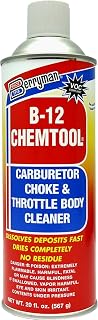
Berryman
B-12 Carburetor, Choke and Throttle Body Cleaner
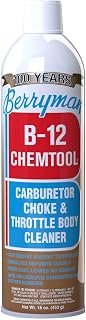
Berryman
B-12 Chemtool Carburetor, Choke & Throttle Body Cleaner
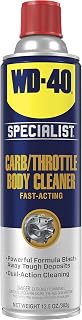
WD-40
Specialist Carb/Throttle Body & Parts Cleaner
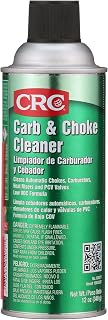
CRC
Carb & Choke Cleaner (12 oz aerosol)
As an Amazon Associate I earn from qualifying purchases. Full disclosure

Community
0 postsShare how you use this product
Drop a quick comment or post a full review with photos and a star rating.
Sign in to postNew here? Create a free account.