CarCareTruth Score
Decent, but wear gloves and ventilate.
Opens Amazon in a new tab. No account needed to look.
Saved to your guest loadout. Sign up to also save to your Cabinet (consumables) or Kit (tools you own).
As an Amazon Associate I earn from qualifying purchases. Full disclosure
Prices may varyAbout this product's hazards. This product's Safety Data Sheet uses signal word DANGER.Read the manufacturer's SDS and follow all safety instructions before use. CarCareTruth ratings translate the manufacturer's safety sheet. They do not replace the SDS or substitute for a hazard assessment specific to your task.
Health score is for adult use as intended, per the manufacturer's SDS. It does not model child ingestion, accidental spill cleanup, or off-label use. See the safety panel below for full hazard classification, and /disclaimer for the full editorial scope.
GHS hazard codes are quoted from the manufacturer’s Safety Data Sheet. PPE tiers below translate those codes and the listed ingredient chemistry; they are not CarCareTruth recommendations.
Show details for all categories ▾Hide details ▴
Especially relevant: misting overhead · splash risk · when spraying
Translated from the manufacturer’s Safety Data Sheet, Section 2
SDS §2 classifies the product as H319 (Cat 2 serious eye irritation) · not H318. Aerosol spray with acetone-driven vapor pressure (~185 mmHg) generates inhalable mist that drifts toward the face during close-range carburetor application. SDS §8 lists safety glasses.
U.S. regulatory standard
29 CFR 1910.133(a)(1)
“The employer shall ensure that each affected employee uses appropriate eye or face protection when exposed to eye or face hazards from… liquid chemicals…”
ANSI Z87.1 (incorporated via §1910.6)
OSHA standards apply to workplaces. Cited here as the U.S. reference threshold for the underlying hazard class.
CarCareTruth publishes the cited sources verbatim and does not advise what action a user should take. Consult the full SDS before use.
Only when: prolonged use · handling concentrate
Translated from the manufacturer’s Safety Data Sheet, Section 2
SDS §2 mixture classification does not include H315; the toluene component carries H315 at ingredient level only. SDS §8 lists protective gloves for prolonged or repeated handling.
CarCareTruth publishes the cited sources verbatim and does not advise what action a user should take. Consult the full SDS before use.
Translated from the manufacturer’s Safety Data Sheet, Section 2
SDS §2 lists H336 (drowsiness or dizziness from vapor inhalation) and H373 (target-organ toxicity through repeated exposure) alongside the H222/H224 flammability stack. The DANGER signal word is co-driven by these health H-codes, not flammability alone. SDS §7 directs use in a well-ventilated area; SDS §8 directs suitable respiratory equipment when ventilation is insufficient · the operative case in any enclosed garage given the acetone-driven vapor pressure and toluene fraction.
U.S. regulatory standard
29 CFR 1910.134; 1910.138; 1910.1000
“the primary objective shall be to prevent atmospheric contamination…”
OSHA standards apply to workplaces. Cited here as the U.S. reference threshold for the underlying hazard class.
UN GHS hazard statement
H373“May cause damage to organs through prolonged or repeated exposure”
UN GHS Rev. 9 (2021)
CarCareTruth publishes the cited sources verbatim and does not advise what action a user should take. Consult the full SDS before use.
The published Safety Data Sheet for this product does not specify ventilation protection for consumer use.
Workplace context
29 CFR 1910.134(a); 1910.1000
“the primary objective shall be to prevent atmospheric contamination [via] accepted engineering control measures (for example, enclosure or confinement of the operation, general and local ventilation…).”
Triggered by GHS H336 on the SDS.
OSHA standards apply to workplaces. Cited here as the U.S. reference threshold for the underlying hazard class.
PPE tiers translate the manufacturer’s SDS and U.S. regulatory standards. Not professional safety advice. How we report safety.
Scope of these PPE tiers. The tiers on this page translate the product's Safety Data Sheet where one is published, plus its ingredient chemistry, into a comparable rating. They describe a formulation, not a situation: a tier is not a safety determination for any specific user, task, quantity, or environment. The manufacturer's label and use instructions govern how the product is handled. Where the product is used at work, the employer's PPE program and hazard assessment under 29 CFR 1910.132 decide what protection is selected, not this page.
No warranties. CarCareTruth makes no warranties, express or implied, and expressly disclaims the implied warranties of merchantability and fitness for a particular purpose.
This product ranks #5 of 13 in Carburetor Cleaner.Three above it ↓
Last reviewed May 26, 2026
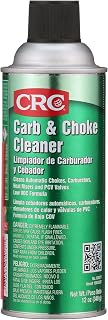
TL;DR A fast-evaporating solvent aerosol that clears moderate gum and varnish from carburetor passages on a single pass, then dries clean with no oily residue. The label's "safe for oxygen sensors and catalytic converters" claim is the category differentiator · the formula won't poison emissions hardware the way some legacy carb cleaners do. It still carries the full DANGER profile of the category · Prop 65 warning, ~750 g/L absolute solvent emissions despite a low regulatory-VOC sticker, and respiratory PPE required for indoor use. Safe around assembled rubber O-rings at short dwell times; skip it on diaphragm carbs.
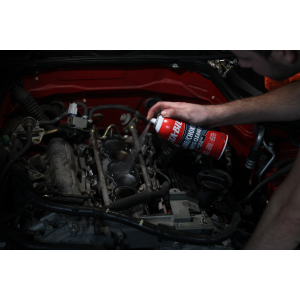
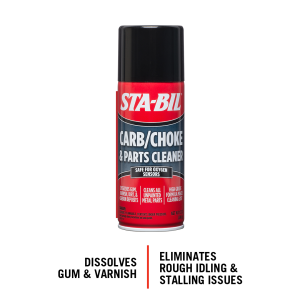
Shake the can, point the red straw into the carburetor throat or at the gummed linkage, and spray in short bursts. The formula dissolves varnish and fuel gum, flushes them out, and evaporates within seconds · passages come up dry with no oily film in the float bowl or jet bores. Community evidence is strong and highly rated on Amazon, aligning on the category-typical performance pattern: one can handles a seasonally-gummed lawnmower, generator, or outboard carb in a single pass; severely varnished long-stored carbs may want a second can or a proper dip. The explicit O2-sensor and catalytic-converter compatibility claim is the meaningful Gold Eagle distinguisher in this category.
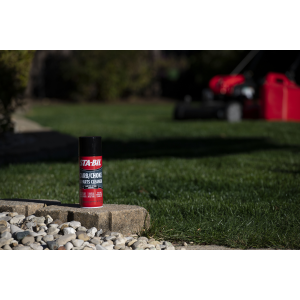
The right buy for a home mechanic with a sit-started lawnmower, generator, snowblower, outboard, or vintage carbureted vehicle that needs the seasonal gum cleared · and especially the right buy if the engine has downstream emissions hardware the user wants to protect. Skip it for diaphragm carbs (CV-style motorcycle units with rubber diaphragms · the aromatic-solvent fraction can attack thin rubber), and skip it for severely lacquered carbs that have been sitting with degraded fuel for years (those call for ultrasonic cleaning or a true carb dip, not aerosol). For routine throttle-body service on a fuel-injected engine, a purpose-built throttle-body cleaner is still the better-matched tool.
The signal word is DANGER and it is earned. SDS §2 lists H222 (extremely flammable aerosol), H224 (extremely flammable liquid and vapor), H319 (serious eye irritation Cat 2), H336 (drowsiness or dizziness from vapor inhalation), and H373 (target-organ toxicity through repeated exposure). The California Prop 65 warning on the label calls out toluene for developmental harm. Flash point is around −104 °C · vapors accumulate fast in still air. SDS §7 directs use only outdoors or in a well-ventilated area; SDS §8 directs suitable respiratory equipment when ventilation cannot be achieved, which is the operative case in any enclosed garage given the acetone-driven vapor pressure and the toluene fraction. The SDS reports 9.9% regulatory VOC under the U.S. EPA acetone exemption (40 CFR 51.100(s)) · that figure is a regulatory accounting result, not a low-emission claim. Absolute VOC is around 750 g/L: that is what the lungs and the atmosphere actually see. SDS §12.1 states the product is "not considered harmful to aquatic organisms" · an explicit aquatic-negative that is the rare environmental positive for this category. Empty cans go in household hazardous waste, not the regular bin, and any overspray runoff should be wiped up · never rinsed into a storm drain.
At standard short-burst spray dwell times the formula is generally fine around assembled rubber O-rings on small-engine carbs. The toluene fraction here is broader (0.1-20%) than some siblings, but acetone dominates at 70-90% and evaporates quickly. Prolonged soak or pooling solvent against gaskets can swell or harden rubber over time · spray and flush in short bursts, do not let the liquid puddle against rubber components. Skip it entirely on diaphragm carbs (CV-style on Japanese motorcycles); the thin rubber diaphragms are sensitive to any aromatic solvent.
The label claim is plausible at the chemistry level · the formula is acetone-dominant with a toluene secondary, and lacks the contaminants known to coat or poison O2 sensors and catalyst beds. It is a manufacturer claim, not a third-party-validated certification, so treat it as a category-relevant differentiator rather than a guarantee. For peace of mind on a fuel-injected engine, a dedicated throttle-body cleaner is still the better-matched tool.
The 9.9% VOC figure in SDS §9 is the U.S. EPA regulatory accounting under 40 CFR 51.100(s), which exempts acetone from VOC counting. The formula is roughly 70-90% acetone plus up to 20% toluene by mass · absolute solvent emissions land around 750 g/L. The 9.9% is regulatory-true; it is not a low-emission claim. The lungs and the atmosphere see the absolute number, not the regulatory one.
All three sit in the same DANGER / Prop 65 / high-VOC category band. STA-BIL distinguishes itself with the explicit oxygen-sensor and catalytic-converter compatibility callout · Gumout and Berryman do not market that as prominently. Gumout's SDS classifies a reproductive-toxicity hazard (H361d) that STA-BIL's 2021 SDS does not · the toluene concentration band is similar but Gold Eagle's SDS author has not escalated to H361d at the mixture level. Berryman B-12 is the small-engine community favorite for severe varnish via a more aggressive methanol-acetone-toluene-xylene blend; STA-BIL is closer to Gumout on cleaning profile.
The 'safe for oxygen sensors and catalytic converters' claim makes this less risky than some siblings, but a purpose-built throttle-body cleaner is still the better tool. For port-injected throttle bodies a dedicated throttle-body cleaner is gentler and matched to the application. For direct-injection intake valve deposits use CRC GDI IVD Intake Valve Cleaner · that is a different chemistry problem an aerosol carb cleaner does not solve.
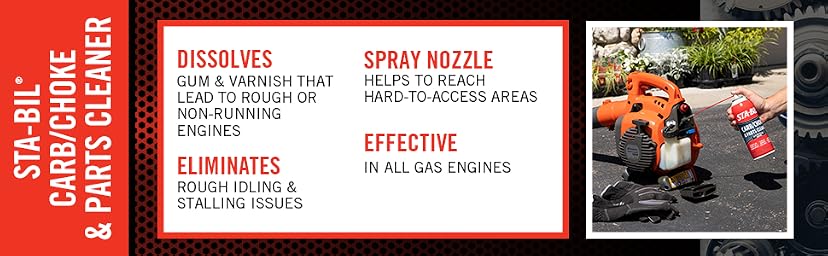
Marketing copy from STA-BIL, via Amazon. Not editorial.
Weekly pick
One product, one safety verdict, every week. No spam.


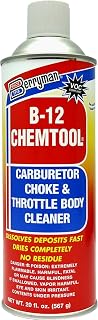
Berryman
B-12 Carburetor, Choke and Throttle Body Cleaner
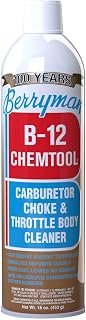
Berryman
B-12 Chemtool Carburetor, Choke & Throttle Body Cleaner
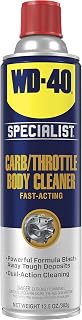
WD-40
Specialist Carb/Throttle Body & Parts Cleaner
CRC
Carb & Choke Cleaner (12 oz aerosol)
As an Amazon Associate I earn from qualifying purchases. Full disclosure

Community
0 postsShare how you use this product
Drop a quick comment or post a full review with photos and a star rating.
Sign in to postNew here? Create a free account.